| « White to Black, Or Black to White | The Journey Into the Stone Continues » |
It's All About the Form
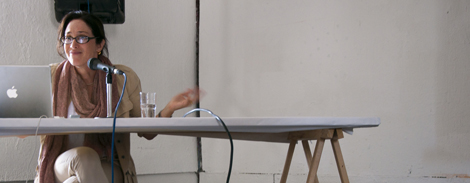
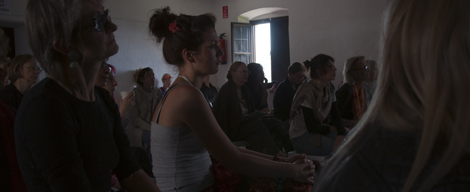
"I look at depictions of all kinds, study the gestures and then put them in a contemporary context to see what they might mean." explains artist Judy Fox, currently teaching the figure-modelling class at the Fortess Hohensalzburg, as she shows her older work at the lunch talk this Thursday. This resulted in a life-sized version of the Venus of Willendorf, or in a series of children modelled on holy statues from all around the world. It's also important to her to stay true to ethnicity. When, for example, she works from an old african protection charm, the statue displaying the gestures will look african, and so on. "It's interesting how much the gods of a region, even if they're from civilisations that ceased to exist long ago, look like the people living there today." Showing some of these clay figures on display, she adds how she likes to make the viewer feel a bit guilty for looking instead of putting a blanket over her very alive-looking works.
She also presents some of her recent work, which is a lot less humanoid, weird creatures that look like the creepy-crawly population of a garden after it's been hit by an atomic blast. "It's about this childhood feeling of something that grosses you out but fascinates you at the same time, like bugs and spiders do." seeing the faces of some of the audience as they look at the images, she's doing an almost too good of a job in conveying it. We even got a peek into her studio and the exhibition she is currently preparing for, featuring all kinds of sea creatures like fish and octopodes, but also the fabled mermaid.
When it gets to questions from the audience, the topic of problems because of her children statues - Judy Fox lives and works in the US - comes up fairly quickly, to the amusement of the artist who just laughs and explains how "I started doing these kinds of statues in 1981, it was not a problem then, and when it could have become one I just played dumb and kept on doing what I was doing. " She adds that she doesn't notice body parts and such anyway, for her it's simply about the form, of constructing and following it, of interpreting it. Being a woman helps, too, I'd think. It was a bit disappointing that the audience was more concentrated on implications than on one simple question, how these intricate, huge pieces are actually made, but Judy Fox will be here for another two weeks so there's always the chance to just ask. [mp]