| « The Secrets of the Gargantuan | Not Investor, but Junkie » |
Let's Take a Stroll Down Memory Lane - When Art still had the Potential to Upset and Disturb
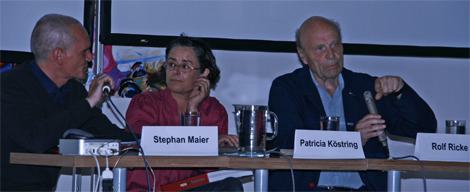
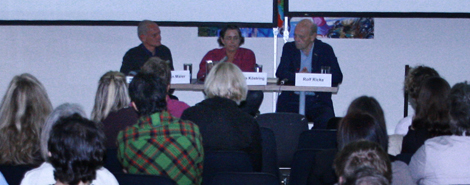
The first instalment of our discussion series On attitudes to form and so on at the Künstlerhaus featured a long-standing key figure of the german gallery and art scene in general, Rolf Ricke. Hailing from Kassel, his interest for art was first piqued by the Documenta happening there in 1955. Never having had any formal training or interest in art, be it theoretical or practical, he simply slid into the scene by buying some prints there, in turn getting his friends inter
ested and then arranging for them to also buy some prints, seeing as there was no art gallery in the backwater town of Kassel at that time. He ventured deeper and deeper in until he finally was sent on a trip to New York to discover new interesting artists for a collector, simply asking at museums and finding his men by looking and walking around.
This trip fortified his position of alw
ays being a bit ahead, already showcasing american artists in Germany that weren't even popular in the US yet, it was indeed the starting point for what would make him one of the great figures of the scene. Pretty soon he and his colleagues started working towards an art fair for Germany that would bring together all that was avantgarde at the time. They picked Cologne as a location, thus the cologne art market was born. When Rolf Ricke reminisces about that time, the 60ies and to an extent also the 70ies, the artists seem a lot more wild and free, not "poor gits dictated by the market and all the money that's in it now", as he candidly puts it. Hearing him talk about the art of then and now, his way of working and dealing with the artists and the clientele, it comes as no surprise when he explains that he felt the need to retreat f
rom the art market as the 70ies hung on and the whole of germany made a big move towards conservativism, pulling the art scene and all it achieved in the last decade back with it. "There were even times when I didn't open my gallery for days out of frustration" he says, only to add that things of course got better in the mid-80ies so he could return to what he loves best.
And what about today? In 2004, he sold his collection he built up by always buying pieces of the artists he exhibited himself to help them, as it was his habit to immediately put on shows if artists he met and liked, no matter how unknown or even unpopular they might have been at that time. Then he closed his gallery so he could actually keep the profit in order to have something for his old age, he says with a smile made to convince that that's still far off, and launches into a descrip
tion of his current project, supporting an art gallery in Berlin run by a cooperative of 24 artists. Asked if he would choose this path again, or what he would do if he were 30 today, he complains a tiny bit how there simply is too much money to be made in art today, and how this is bad for creativity. "But", he adds without hesitation, "for me this is the most beautiful profession I can think of. Th
ere's so much passion, tension, conflict, connection and thoroughgoingness, lots of great and tolerant people, you get to feel most incredible highs but also utmost defeat, just great moments ... this is why I won't stop." [mp]