
| « Producing Desires in the City | The pad.ma project » |
Political Art and Action
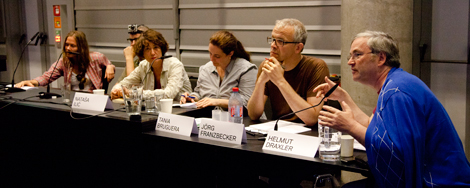
Friday night witnessed the third of our lecture series, and perhaps the most intense so far. Entitled “Political Interventions and Working in Collectives”, the session brought together artists and activists, for whom the political is the central aspect of their work. The panel was chaired by Helmut Draxler, an art historian, critic and curator from Berlin. He highlighted the issues surrounding the links between art collectives and political actions, and asked whether it is the artistic practices, or the goals, that are political.
The first speaker was Nataša Ilić, a founder member of What, How & for Whom (WHW), a collective formed in 1999 in Zagreb. She outlined the politicising origins of the collective, and the political and social forces at work during its inception. The founders sought to challenge prevailing narratives, such as the notion of a “year zero” with the founding of an independent Croatia. She then described some of their key projects: the 2005 project, “Collective Creativity”, investigated the ways collectives acted and interacted within the context of social and political forces; the 2009 exhibition “What Keeps Mankind Alive” drew on Brecht’s notion of ownership in society and “communist hypotheses”; and the “Details” exhibition (2012) considered the rise of contemporary fascism.
Joerg Franzbecker, a freelance curator from Berlin, considered the ambivalence, and varying forms, of collectives, and their appropriation of space. His approach, he insisted, was based on experience rather than any theoretical standpoint. He considered some examples of collectivity and concepts drawn from Kafka and Gerald Raunig, before turning to a collective in which he is involved. The Haben und Brauchen (To Have and To Need) collective published its manifesto this year. They seek collective group action, and produced an open form manifesto which allowed the forty-plus contributors to be heard in their contrary and individual forms. In this way, they hoped to emphasise the “singularity within the whole”.
The third speaker was Yana Sarna, accompanied by Alex Pluster-Sarno, members of the Russian art collective Voina. Sarna outlined the principles of the group, which produce “protest radical street art”. She showed clips of their “actions”, which mainly appeared to be directed against the Russian State Security Services. The most radical of these actions included painting a giant phallus on the Liteiny Bridge in St. Petersburg, and overturning police cars. Several members of the collective have been arrested, prompting the collective’s Europe-wide campaign to heighten awareness of the fate of “political prisoners”.
Finally Tania Bruguera described the political aspects of her work. She critiqued notions of “left” and “right” as being no longer applicable to contemporary politics, seeing now as a moment for new political definitions. Her aims are ambitious: to generate an art which is understood by politicians, an art which goes beyond the art world, and can transform viewers/participants into active citizens. For her, the collective is the public itself, and they are integral to political change.
The panel was followed by a lively discussion, which reflected the passionate nature of the subjects. Issues such as the internal dynamics of groups, and how audiences can relate to collectives were raised. There were also some voices of warning: what happens beyond temporary collectivity? Are artists manipulating audiences, and thus reflecting the very totalitarian practices they seek to dismantle? The most severe criticism came for Voina, and their apparent use of a young child in some of their actions. They describe the child as an “activist”, but some audience members felt that the child himself was being used and placed in highly dangerous situations. In response, Pluster-Sarno declined to engage with the questioners, claiming such issues “did not interest him”, and that he was not concerned with the questioner’s opinions. The entire session highlighted the fact that freedom of expression is both a complicated, and a sensitive, issue.


