| « A Look into the Stone | Abstraction through Stills » |
So What Is It Now? - Global Art Symposium II
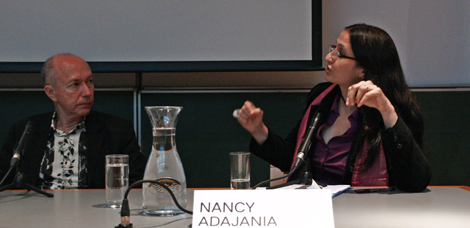
The second day of the global art symposium, consisting of two discussion rounds and several lectures, saw a rather theoretically-based first part with speakers like art curator and critic Maria Lind and Nancy Adajania, also curator, critic and a cultural theorist.
They demanded the museum to be built up as an international hub, not a space that exhibits but one that houses cooperation and processes. Another aspect brought up by Nancy Adajania was that of ethical responsibilities and what global art was against, which in her opinion is something that completely shifted towards the artist, giving him/her room to make their own ethical stands. She also sharply declined global art the protection of transculturality, which in her words "is no temple for it".
Things got interesting when global art was all of a sudden declared a condition that needed to be medicated and channeled, but how was not all that certain, aside from introducing new networks especially interlinking and aiding smaller projects and institutions everywhere.
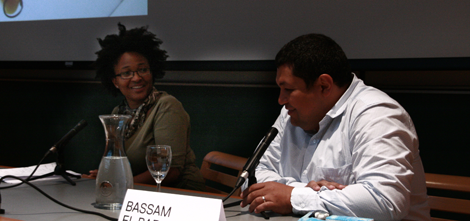
The audience went into the lunch break with visibly full heads. Things got a bit more practical as artists Jitish Kallat and Senam Okudzeto took the stage in the afternoon, with a more theoretical interjection by Bassam El Baroni, curator and art critic who sharply seperated fine art from contemporary art and analysed the dynamic of the art market, explaining the different ways of making it as an artist today. He also proclaimed the end of art, claiming the artist working in an artificial timezone that is cut off from the past and the future, a statement that helps to make sense of a lot of art produced today.
Senam Okudzeto on the other hand was a lot more concrete in her exploration of globality, explaining the Ghana-based NGO Art in Social Structures (AISS, http://www.artinsocialstructures.org/), she has founded and she is executive director of. The organisation, it's members people from all across the globe, strives to free art in Ghana from its elitism and get the people in the street interested in it. The ensuing discussion made some interesting points, stating that artworks are actually not global, but stem from a location, travel the world and create local reactions. So how can this art that has become global through its travels be brought back to its local communities, and why is there even global art? As Senam Okudzeto sharply remarked, over these two days we slipped into easily talking about global art without questioning the term in itself, reminding us of the mail art of the 60ies and 70ies and adding that spam thus might be the new global art.
In the end, we come away with some answers and a lot more questions that have even more possible answers. To say it in the words Hans Belting, our very first speaker, started off his talk with, "it is difficult." Difficult, but oh so interesting. Maybe we should just all meet again next year and see if in the meantime we found some more answers and questions concerning this fascinating topic that is always in process. mp