
| « From Science to art | Jo Ractliff's Lunch Talk on July 27, 2012 » |
The Social functions of Architecture
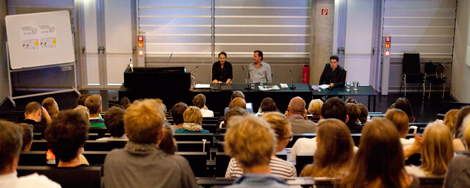
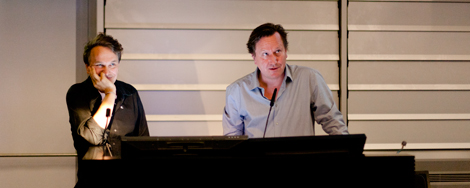
Arno Brandlhuber is a Berlin based architect, concerned with the interaction of architecture and the social. On Wednesday evening he spoke to use about a range of pressing issues, and some of the ideas which underlie his work.
He began by explaining some of his projects and the role of functional purpose. One example was a sport and cultural centre in the Ruhr: a combination of dance and sports - “high and low culture”. The building had to be defined by the length of a football field: which means, its function determined its form. He then turned to a number of ideas and issues surrounding the interaction of architecture and social relationships, including a gallery project in Berlin, and the work of Hans Kolhoff, who made challenging designs for Potzdammer Platz before the wall came down.
Architecture is not defined by its appearance, whether it looks good, but the way in which it orders social relationships. However the issue of social relationships cannot be dealt with according to good or bad architecture. It is the overlap between the social and the architectural that become key political issues. Two discourses in particular illustrated these problems. The first concerned government policy and space for cultural production. In the past, publically owned buildings which were not required - for example school buildings which were not in use - were often let for low rents, on the assumption that they would be needed at some point in the future. These spaces were available as artist's workspaces at very affordable prices. However changes in the economic thinking have led to a change in policy. Traditionally the budget of local government was calculated on a real cost basis; but the introduction of calculations based on potential profit suddenly cast these buildings as a loss, because they were not realising their full economic potential. This new way of thinking meant that local budgets were recalculated to show a loss. What had been a long-term policy, which in the short term benefitted local cultural production, was then replaced by a sort term profit orientated policy. The only way for local government to balance their books was to sell unused buildings to the private sector. The result has been an increasing loss of affordable space for cultural production. Several prominent artists wrote letters to candidates of the parties in the Berlin Senate elections, requesting that public property was no longer sold. All the parties responded with the same support for privatisation. The media reacted supportively, as artists found that there may be a connection between the loss of studios and urban property politics. But the policies remain.
The other issue concerned the plans to rebuild the Stadtschloss on the site of Palace of the Repubic on the Berlin Schlossplatz. The prohibitive cost of the project, which Brandlhuber suggests is driven by partisan politics, has created strong opposition. He shared a film in which he and a number of others satirise the project and its aspirations. But, he fears, it is too late to prevent it. It can only be parodied, not halted, he said with resignation. The parody, however, remains a powerful tool of political critique.
11/08/12 17:15 Summer Academy 2012

