| « Politics, Art and Revolution | Photographing Spaces » |
The Past through Place
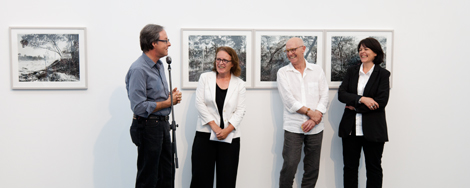
Last night witnessed the opening of Jo Ractliffe’s remarkable exhibition, As Terras do Fim do Mundo (The Lands at the End of the World), held at the Fotohof in Salzburg, and introduced by Christine Frisinghelli of Camera Austria International. Here we were confronted with a photographic exploration of the space, location and place of Africa’s longest war.
The exhibition presents a series of images Jo took during several journeys through Angola in the company of veterans of the war. These expeditions were intense experiences for both the photographer and the former soldiers, who were seeking to come to terms with what they had experienced. Angola is a forgotten war in South Africa, one played down as a “border war” at the time by the Apartheid government. There has been no support for former soldiers, and even the Truth and Reconciliation Commission sought to avoid the issue. Angola has become an imaginary space, fictions woven in the South African imagination, ephemeral and distant.
So how do you photograph ephemera? It was in the company of men who themselves were undertaking a journey through themselves as much through space, that Jo Ractliffe was able to tackle this dangerous subject. She was seeking to anchor this imaginary space in its real location, and its very real consequences. This was about finding and examining the “space” of war, a combination of landscape and pathology, touching the past through the medium of place. It took a very different way of “looking”, without preconceptions, but using at times the eyes of an artist, and at others the eyes of a soldier. The result is a series of images whose resonance lies it what happened there. These are not simply artistic representations of battlefields, nor historical documents; they are a connection to a mythologised past, and examination of conflict within its context. They are thought provoking, at times beautiful in a melancholy way. But, perhaps more importantly, they are a recognition of what happened, an attempt to come to terms. They are the past accessed through place, the distant brought near.