| « Portraits of a Working Space | The First Open Day » |
Art and Political Spaces
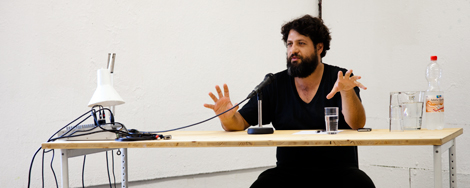
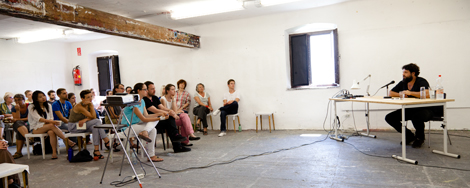
Juan Gaitán, a curator and art historian based in San Francisco and Mexico City, spoke to us on Monday about the role and relevance of art in society, and his own experiences within the world of cultural institutions. He described some of the funding problems for cultural institutions in the United States, and then the situation in the Netherlands. Having taken up a curatoral position at the Witte de With Centre in Rotterdam, he found himself in a society undergoing fundamental debate about the nature and necessity for government support for the arts. Traditionally Dutch governments have been unusually supportive of cultural projects and institutions, but a shift in the economic and political situation had led to a change in policies. Institutions were encouraged to develop new funding models which would combine public and private sources, but such ideas have been difficult to realise in the current economic climate. Indeed, Gaitán suspects that the entire debate over funding was a conspiracy to distract people from other, more threatening, issues.
These questions led to a discussion of the necessity and relevance of art in society. It was suggested that art, and in particular the space generated by exhibitions, were essential for the development of political society. Such debates always raise controversial issues, and in the climate of defensive competition caused by the funding crisis for institutions of any sort, all claims must be taken as the politicising statements that they are. But it is in these discussions that we can get to the heart of what art means in contemporary society. Gaitán certainly gave us much to think about.