| « Willkommen in unserer Welt. | Necessities for Hubert Scheibl » |
Where are we running with our flag?

While you watch the two videos next to each other, both showing the run in the middle of the street with the red flag, one from 1968. and the other from 2002. you realize that this run is not only a political act but that in its core it has a very personal, very intimate memory. Question pops up if it is ever possible to run away from the memories you have? To run away, so far away, to a space where new language will be born and this new language will not make us think that we are all running after old models but it will be a space of new discovery.
I am not suggesting that originality is the most important to our third lecturer in the series of lunch talks and one of the teaching artists, Felix Gmelin. I would argue that he doesn't care much about it. It is not grand gestures that he seems to be after but this delicate change, this delicate new something that comes out of repetition. Let's see something new by seeing it again. Let's question the perception of the world around us and let us play in a sense with this idea of time. Remember that all this is a circle; we are all part of our own small community, then one bigger community and then the world. Why not reenact memories, time that was important not just for you personally but for the community we all share and see if the end will be the same or will it lead us to a new place.
The artist seems to suggest that the actions we take should be and are political ones. The questions you ask yourself and the questions you ask of others should be well thought through and answers received taken with respect. The individual should be respected and protected in this fast pace moment we are all in. The capitalism, globalism, all these -ism's have they taken away the right to the originality, to the individual?
With juxtapositions of two completely different videos that some may think never will go together Felix Gmelin suggests that small changes, juxtapositions of sound or of soundtrack can be the small actions to take so that the time is not possibly wasted in waiting for the big move. Act and see what comes out of a small action that may be the trigger to something new and to the new way we look at things. Allow yourself the moment where you don't know what will happen and explore that. Take that moment to be a moment of action and not stillness and fear.
This notion of not knowing and exploring seems to have transcended to the first talk in the lecture and discussions series organized later on in the evening at the Kunstlerhouse. Stephan Dillemuth, similar to Felix Gmelin emphasizes the importance of the community, of the collaboration between the peers in the search for the solution to the problem artists, art educators face today. Issues talked about in the lecture, where more practical in nature and dealt around the questions of research methods in art today and how to implement these methods in art educational systems but as well as in art creation. It is here that Stephan Dillemuth explained more his ideas about the notion of "Bohemian research". It is exploring life by living life. It is realizing that 90% of experiments end in failure and that is why they are called that. "Go and fail but fail better."
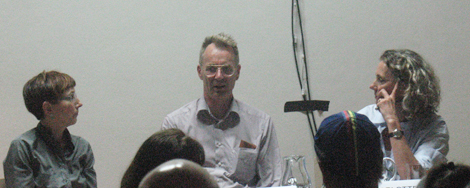
Stephan Dillemuth was later joined by the teaching artist Charlotte Cullinan and director of the Summer Academy Hildegund Amanshauser in exploring more this notion of Bohemian research and also what the differences in teaching methods are and what in fact could be said that art research methods are.
What seemed to connect the day together in the end was found in the idea that the community is and in some cases again needs to be an important factor. That the run should be a relay run where we are all aware where we are and what we need to do.