
Telling a Story Together with Tex Rubinowitz
Upon entering Tex Rubinowitz’s classroom, I found a large group of people sitting around the long table, engaged in a lively discussion in German. Catching about every tenth word, I struggled to grasp what the conversation is about, but the creative and positive atmosphere was evident from the start.
“It’s like a beehive,” Tex said to me later describing the climate in the room, “Everything is buzzing, full of sound and that makes me happy.” Comparing the second to the first, more difficult week, he shared that the entire experience is like a group workshop, a sort of a psycho-buzzing artistic therapy in which each student speaks, connects and works with another. In our conversation, he compared their joint practice to the practices of Fluxus, which marks this course the most interdisciplinary of all.

You told me that your class is about telling stories. In what sense?
In the sense of what comes first. Is the picture first, or is it the idea. They are both connected. I think what the idea or the story can tell is more important. Many students came here with ideas and now they are developing them. So we are trying to work with that, change it and make something new, in a group and in the space. We work as a group and try to feel the space and the city of Salzburg, we are getting to know each other and the surroundings. We have grown to like each other very much and on Friday, when everything is done, it will surely be melancholic. We’ve become very connected during this time of working together. The biggest thing what we are doing is not visible, it’s a social matter.
How do you see the dynamics of the class changing from the beginning? When I came on the first day, everybody was at their desk, doing their own thing and now everybody is together, chatting, laughing…
In the beginning, we didn’t even know each other’s names and we’ve had this quick transformation into knowing each other and learning about the attitudes, background, family status and other things. I believe this is important, it’s normal for a group that will spend two intensive weeks together.
How do you approach your role as a teacher and transfer the idea to the class?
I ask them a lot. I see what they are producing and ask them to incorporate personal things and work out problems in the work. It’s not a material thing, we have a student who does a dance performance. Everything could be a picture and nothing has to be a picture, it’s more important to talk.
What are you hoping the students will take from this experience when they leave?
I think friendship and brighter horizons. And to know that this is a beautiful experiment in space, and that was not a bad idea. Last year I had a smaller group and connecting was a challenge. So now, in a larger group the exchange, the fluid flows much easier, so people can make the exchange and inspire each other, and themselves.


***
Tex will give an artist's talk tonight, right after Valerie Jouve. I am hoping to get some warmth from that, because Salzburg summer is not summery at all, at least not at the moment.
Until tomorrow!
Ana
Showing the Reality We Believe Inside - A Talk with Valerie Jouve
“Photography is not something that I can show, but something that can help me induce a feeling, a strong feeling that I felt.” This is how Valerie Jouve explains one of the aspects of her photographic practice. She takes pictures only after hours of preparation and heaps of sketches and notes. This year, she is teaching the Photography course for the second time to a dedicated group of artists. “It’s a good class,” she said, while we talked about her teaching approach and her ideas about the photography as a means of expression.

You have a very relaxed and individual approach. How do you approaching the teaching task laid before you?
The teaching for me means to accompany more than to instruct. I believe that people coming into my class already have some knowledge of the subject, so just giving them exercise is not my way. Mainly, I believe that each person individually has their own story to tell with photography.
How do you see photography when you talk to people?
Photography means so many different things. It’s a very open tool. But what I aim to teach is that making a picture, even a good picture, is not enough. A picture has to be more - a link to a thinking position in regard to the world. It’s how the photographer perceives the world in all aspects, a way of seeing with the brain. If we don’t have this, then what we have is a mere look. A photograph is therefore not real, it shows a way of thinking and defends the reality we believe on the inside.
Why did you choose to teach 4 by 5 camera?
Because it’s the base of photography. This is the camera obscura. And also a tool that you cannot use to make a snapshot. You really have to think about the image you want to construct, not to take. It’s all about the thinking and the sense the artist gives to the image.
Now that one week is over, you know your students, I saw they did some pictures. Where are you hoping to arrive by the end of the course?
Most of the students are really inside their own practice. I will accompany them on their way of learning how to organize a picture, how to put pictures in relation to each other and space, how to make people feel the image with their bodies and not only their eyes. This is the matter of mental construction, in between the picture making. I will never show the type of pictures where art object are shown one by one. For me, now, it doesn’t make sense.
What makes sense?
It makes sense if somebody goes to an exhibition and change their ideas a lot. If they get a different grasp of their previous view. In my work, I present a certain level of utopia, which is very important, because I construct my own landscape. Such a construction radiates into space in a certain way and this is what I think photography can do.


***
At the end of a slow and rainy Monday, I am looking forward to the Mark Van Yetter's Artist's Talk and some quiet time. With chocolate.
Read ya tomorrow!
Ana
The First Week of First Times
The first week at the Summer Academy was the week of first times for me. I’ve come to Austria for the first time, for the first time I am required to keep a blogging diary of this sort, for the first time I am surrounded with this many creative people at all times and for the first time I experienced two creative processes first hand. The first one was in the printing studio and you can read about my experience here. The second one was in the photographic darkroom where I learned that light is just like water - it always finds a way in, and that four minutes in the complete dark can feel like forever.

Before I got to Salzburg, it was the first time in a long time that I have spent about 40 hours on the road with very little sleep. Wednesday was the day I started feeling at home for the first time. Tomorrow is my first weekend.
I have also had a personal premiere of the moody Salzburger thunderstorm and the rivers running down the street, which had me miss the first walk around Salzburg dedicated to the act of “Seeing”. Canceled because of the weather, the walk might be repeated in the coming weeks, but what I also missed was William Kentridge’s talk, which is my sole regret this week.
To get back to the exciting experiences, I got to see the etching process yesterday and not see, but rather hear, a film developing process today. I’m ending this week with tired eyes, so I invite you to close your eyelids and take an audio-peek into the darkroom with Valerie Jouve, her co-teacher Nina and students (and journalists!) Anette and Angelica and experience what the developing of 6 pieces of 4 by 5 negatives sounds like! Scroll down for the audio.
Have a lovely weekend!
Ana
P.S. Even though the world's day of ice-cream was yesterday, I've had my first portion of the lovely Eis only today, so there's that as well.
The ABCs of Printing with Lukas Pusch
Thursday was reserved for Lukas Pusch class, as I was promised that I will get to see them making a print from scratch. The promise came true and after several hours spent in their workshop, the first collective print was out!

Traditional printmaking has a rich and colorful history in both the East and the West, but I have a feeling that it was often looked down upon in terms of artistic value. Contemporary art has finally erased this kind of differentiation, but we can still hear people asking - “Is this an edition or an original?” Why would a printed edition not be original? Perhaps they mean unique, but in truth - each print is unique in its own, subtle way.
I was present during a presentation in etching. One of the biggest impressions that stuck was the amount of work that goes into each etching. Without considering the preparatory drawings and idea development, up to two days of work is necessary to make an etching starting with the preparation of copper plates to what we see as artwork! With so much work behind it, printmaking is indeed one of the most crafty artistic disciplines that require both a creative mind and a good pair of hands! Artists approach it with a fresh enthusiasm that often descends into a life-long passion, marking printmaking as an ultimate labor of love.

In a chat with Lukas Pusch, I’ve learned that in his diverse practice he uses a lot of woodcuts. With a vast experience in print production, he is leading the Print Print Print course for the second year in a row, after having included woodcut and screenprint into the program, along with the etching. Michael Wegerer, the co-teacher, puts an emphasis on the course’s practical side. Like Lukas said, it’s important the students master the basics of each technique. “I want to give them autonomy to create,” he said, highlighting that a lot of skill and practice is needed in working with the materials and presses.
Standing and observing this painstaking process crammed into a couple of hours only, I was once again seduced by the magic of the old printing press, feeling an embarrassing amount of excitement when the test print came out.
I will definitely revisit this class next week and check out the first prints in different, or even combined techniques!
On a personal note, the printmaking class is where we can find the youngest student at the Summer Academy, a 16-year-old Liza. She is still in school and maybe she will become a printmaker. I wager she just might.


***
Today, my day goes to the photographers and reflection.
Let there not be rain until Monday! :)
Ana
Gesture as the Fluid of Life - A Talk with Melissa Gordon
Melissa Gordon is teaching at the Summer Academy for the second time. I've noticed that her students are the most covered in color compared to others. Hardly a surprise, since what they are doing is exploring gesture in all of its forms.
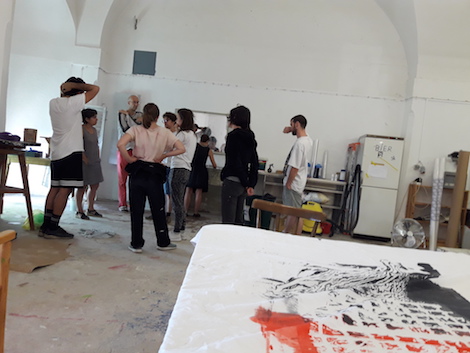
In this class, you will explore gesture in all of its forms. Your Tuesday talk was named “The Gesture is a Fluid”.
Yes, in the talk I was talking a lot about theory, about how the gesture functions in painting. But then also I was trying to think through where we locate the gesture and that it’s not necessarily a mark on a canvas. It’s rather an attempt or the link between the action and the thing you see.
How do you plan to present this idea to your class?
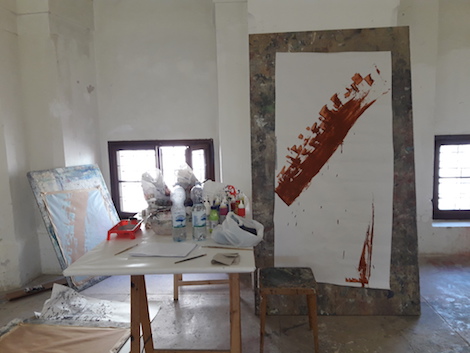
In the class, I’m hoping the students not approach making work as putting something onto a surface, but rather think about what their intention is and what kind of attempt they went through to get left with an object. So, to me, it doesn’t matter if they do performance or sculptural objects or painting. Whatever they are making is more about thinking where the gesture lies.
What do you think can a gesture be in physical and conceptual terms?
I think when you’re looking at artworks, it’s the thing that is exciting. It’s the thing that’s being affected or transformed or adjusted. I often say to my students: “Show me what you’re thinking!” When looking at art I like to see what the artist has been thinking, to get the view into their thought process through the object, and get a sense of their person, their interests and their attempt in a way.
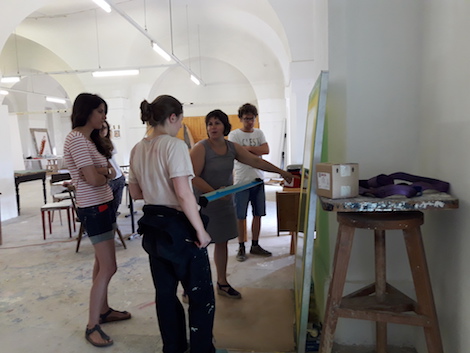
What does your teaching process look like?
We started off with some readings than we engaged in an interesting conversation. They were asking questions what’s the difference between the gesture and the trace. They are trying to think outside of normative terms about what they are trying to do. We have done some contemplative exercises, but now I am showing them some techniques and letting them go - it’s time to make stuff.
You taught a course here in 2016 as well. Do you have any hopes regarding the course this year?
Last year we did performance events and the students were really interested in thinking about the theatricality of painting. So now I will ask the students to think about the sight of painting, but I would like them to come up with their own idea. We will do something active, explore new mediums and ways of thinking. We can make a book together in the end. I hope I will be giving the students a tool they will leave here with.
Do you think there could be art without gesture?
I actually don’t think so. I think the gesture is the thing that brings something to life. I also think in art history, the artists’ gestures are what we look at, not their personalities. I don’t care what Duchamp was like as a person, I’m only interested in the gestures that he made and those gestures that changed art.
***
Today, I am finally going to see the printmakers in action! Cannot wait!
Read you later!
Ana

