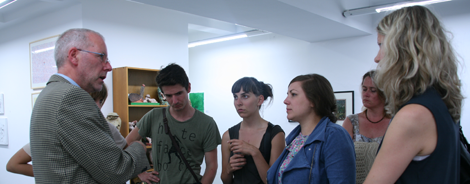
Society of Friends Guided Tour @ Hallein
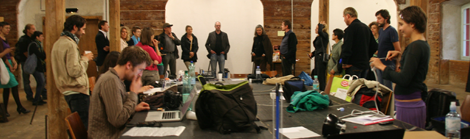
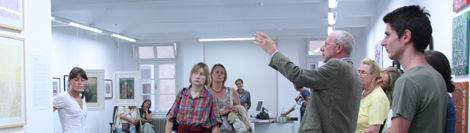
After an initial introduction to the teachers given in the lounge by Hildegund Amanshauser, the society made their way through the different classrooms at the Alte Saline in Hallein. They started in the class carrying the title Extremes in Photography, run by Elfie Semotan and Roberto Ohrt. Every morning, they spend about 2 hours with their students solely discussing their projects.
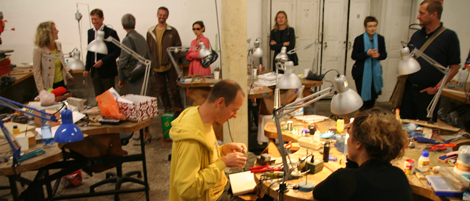
‘They want to show them different extremes of photography, like the highly polished works of LaChapelle and the seemingly sloppy images taken by Miroslav Tichý, and let their students experience a professional photo shoot by transferring one, complete with high-end clothing, to the Alte Saline. Ines Doujak, who teaches the class It’s not easy being green, says she only sees her students at their planning meetings as most of them went up with the elevator on the first day and spread over the other floors of their classroom. The solely female class works with different materials, trying to find the difference between nature and culture. So far they seem to have found a lot, as they will be holding an exhibition and a performance for the coming Tuesday at 3.30 pm. The garden magazine they had planned in the beginning has grown into something more, as well. After this class, it seems logical to move on to the one called Where’s the Garden? held by Véronique Faucheur and Marc Pouzol, together forming Atelier le balto. The class began with sending the students outside to select a spot on the island, and then bring back their impressions to further work with them. “At first they don’t know, but that spot becomes theirs, they experience it, research it, play with it … “ explains Marc Pouzol. They also want to use computers as sparingly as possible, as they feel that their field, landscape architecture, has partly lost its artistic soul due to the increased use of technology. Next, the society went to visit the workspace Alice Creischer and Andreas Siekman. The students of their class, titled Plasticine Animation as a Sculptural Experience, were busy finishing their figurines and stages, as they soon need to start the actual shooting process. The class split itself into four groups working on different projects, one of them being a rendition of the history of the salt-town Hallein, replacing salt with cocaine. Wanting to keep the post-production to a minimum, the workload ahead of them is immense, but as their teachers say, everybody is very inspired by the building and its atmosphere. The society then went up one floor to visit Sonja Abian and her class, who are working under the motto The Picture as a Point of Intersection. This means a new interpretation of classical paintings, connecting them to contemporary images and contexts. Some of the students use paintings they found in a museum in Hallein, depicting the story of the salt production that dominated the town for centuries. Other brought their own images to the class. They all try to build connections, thinking of how the images are seen and how they change with time. They also had models visiting some incorporate into their works. As the still-life class of Ulrica Lundberg had already closed, the tour ended in the jewellery workshop set up Manuel Vilhena. For him, it is important that the students learn to see contemporary jewellery as an art, a mode of artistic expression equal to others like painting and sculpture. They employ traditional techniques while using all kinds of materials to make beautiful pieces that also contain meaning. After watching the students craft their pieces, people rounded off the very interesting and informative evening with a glass of wine in the lounge.
Introducing the sketch before the photo - Lunch talk Elfie Semotan and Roberto Orth
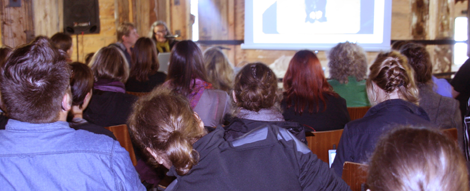
In their well-attended lunch talk at the Alte Saline in Hallein, Elfie Semotan and Roberto Orth talked about a book project they have in the making. In her long career as a fashion photographer, Elfie Semotan would take a Polaroid of the location while the model was still getting prepared, to see how the light and background would look like. Often, she used whoever was available as a stand-in for the person later being photographed. This creates a special feeling in the pictures. “They are pictures outside the planned photography, something you would normally throw away. I collected them.” Elfie says. After an initial project with Martin Kippenberger, the idea to compile them in a book was born. “We set strict criteria” explains Roberto. “The book is supposed to show the sketches before the actual work, the sketchy part of photography.” Elfie adds ”We want our stand-ins to have an out-of-focus quality, like they are not really sure why they are here or what they are doing. We decided to take out the ones that try to be funny or strike a pose. As they show different polaroids that will be featured in the book, talking about the projects they came from and the conditions they were made under, I can’t help but like their unique aesthetics. Elfie seems to think the same, as she points out how “ I would really like to do a photo shoot with polaroids, but this needs to be planned incredibly well and you cannot guarantee the outcome, as polaroids fade by themselves and you can’t know where the process will start, for one thing.” We will see if she decides to do it after all.
Red, Blue, Grey, Pink - Vernissage Stefan Heizinger
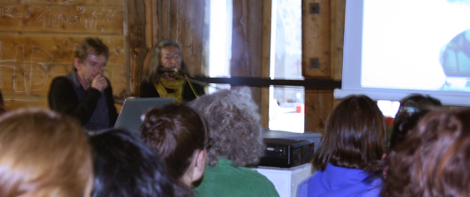
"Still waters run silent" - That would be the best way to describe Stefan Heizinger as a person. Even during the speech of Tina Teufel, when she was describing both his substance and his work, Stefan stood next to her straightfaced like a bastion of calm.
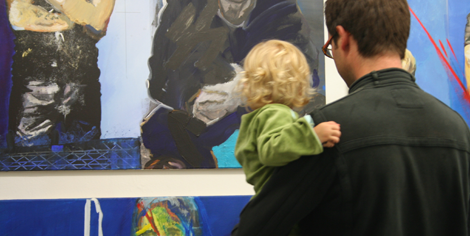
His artwork whereas seemed everything else than calm. His works are very colour- and powerful. The contentual background of his shown pieces are technological development, digitalisation and the media. He takes these systems and their special codes, transforms them and forms something new out of it. The four colours red, blue, grey and pink are standing as subjective counterpart to the colourcombination CMYK (Cyan, Magenta, Yellow and Black) which is the basis for the modern four-colour print.
After Tina Teufels speech, the artist took the chance to say a few words to his audience and ask them to participate. He asked his visitors to write down the first impression or feeling, they had about his "red" painting, on a postcard and tack it to the wall around it. So in the end an interactive piece, wich visualized the different perceptions of subjects seeing the same thing, developed.
The exhibition will be shown till 10th of september. For more information check: www.eboran.at
The Painter as an Archaeologist - Lunch Talk Christina Zurfluh
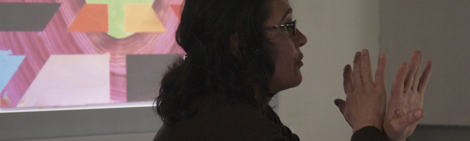
In her lunch talk at the fortress, Christina Zurfluh laid out the development of her works from 1996 to today, focusing on explaining the techniques she employs. This went from her earlier paintings, where she applied layer upon layer of paint, knowing exactly how she was going to finish right from the start, and then cracked open the dried layers to reveal the ones underneath. She would then sand the cracks under water and put the pieces broken off before back into the painting.
Over time, she would start incorporating drops of fallen and runny paint into her work, as “I wanted to include the surroundings into the work.” Later on, she got more interested in what is revealed underneath, and began covering parts of the paintings with masking tape only to remove it later, forming geometric patterns that let the often figurative background shine through. “I also like it when it’s not perfect, when wounds and little imperfections happen.” This, she began doing in 2005. A while after that, she moved away from the canvas as sole medium as she began throwing acrylic paint onto the plastic covering her studio walls, creating a dense net of layers and layers of runny paint she would tear off the plastic once it had dried and stick it onto paper, a canvas or directly onto the wall. This caused a lot of questions by the audience, who seemed to find the idea of wallpapers made of paint a bit hard to follow. Once the exhibition those pieces are presented in is over, the tapestries of paint need to be scratched off and all that remains are the photos. Christina Zurfluh also uses the same technique to make sculptures, where she lets paint run and drip over a thin construction of wires.
Exploring Salzburg: Galerie Altnöder
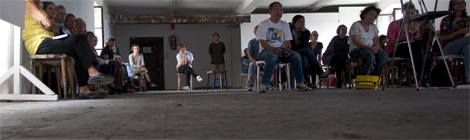
Ferdinand and Heidi Altnöder together with their assistant Annelies Senfter welcomed yesterday's visitors in their gallery, offering drinks and giving a detailed insight in the actual exhibition Der Hofmaler. Eine Hommage an Josef Rädler, Kunst aus Gugging, Hüpfner u. a. (The Court Painter. A Hommage to Josef Karl Rädler, Art from Gugging, by Hüpfner etc.) as well as discussing the backgrounds of so called "outsider-art" by mentally ill artists and other outsiders. The Galerie Altnöder promotes very individual artistic positions within the Austrian Modernity, not following any specific genre, but having a focus on outsider-art and constantly exploring for unexpected newcomers.