How to construct an image – Lunch Talk Sonja Abian
But where in the original paintings lavish fabrics impress and archebuses link the angels to the mythology of the Indios, Sonja Abian cuts patterns out of newspaper reports of women abducted in Latin America, and maps showing the suspected locations of mass graves from the Franco era. She made a big effort to explain all the different layers and aspects put into this work of hers, saying finally that she was still working on the final explanatory layer of it. For those interested in seeing it for real now, it is on display as part of the exhibition “the Potosi Principle” who is currently housed in the Museo Reina Sofia in Madrid and will move to the Haus der Kulturen in Berlin in September, opening there on the 7th of October.
Artistic Reasearch – A discussion
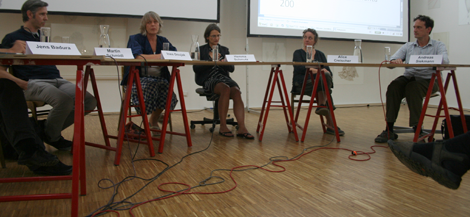
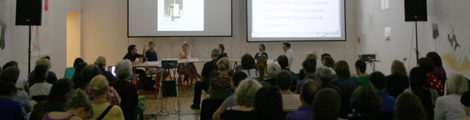
A diverse group of artists, including Martin Schmidl, Ines Doujak, Alice Creischer and Adreas Siekmann, plus one „scientist“ to represent the other side, the philosopher and sociologist Jens Badura, came together last night to talk about something called artistic research. As introduction, moderator Hemma Schmutz asked the obvious question: What is artistic research? The artists began by each presenting a specific research project of their own. The start was made by Alice Creischer and Andreas Siekmann, who talked about their exhibition in Madrid titled „the Potosi principle“, where they brought never before seen colonial paintings out of bolivian churches into the Reina Sofia museum in Madrid and invited different artists to react to the painting.
The former mining city Potosi, exploited by colonialism, becomes linked to todays victims of globalisation. Funnily enough, Ines Doujak chose the same region for her project „ weaving shuttle and war path“. She and her team travelled to build up a textile archive that will be found on the outskirts of Vienna, funded by the austrian research fund, who initially were very confused about what she was actually doing. They collected textiles, books, and also interviews, learning about the deeper meaning and sacred knowledge stored in the pieces. Martin Schmidl, on the other hand, has an altogether different project. Intended as his PhD project in England, he was researching the history of exhibitions in the former concentration camp Dachau, as he was intrigued by it “being very similiar to normal exhibitions from the way everything is presented, but the approach to it is very different.“ In the end, his professors did not recognize it as art-related so Martin went to Vienna to finish it.
Then, Jens Badura shortly explored the relationship between arts and science and the meaning of the term defining the evening. „Artistic research is a term only coined recently and immediately seems to set it apart from other research“, he says. This might come from the archaic concept that research means proving some theory wrong, an idea that is still very prominent today. A different approach would be to call every scientist an artist, as they do creative work too. Here Andreas Siekmann begs to differ, as surely not every scientist, e.g. one working in an atomic reactor, can be called an artist. Also, he says, the artists often don’t use readymade systems, building their own structures and curating their own works, which stimulates the individual thinking process outside of structures, sometihng that is not encouraged in scientists. Ines Doujak also points out that the difference between artists and scientists lies in the thought, as „ reflecting about something gives you a lot more freedom than researching it.“ Asked about what tools they would like students to be given on their academic path, the debaters reached a consensus that the artistic education today seems to become more and more standardised, with no more room for individual thought and learning. Students don’t seem to organize themselves any more, they just go through the different classes as fast as possible, absorbing what they are taught. Martin Schmidl adds that he hopes artistic work won’t lose its spontaneity and adopt all the wrongs in scientific work. In the end, it seems like the fields are getting closer, morphing into each other, which makes the personal approach ever more important, the personal way of seeing and thinking that comes with time and experience, and which is something that will be researched as well, maybe with some results.
The new, the old, and the phrases - Lunch Talk Marco Lulić
Yesterday, artist Marco Lulić acquainted students and staff deeper with his work. He likes to play with objects and words, re-inventing sculptures and films, just to cite some examples. The interest of the audience was roused by a piece he calls “Karl, Rosa, and Mies”. Hidden behind this name is a sculpture commemorating Rosa Luxemburg and Karl Liebknecht, done by Mies van der Rohe in the 20ies, but the Nazis tore it down and only 2 photos remained. He made different versions of the sculpture, toying with its dimensions, making it too big for inside so people had to squeeze by to continue through the exhibition he showed it in. “I completely had to freestyle the back, as there was no documentation of it.” He says. Later, as he talks about another project where he put a whole pre-fab, but modernist house into a museum for an exhibition, something that he suggested just to get his idea shot down by the curator, he states “ The nice thing about being an artist is, you can always fail.” At this, stifled gasps could be heard from the audience. He added that it’s important to let in a certain amount of randomness, “if you choose the right kind of people, it will be fine.” After these statements and hearing about the way he works and sees things, I am looking forward to see what will be created in his class. So will be the other students, judging by the discussion about his work that started once the formal part was over and Marko invited to ask questions.
Reception Hallein
Monday evening in the courtyard of the Alte Saline in Hallein the beginning of the second cycle of classes of this year’s Summer Academy was celebrated with a nice buffet and good music. The very special atmosphere of the Alte Saline is not only due to the charm of the aging industrial site, but arises from the creativity and communication of all people involved – something that could be perceived yesterday evening in the courtyard.
Finissage Hohensalzburg Fortress
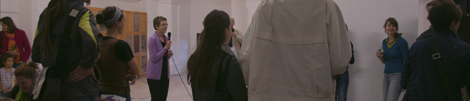
After opening the doors of the classes at the Fortress and the alte Saline, it was time to have the first student-exhibition of Summer Academy 2010. This happend at the Fortress Hohensalzburg where the classes of Rebecca Morris, Krystyna Piotrowska, Dan and Lia Perjovschi and Katrin Plavcak showed their work to a very curious and eager audience.
In every class you could find students, artists and vistors came togehter to chat about art, technique, work, colaborations or just about their experiences in Salzburg.What made the atmosphere so easy and nice was that there were no limits in between classes or generations. All in all it seemed that people were happy to meet like-minded people to discuss with.
After closing the exhibition and packing the artworks originated in the last three weeks, many of the students were not to tired to meet downtown at a very livingroom-like place, to celebrate the succeeded exhibition and to take the chance one more time to meet, talk and have a drink together. I'm pretty sure this party lasted quite long and it seems probable that some students went on their travel home a little tired. In the end there is to say that it was a real nice 1st term of Summer Academy 2010, with great students, amazing artists and very helpful assistants. Hopefully we will see a lot of them at Summer Academy 2011!