Lunch Talk - Manuel Vilhena
Casting emotions into pieces of work
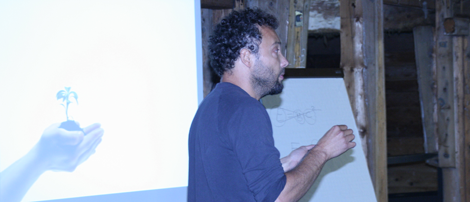
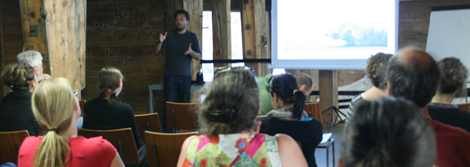
After posing the question „What is contemporary jewellery?“ and showing some exemplary pieces made from knotted hair and textiles, Manuel Vilhena begins telling his personal history with the matter. At a time when he was absolutely unsure about what to do in his life, just having broken off an education, he met a jeweler in a market that convinced him it was the ideal profession. So he became a craftsman, and was amazed at how „ freely people share their knowledge and experience, once you’re in the circle.“ From constructing pieces out of wire, he went on to study gold smith techniques and steadily increased his means of expressions. But to become an artist, he had to leave the confines of his native Portugal and go to study under Peter Skubic in cologne, who at that time was already well known as a master in the field. He tells the story how Peter opened his one day eyes by saying: „No. Don’t introduce yourself as a jeweler. You’re an artist.“ This led to a whole new understanding of his works, and the things he can do with his skills and techniques. Later on, he mentions his secret society called NASA (National Art Science Academy), where he collaborates with other artists to promote a unified theory for the Arts, of which the formula ‘E=mc3’ is but an example. In the end, he says „Sometimes I feel a bit lost because I always go from place to place to place, but the places are great and so are the people. I get to create something out of my body, which is very magical, and I can tell stories with my pieces.“ So he won’t be giving this up to settle down somewhere, at least not any time soon.
–TeER- Midissage
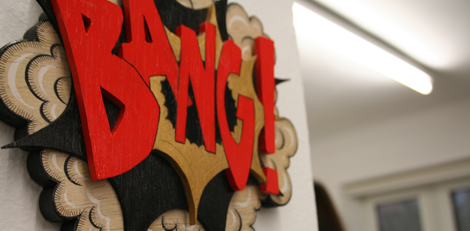
Screaming images and staring eyes transcend the pages of a comic book and take on a life of their own
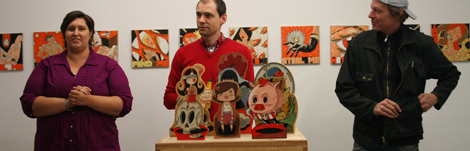
Yesterday, participants and staff of the summer academy took the chance to enjoy art and celebrate a bit at the Midissage of –TeER-s latest exhibition. Upon arriving early at the gallery, despite my best efforts to get lost a bit on the way, I was jumped by the densely populated, vivid panels covering the walls, unblocked by other visitors, while still in the doorway. As an avid reader of graphic novels of all kinds, I was very impressed by the uniqueness of lines and characters and the use of colour that define –TeER-s style. After a short introduction by Stephen Mathewson, a close friend of the artist and also a long-standing collaborator in a myriad of fields, they took to their guitars, entertaining the audience with a variety of what one can only call sort of folk songs. If you have not seen the exhibition named “ Eye in the World” yet, it continues still until the 6th of august in the gallery Eboran. www.eboran.at
A look at the artistic workspace
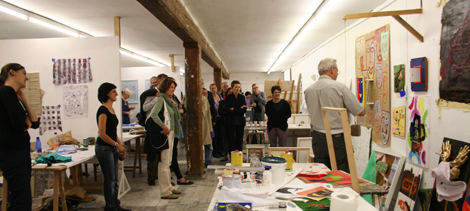
Yesterday, the Society of Friends gathered for sneak preview of the works the students at the fortress have been creating over the last three weeks. Wandering through the classes, talking to the teachers and watching the students at work, they gained an insight on how the different teachers were holding their classes.
Asked about hers, Katrin Plavcak explained how everything “is very open at the start. I simply let them be artists without second thoughts, and irritate them away from how they normally work.” We moved on to the slightly labyrinthine class of Rebecca Morris, who points out the benefits of different levels of experience in her students, and how “somebody who is 60 might have crazy ideas somebody who is 18 would never think of.”
This was proven only minutes later as one of her students shows us his work, or experiment, as he calls it. The students’ final task, described as deconstructing the picture plane, was carried out by him in the form of a brick on a pendulum crashing into a glass panel incorporated into his painting.
Still awed by the clever destruction, the Society arrived at the workspace lorded over by Dan and Lia Perjovschi, who proudly presented the spaces created by their students, taking time to talk in detail about the different projects and the people behind them. As Dan puts it, “ we want to be close to our students, understand what they want to do and help them get there.”
The last stop of the tour brings us to the printing lab of Krystyna Piotrowska, who shows us a whole heap of prints done by her students just this on this day. She watches over every print that is made, giving a hand and advice to her students. “I teach them every technique they are interested in, and some of my own I came up with” she says while carefully removing the paper covering a fresh print.
The works of the students will be displayed to the public on Friday, the 6th of august, from 2 to 6 pm.
Lunch Talk - Katrin Plavcak
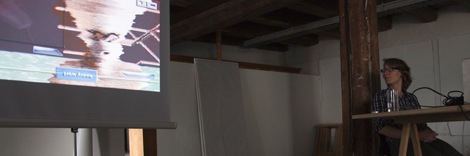
Come with us now on a journey through time and space …
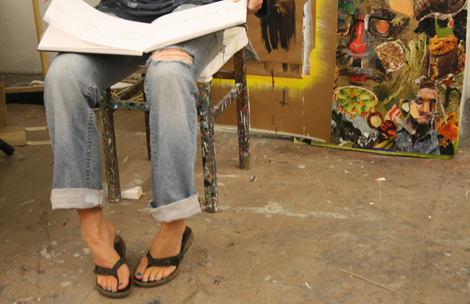
As she takes us along on a stint through her work, Katrin Plavcak introduces the audience to a world of layers and perspectives. She often starts with an image that becomes a painting, transformed through being mirrored, placed under grids, or overlaid with another image just to cite a few of the methods Katrin employs. Politics and social issues keep appearing in her work, like in a painting made about 2 years where she grafts the heads of politicians like Wladimir Putin and Li Huanbao(Sp.), the chinese prime minister, onto the bodies of dinosaurs, as they are following “dinosaur politics that simply should not be usable any more”. Another reoccurring topic is travel to space and its consequences. “ We’ll never be able to see humans from an outer perspective, it always stays in our perimeters” explains the artist her interest in outer space. “So it’s very interesting to speculate what will happen if we meet an alien life form. Will we still be in a colonialist mindset, or will it be a more peaceful, fruitful encounter?” With this curiosity, I am sure she is not alone with. And who knows, maybe we will find a better world like this one day, to keep in reserve for when we're done using up our own.
Kristine Stiles - Global Techniques of Performance
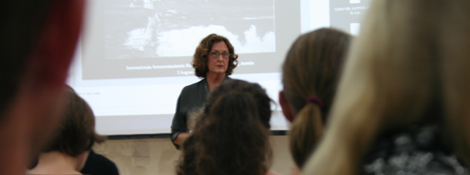
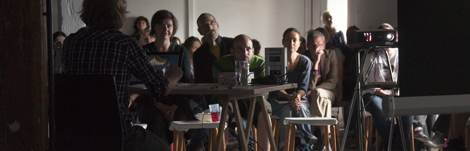
In her lecture Kristine Stiles questioned what artistique technique are in the context of performance. According to Stiles it is crucial „how something is made“ because it „helps you to arrive at the meaning“: „When we think about technique we have to think about form as a gesture toward content“ – she states. A similar technique could lead to compleatly different meanings according to the actual circumstances of a performance. The circumstances and references of a performance make it a unique and un-repeatable statement and experience.