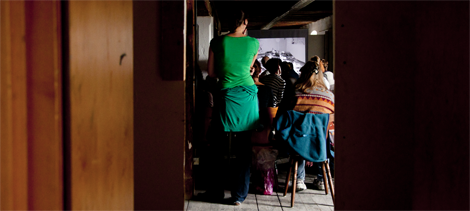
Exploring Salzburg - Galery 5020
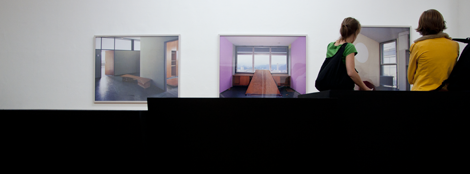
Hildegard Fraueneder, director of the gallery since 2001, gave a broad overview about the gallery’s history and how it changed since its founding in 1992 – formerly thought as a gallery and production space for artists, now the gallery primarily promotes young artists and has a special focus on theory through lectures and discussions held in the art space or in cooperation with other institutions. The very interesting summer exhibition „Am Rande der Balance. Paradoxien des Instabilen“ [Precarious Balance. Paradoxies of the Instable] was opended yesterday after the gallery visit – it presents varied installations, dealing with issues such as election campaigns, the role of the artist, or the perception of sound and space, creating unexpected moments of reflection.
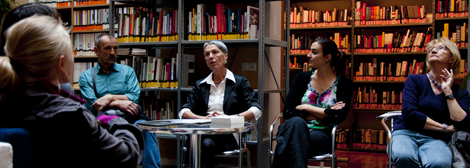
Vernissage Parcours I

Folded paper, butterflies and smashed wood
Last night, the rain tried in vain to keep people indoors and away from the gallery KG_Freiräume in Hallein where the first of two exhibit cycles of works from the assistants of the international summer academy was opened to the public. After an initial round of welcoming everybody and thanking various people, the artists themselves were given the opportunity to introduce us directly to their works.
Ioana Stoian began with explaining how her hexagon made up of layers and layers had started out as 2 meters of paper that, starting in the middle, she had folded over and over and over until after a time too long to say she had created this origami taken to the extreme. Next, Siegfried Zaworka talked about the symmetry in his paintings and how they stemmed from a series where he had tried to magnify parts of faces. He says he wanted to "paint something that looks back at you, and in one case, doesn't just make the viewer think "ouch", but screams so itself." Looking at the painting, he definitely succeeded in doing that. The work of Nievis Salzbmann brings us back into more peaceful waters. Her paintings tell of the search of a bridge between painting and stage design, one of her other passions. Her paintings are like a space within the space, like an installation. Moving on to Karin Peyker, who collects her materials, interested in the way they are used. Puzzles and old flowerpot ornaments from the flea market are turned into an artifical nature. Even the birdsong comes from a CD. The only thing real are the dead buttlerflies trapped under glass.
Stephen Mathewson, asked at the last minute to contribute, has a split relationship with his work. " I like it, and i don't like it." An empty room, leftover wood and the wish to practise his hockey shotled to constructing a goal and two keepers, one of them to be brutally destryed by shooting it to pieces with a puck. This is exactly why Stephen is unsure of liking his work, as shooting his creation to pieces made him feel sick to his stomach in the end. After last night he might feel better though, being assured the greatness of his work by many.
The exhibition can be seen at the gallery KG Freiraum in Hallein until the 6th of august. Opening hours are every wednesday from 17 to 21 o'clock and every saturday from 10 to 13 o'clock. It's definitely worth the trip.

Lunch Talk - Tanja Dückers
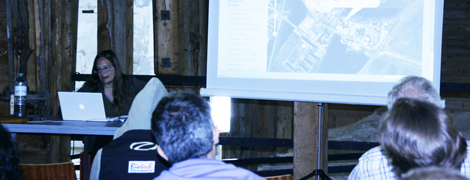
Today, summer academies author in residence Tanja Dückers presented a project calling itself remote words. Originated in Cologne in 2007, the idea takes the viewer to the skies as words and short sentences are painted onto the roofs of galleries, art institutions, but also private residences and factories now used for other purposes.
She then showed the audience different examples, like a gallery in Kiel that made an anagram out of their name Stadtgalerie(city gallery), leading to the words Edle Artist AG (noble artist CO), or a mineral water factory on the german island Sylt that adorned the roof of their art space with the words: Ich sehe nicht, was ich nicht sehe(I don't see what I don't see). For her own project on the roofs of an old coal mine in Lohberg in the Ruhrgebiet, the former industrial heart of Germany, Tanja chose the words Was bleibt ist die Zukunft (what remains is the future). But not only houses in Germany are decorated thusly, the idea has already spread as far as to the township of Soweto in South Africa and the university of Sao Paulo in Brazil.
Once the location and words are found, they are written on the roofs in red, black or white paint, which can be a taunting job as utmost precision and care is necessary in the process. Then, a plane is flown over the buildings to give an aerial view of what in the future will appear in google earths world viewing program. Some of the institutions toy with this fact, as did the academy of arts, Berlin. They embossed their roofs with bright red letters saying: Off limits to google. Funnily enough, they got denied permission to fly over the building for the photos due to their proximity to landmarks such as the Brandenburg gate and the german house of parliament. For those of you who got interested now and are the proud owners of a roof, ready a word or short sentence and check here for more information: www.remotewords.net But remember, it's permanent.
Reading - Tanja Dückers

Even though the reading was in German, because Tanja Dückers is a German writing author and it's hard to translate literature, many students came to listen to her. After a few paragraphs it became clear, how Dückers made herself a name in Berlins poetry slam szene. Her voice is very powerful, her pronunciation accent-free with a charming little influence of Berlin-slang and every single word seems carefully choosen.
After the reading the audience had the chance to question Mrs. Dückers about her work and particulary about her correspondence in cipher she used to work with since 1997 - This topic seemed to generated the interest of the audience a lot, but when it came to the point to ask her how to decode this writings, she underlined that it was only designed for herself to give her the chance to work in public spaces without anybody realizing what she is authoring about. So she just gave a very opaque description about her own language "Autumnisch" and when she explained how she developed her font and made it more complex within the last ten years, it became clear to everyone, hoping to decode it sometime, that "Autumnisch" is gonna stay Tanja Dückers secret for maybe forever.
Dan & Lia Perjovschi - Lunch Talk

Disappearing to make it better & building the holy halls of knowlegde
As Lia Perjovschi unfolds the story of her youth in communist-ruled Romania, a youth governed by restrictions on what to learn, know and say, it quickly becomes clear to me that this is the root of her thirst for all kinds of knowlegde and experiences. When she is later asked about her dream by a member of the audience, she immediately answers: " To travel everywhere and see everything. For the first 29 years of my life I could not, so when it was finally possible I wanted to travel as much as possible."
After a switch at the speakers table, Dan Perjovschi takes over the microphone. Where Lia is bubbly, jumping from thought to thought within mere seconds, Dan seems to be more pensieve. He explains how it took him about 10 years to get out of the confinements educated into his head in the communist-era art schools(as he says, painters did not rebel, they painted what they were supposed to or left the coutry) and develop his own style, which led him directly onto the walls, the floors, even the windows of buildings. His interest is the world at large, yet every now and then he has to come back to his own country because it never solved its history. So, he has to bring it back up with his drawings. These, he does on just any space offered to him. " I mostly get the bad ones, in hallways and over doors and staircases" he says with an amused smile.