
29 / 30 What matters will come back
During the last hours of the academy many of my first observations come back in a condensed manner. Maybe this is the heightened attention of a farewell. Maybe it is the slowly creeping exhaustion that I accumulated over the past six weeks. Maybe I am accustomed to the proceedings of final exhibitions and their farewell ceremonies by now.

But certainly, as the title of this post already tells, all that matters will find its way back. Even if it should escape your mind or your circumstances for the moment, if it matters, it will come back, eventually. On Friday, the remaining classes presented their works in a single final exhibition. As eight classes finished at the same day, the academy opened its doors from noon to 8pm. And many of my first observations came back.
Like the idea that knowing what you don’t want is more important than knowing what you want. This withdrawal from intention is very pronounced in the pieces by Golnesa Rezanejad from Iran. During her time in Adriana Czernin’s class on drawing, she has created a series of textile collages.

“It is a kind overview over time. It is a piece of archive”, she tells me. For many of the collages she printed family photos from her parents on textiles and later arranged them into carpets. For another series she took photos of public spaces and stitched figures in intimate postures onto them.
“It is really common for people from the Middle East to be expected to show hijabs, but I like to think more abstract. I am looking for opposite parts. I try to show by image the different spaces, the different outfits of people, their posing and I add my imaginary.”

In a similar way Alteronce Gumby’s work attempts to fuse two histories that have been forcefully separated for a long time. He created a series of plates from disposable paper plates. For the titles of the single pieces he adapted the names of traditional soul food dishes: the dish ‘black eyed peas’ became ‘black eyed police’ or ‘watermelon’ became ‘whiter melon’.
“I choose to make these plates because of my fascination with 15th century ceramics. I wanted to fuse their history and heritage with soul food. Soul food is a comfort food. It is a food that is usually served at holidays or when the whole family will get together and has a conversation. This food is contextualized as African-American history, but the thing I keep wrestling with is that Africans were present from day one in America, but there is this continuous separation between the two histories. I have to deal with idea that I am an American, but also dealing with the racial tension that is going on.”

What he has produced at the academy, however, are merely prototypes. Back home, he wants to create the plates in real porcelain. I am fascinated by this speculative fusion of traditions that are forcefully separated. The fine porcelain is as much a result of early globalized imperialism as soul food, that first came up among black slaves in the United States.
At the after-party I ask several people where they go next. Many go home to their art schools or jobs, other continue to travel or join the next residencies. Whatever they have learnt or unlearnt at the academy, what matters, will come back.
28 / 30 What you did not read
The last preparations are on its way. In a few hours the final exhibition will open and the summer academy 2015 will come to its end. And with it my six weeks of participatory observation. In the first light of this last day, I am going through all my notes that I took for this blog. I realize that you only read a small share of my observations, conversations and reflections.
In many cases this is probably for the better. Nevertheless I will give you in this post a little peek into some of the things that somehow did not make it into the blog. Or to say it with Bernhard Martin: “I give the illusion of being a storyteller, faking an idea that I did not have.”

(…) I met Professor Anne Koch from Munich University today. She is one of my anthropological mentors and was in Salzburg coincidentally. We drank a coffee together on the Festung. I asked her about her observations on my observations. She likes the project, but is surprised by my use of photos. “These are not illustrations, but something else.” She is right… What about the social facts? What about the persons on the photos? (…)
(…) Every town has these places where you go when nothing goes anymore. In Salzburg this place is called Mirjam’s Pub: lost souls playing darts, a jukebox and a drink that consists of vodka and Tabasco. Somebody at the bar tells me that already the poet Georg Trakl would end up here. Salzburg, even your strangest corners claim to have a great history (…)

(…) What is the problem with bad political art? It is a cheap moralization: we should be concerned! You are complicit! You have to act now! It is useful in the worst sense. It just imitates and sustains an economy of concern. Good art and good political art are concerned with something else than concern. (…)
“Not those who are saturated, happy, successful and powerful envision the new. To the opposite, new evolves from the critical break, the suffering from society, from the impotence before the state and from the pain of injustice. Mourning gives birth to the new.” (Hartmut Böhme)
(…) Gabriele Winter runs the office and has been working almost as long for the academy. When I ask her if and how the students have changed throughout the years, she responds that nothing has changed. Later, she tells me that the rhythm of the academy is different today. Before the 90s, students and teachers would spend five weeks together. Nowadays, none of the courses lasts longer than three weeks. “Students and teachers don’t have time to spend five entire weeks on one project.” The acceleration of the art world it seems has not held back from the summer academy. (…)

“For Foster the relationship between artist and anthropologist is that of mirroring. Both look at each other as an image of what they would want to be—an “envy”: anthropologists want to be artists, they envy their freedom and openness; while artists want to be anthropologists, they envy their critical perspective, and direct access to cultural alterity.”
(…) Professional Deformation: At a philosophy conference some time I ago, I learnt that the artist is the prototype for the new neo-liberal worker. The old workers hated their work and thus had to be controlled, disciplined and punished. The artist however is passionately working. To her and to him working is not a choice, but a self-realization. Be creative, disruptive, innovative. Be your own boss. But in times of the professionalization of desire, how do you love? What happens to the amateur, the lover? Further, I am always suspicious when people are framed as prototypes. (…)
(…) There is something strange about beginning. You leave your home and comfort zone. You have to find directions and approach new people. The dust of everydayness and of your routines are blown away. And you are confronted with the failures of the automatic knowledge that governs your thoughts and observations from day to day. In that sense, beginning pulls you back into the present, into the immediate environment you are in. (…)
27 / 30 Exercises in unlearning
Not-teaching means providing the conditions for unlearning. But what does unlearning entail? Certainly, not just forgetting something. Certainly, not just to imitate something. And certainly, not just to replace one set of skills or one set of knowledge with another. You already noticed the amount of negations in these sentences. Maybe that is what unlearning is: the move away from something, rather than the move towards something.
“If you think of classes that were good, in many ways the object of study does not matter. It is more the moment in which people lose a sense of constraint in relationship to an object: that difference between me and an idea or me and the world.” (Doug Ashford)
‘Losing a sense of constraint’ could be such a move away. I have this impression after accompanying Doug Ashford’s class on ‘the non-human’ for the last few days. One of their first tasks was to imagine and describe an impossible artwork. I was fascinated by this instruction. It requires both: to detect one’s own limitations and constraints and to extrapolate them into objects. In our conversation Doug Ashford navigates through the paradoxes of teaching art today.
In many of the conversations about the teaching of art the term unlearning comes up. What is your position on that?
We still hold on to the idea that the teacher has a sense of expertise. This is an interesting problem for me: the way in which you would decentre that. Because the art school has more and more become a space where the tools around professionalization are learnt. In my mind the tools of professionalization for an artist now is not the making of the work. It’s the other artist. So when you are at graduate school you listen to other artists. You look at artists. You don’t look at forms. You don’t look at things. It is not interiorized. So it’s not about unlearning to become innocent. You learn the industry. But this idea about the industry being not so industrial is an enormous paradox. We are in this place where we think we could have our own terms, but these terms are based on the idea of the artist. If the discursive relationship of the artist to the world is only seen in the systemic hierarchies of art production, then it is a disaster. You just learn to fit in. It is like pedigree.
How do you deal with this problem when teaching? Can you tell me a little about the basic idea of your course here?
It’s hard, because there is no basic idea. But this struggle that we talk about between what it would need to make a work that would create an aesthetic experience and the management of these experiences on an industrial platform is a paradox. Maybe this is a productive paradox, maybe a dialectic paradox. Part of unravelling it seems to me to figure out where the definitions of the figure of the artist are coming from. This work could be sociological, like a sociology of institutions or the clinic or the school. And that is my background in terms of the collective work with Group Material that I did. I was trying to understand the apparatuses and then to intervene into the apparatuses. But what we now know about the contemporary art scene is that the intervention into the apparatus is always already part of the apparatus.
So, the institution already anticipates the intervention?
Exactly. To look at it nihilistically, the only way to deal with this is to withdraw. And withdrawal is quite an interesting discussion. Like Bartleby’s ‘I prefer not to’. The reason why me and other people are interested in that is because of its relationship to withdrawal. You withdraw not just to societal constraints and your institutionalization, but you withdraw from its referent. And by withdrawing from the referent, as Worringer, said you invite other people to also withdraw. From him it was nature, what he called the capriciousness of nature. By withdrawing from mimesis, you withdraw from an enslavement to that which is outside you. Through this you put yourself into a state where you have to negotiate your real anxieties with nature, which is that it is completely arbitrary. Now surely society organization is not arbitrary. But if it is like you said, something that is always ahead of itself, it is not necessarily something that you cant understand in the terms previous to our time now. The time of intervention and progress. Withdrawal is a different kind of interruption.
I found it really interesting that you gave your students the task to develop propositions for an impossible artwork. Do you often work with such exercise?
That would be one exercise. In terms of contextualization of the artistic figure, as a subject, the key element are intentions. The artist today is told, or rather the pre-artist is told: you must be able to describe your intentions. That means you must be able to package them. This is key to what it means to be a real artist. When asking: why are you doing what you are doing? A not-real artist will say: I have no clue or in the context of self-grandiosity: it’s a mystery. This is the act of un-concealing as re-concealment. My idea for the proposition exercise didn’t come from any of this theory, but from the act of pedagogy. When you do a critique, you start with form: what do we see? Then you go to content: what is it about? And then you go to intention: why? And then there another discussion which is not part of the professionalization narrative. It is a different why. Not the why of an intention, but the why of what do you want. It is the way you talk about the actual desire that is shared despite form and content. As long as the artist is outside and is not linked to the utility or ethical production, they can always find that sense of affinity in the desire.
Interestingly, the exercise creates a negative. The propositions that I heard during your class were really interesting. Yet, I found the limitations imagined and described in the propositions even more interesting. I had the impression that your students were also really interested in the question: what are actually my limitations? Everybody came up with their very own limitations. By addressing one’s limitations in a group you create a space where you work together on extending and negotiation them.
Yes, ideally. But it is always a failure. If you think of classes that were good, in many ways the object of study does not matter. It is more like the moment around which people lose a sense of constraint in relationship to that object. That difference between me and an idea or me and the world, becomes negotiated into politics. That is why Agamben’s book The Open is so important to me. He says that those philosophical traditions of the 20th century around the object would lead to an organization of the subject. You are not only not a subject, but you are not part of subjection either. He takes about care in that context. The key of that book is: let’s undo the anthropological machine, not necessarily to make another one, but in which we could figure out some way to act. And how it would be, I don’t know.
26 / 30 The Blogosphere
A while ago, I realized that I am not the only blogger at the academy. I was surprised at first. Who would have the time and make the effort to do this, while taking or giving a class? But everybody creates their very own documentation of the academy: diaries, photographs and some even blogs.
Our trip to the blogosphere of the summer academy starts at a comment written under my post on public routines. Petra Annemarie Schleifenheimer writes:
“Hi Rafael, THX for your daily blog, which has got me the feeling being in Salzburg already. But still it's 5 days waiting and standing in the startloecher for 'my' class ... Congratulation that you now know how to avoid the gift shop of the Festungsbahn! P A S”.
When I google her name, I find a blog called PAS Kunst. Petra Schleifenheimers posts start 21 days before her arrival at the academy. She documents her preparations for Elisabeth Schmirl’s print making class and has written about her work in the class each day since her arrival. If you read German and are curious about her explorations of printing techniques, check it out.
I stumble upon a second blog when getting to know Kelly Briggs from the UK. One of the first things she tells me about is her obsession with the colour orange. All of her drawings and installations at the academy deal with orange, as you can see here.
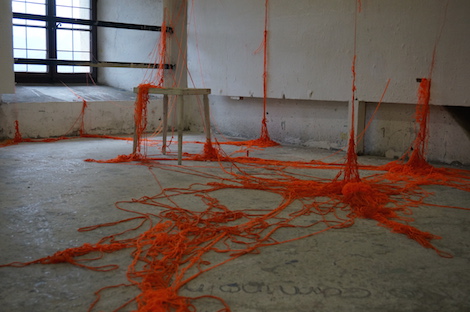
As I introduce myself as “the blogger”, she tells me that she blogging, too. She has been writing about her experiences as an art student on the island La Réunion. To document her weeks at the academy she has set a blog called Artist in a Castle.
The third document I would like to share with you is by Ann Carolin Renninger. She took Bernhard Cella’s book making class. It is not a blog, but a poster that she made in reaction to Luis Camnitzer’s lecture in week two. The poster shows a collection Camnitzer’s questions on the teaching of art.
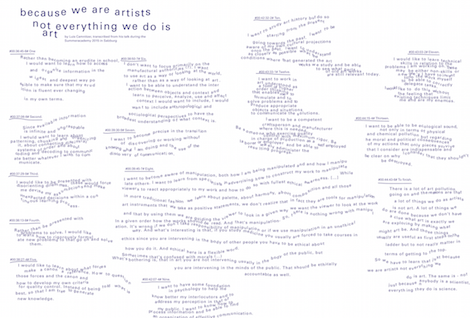
Not only does Camnitzer’s talk address some of the key issues of my blog. Renniger’s documentation turns the talk into a thought-scape: his reflections fade into her practice. I am really sad that I missed Camnitzer's talk, but her document establishes a missed conversation. Maybe that is what blogging is about.
25 / 30 Stuck in Between
The list of curious excursions continues. Nora Schultz’ class on sculptural practice has created an outpost at the local scrapyard. It turns out that the trash of Salzburg is weirdly clean and neat. It is so neat that the class termed it ‘sugar trash’. Here you see some impressions by student Ilan Bachl from Munich, who filmed the hunting and gathering at the scrapyard.
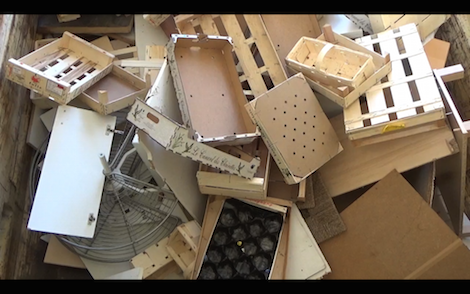
While some of the other classes are already setting up for the final exhibition on Friday, Nora Schultz’ class is still in progress. In our conversation she tells me that there won’t be a final exhibition of the class. For her the course itself is already a happening or performance. We talk about why inbetweenness can be crucial for artistic production.
What is your course about? What was the initial idea?
The idea behind the course comes from the story of Mehran Nasseri. Steven Spielberg made a film about this story, but it is based on real events. It is about a man, who loses his immigration papers, while being on a journey. He wanted to travel to London. But when he changes flights in Paris, he gets stuck in the airport, because he doesn’t have his emigration papers anymore. This led to the situation that he was neither allowed to continue his journey, nor could he go back and leave the airport. Due to this bureaucratic error he had to spend 18 years in this terminal. For the course I took this idea of the terminal as a place where you are stuck, as long as you cannot be identified. I am really interested in this question of a lack of identity (Identitätslosigkeit). This lack of identity, this inbetweenness, is a base of artistic production and it can be turned into means for the same. So, I want to create in the course a metaphorical situation.
Tell me more about this metaphorical situation.
The terminal becomes the guiding metaphor: the students move in the terminal and they produce in there. They perceive the three weeks of the academy as a continuous working with this inbetween space. How do you find materials? How do you get them here to this exclusive space at the Festung? All these difficulties are preconditions for the production. I also would like to see the entire course already as some kind of a happening or a performance, although there are no spectators. What does it mean to work in a place where you are stuck and have no fixed identity? What does it mean to work in a space that is hyper-real and a ‘junk space’ at the same time?
Which other questions became important throughout the course?
We read at the beginning of the class the index text by Rosalind Krauss. The idea of the index became important for us in the context of sculptural production. The index, like in photography, embodies a link to reality. It is not just a hint or something that represents a reality, but an active part of a reality. What is the connection and this embodiment of reality like? And what does that mean for a sculptural production?
So an index has a materiality?
It has a materiality, particularly, if you distinguish materiality from physicality. Physicality is the hard facts and materiality is connected to a human understanding and attention to something. Materiality already means to put things into a context. Material then is not just what it plainly is, but starts to connect itself with other materials and symbols.
Are you also interested in the limits between materiality and physicality? How does something become a material? Or how does something cease to be a material?
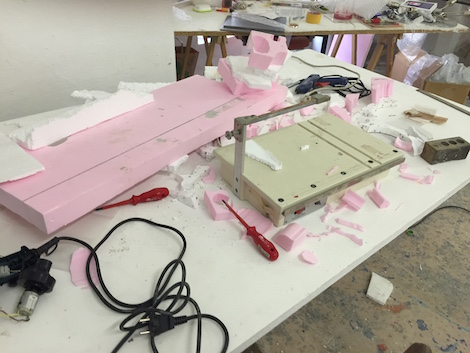
Yes, indeed. The question if a material can go back to be simply physical is very interesting. One student for instance rebuild a movable fence that he found at the Festung, in all its detail. Then the question is, what happens to this fence after the exhibition? Does it end up here at the street and become a use object? And probably nobody will know that this thing was produced in an art context once. I find it really interesting when link can be cut again.
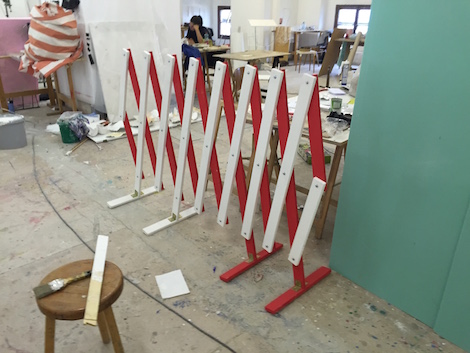
Hearing all this, it makes sense that you went to the local scrapyard to collect materials. How did you prepare the trip to the scrapyard. Did you give the students instructions?
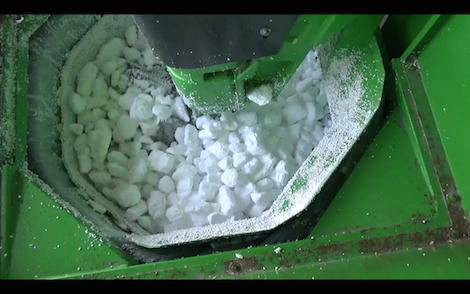
The idea was simply to go and see what they have there. We were surprised that the trash of Salzburg is really special. In contrast to other cities it is really clean and neat. We called it sugar trash. So, the students did not only collect materials from the trash, they also dealt with the concepts of trash and scrapyards in more profound way. One student made a video on site about a machine that grinds Styrofoam. And we also invited a woman for a presentation, who we met at the scrapyard. She is writing about the books at the scrapyard. So the scrapyard became our outpost.
What is happening right now?
Right now, everybody is working individually. Their pieces are really different from each other, but from time to time you see links. What all students share and agree upon is that they don’t want to create a finished exhibition at the end of the course. They rather want to exhibit states of being of a process.
So, the process is more important than the work in our class. Is that something you would like them to take with them?
Yeah, what is really important to me when we talk about process and not-exhibiting that we already see the course as some kind of a happening or performance. If you are here for three weeks in this bubble at the summer academy, you cannot expect that the result will be an artwork that can be exhibited. On the other hand we are confronted with an exhibition situation. This can only mean that you do not distort the situation and arrange something only for that. Rather than that we play with this notion of an inclusive exclusivity.
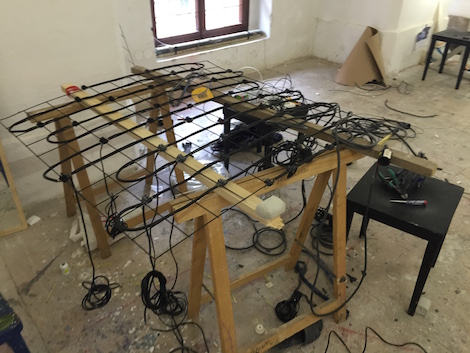
There is this famous quote: theatre is what happens during the rehearsals, not what happens in the premiere. Can you relate to this?
It does not always have to be that way. But for our context this makes sense. I also don’t think that this is the case for all classes here. I am sure that some students in my class will also arrange their works in a particular way for the exhibition. So they create a new environment for the objects they have been working on. This is also interesting and this makes it also again very terminal-like. You have displays with artificially created situations that are as real as the situations of passengers that walk through them in a state without identity. What is really important to me is this simultaneity between a complete artificial and staged situation and a reality that enters from time to time and serves a material.

