
14 / 30 Strollology – the alienation from alienation
Yesterday I was blogging about my annoyance with tourists. Those alien-like figures, who always move slowly, appear in groups and block everything for everybody. I was annoyed by the greedy exotization. I was annoyed by the obsession to turn everything and everybody into a postcard memory. And one day later, I find myself here:
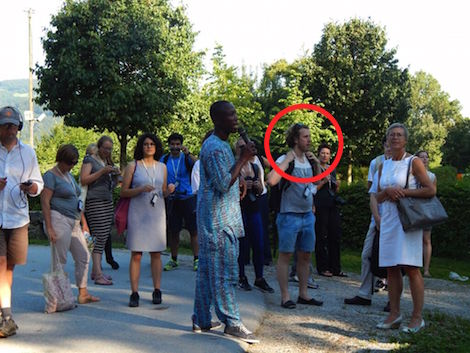
Yes, I joined a city tour. Yes, I look like a tourist. And yes, our group blocked the roads for some poor Salzburger bikers that shouted their characteristic “Hey, Aufbassen” at us. Yet, the tour that I joined was rather unusual. Jubril Olawumi was our guide. Born in Lagos in Nigeria he lives in Salzburg since 1991 and has become a known figure in town. Not only because he runs his own taxi company, but also because he is a connoisseur of Volksmusik, both Nigerian and Austrian folklorist music.
“Show me your city” was the only instruction he got from Bärbel Hartje who curates the walking series. In total there will be four walks during the summer academy. While in the past years dancers, architects and other locals with expert or particularly odd knowledge would be the guides, this year four Salzburgers that were not born in Salzburg run the tours. Bärbel tells me that the concept is inspired by Spaziergangswissenschaft, the science of walking: or strollology.
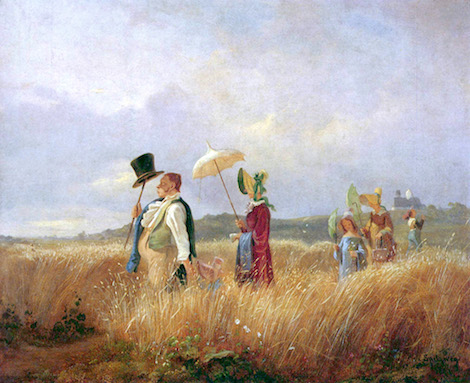
I google it and yes, this is an actual scientific discipline. It was founded by a German sociologist at Kassel University in the 1980s. Strollology does not only claim that walking can be an aesthetic practice. It further allows you to profoundly change your relationship to a space or landscape. Walking is the method to acquire what anthropologists call everyday knowledge: knowledge of a place that you have, but you are not aware of or you cannot easily express in language. An important aspect of strollology is to describe everything that you see. Usually, when coming home from a walk people describe only the beautiful sites that they have seen and forget about the factories and highways they passed. Against this notion strollology is an alienation from alienation as a fellow blogger calls it.
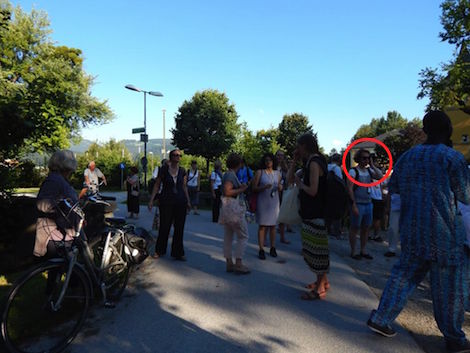
Leading our tourist group in his traditional African suit, Jubril Olawumi attracts some astonished gazes from passer-by. But to be honest, his walking tour is strikingly normal. The tour starts at parking space in the suburbs and goes to the some spots where Sound of Music was filmed and to his favourite places: the castles and local playgrounds. He says that he likes Salzburg because it is so relaxed. This all is so strikingly normal that I become aware of my tourist expectations: I want the exotic, the particular, the insider perspective. In a most charming way Jubril Olawumi insists on being just a regular Salzburger, who loves his city. Maybe that is what strollology is about: paying attention to the obvious and by that arriving somewhere: the alienation of alienation.
13 / 30 Public Routines
Tourism,
human circulation
considered as consumption,
a by-product
of the circulation of commodities,
is fundamentally nothing more
than the leisure
of going to see
what has become banal.
The same modernization
that removed time from the voyage
also removed from it the reality
of space.
(Guy Debord, Society of Spectacle, 1967)
After two and a half weeks in a new town you develop routines. I found my favourite grocery store. I know the less overrun streets in the Altstadt that allow me to avoid the crowds. I can identify the tourist traps among the bars. And most importantly, I know how to avoid the gift shop of the Festungsbahn. All this developed quite naturally. However, when thinking about it, I realize that most of my shortcuts are ways to escape the omnipresent tourism in Salzburg. Although I am visitor, a foreigner myself, every day I am more annoyed by their alienated presence and their alienating infrastructure. And then I am annoyed by my own classist annoyance. If that is what makes them happy, who am I to bother? Thinking that I continue on my shortcuts.
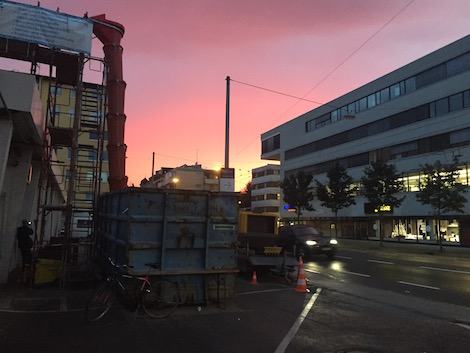
All these thoughts came to me after another visit to Feld72’s public space class. The students are in the final stages of preparation for their public interventions. Many of them explicitly deal with tourism in Salzburg. In their discussions they addressed questions about the politics of tourism in town. Who benefits from investments in the city? Who benefits from a city’s public art? How does an administration design the image of a city? And who is the target group of this image? In short, who is the city made for: inhabitants or visitors? Although these questions sound quite rhetorical their answers are neither simple nor obvious.
“Only 5% of Chinese people have traveled so far. In 2014, 17.8% more visited the Mozart city. They spend 1.4 days in Austria, 1 hour here, spending on average 989.5EU/day. They come, take photos, they buy and go, leaving behind a different Salzburg, irreversibly changing the public space.”
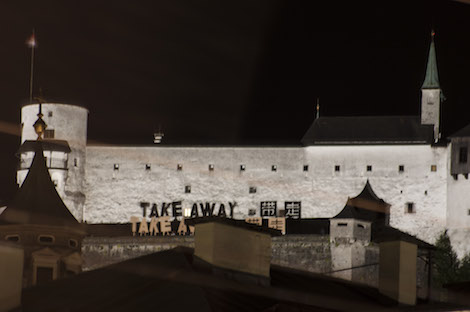
Constanta Dohotaru from Romania is preparing a project she calls Takeaway. She has built two-meter high letters that she will use to project the word ‘takeaway’ onto the Festung Hohensalzburg at night. She is convinced that Salzburgers are avoiding the Altstadt. “With all its tourists’ places they don’t own it anymore. This new fake city is a perfect baroque décor for this ephemeral presences.” Her installation will be visible from most of the city. It does not question tourism per se, but the protocols and routines in which tourism works in Salzburg.
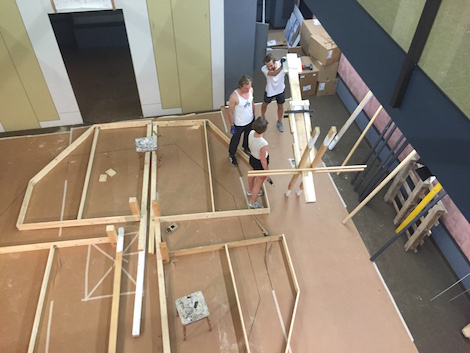
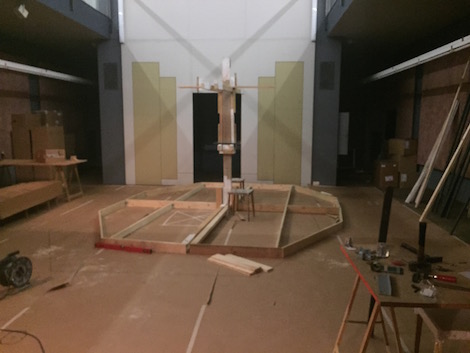
Another group of students tackle this phenomenon, too. They are in the process of building a 1:1 replica of the fountain at Kajetanerplatz. They idea is to place it upside down next to the original fountain and occupy it as a space to disrupt the fairy-tale façade of the plaza. While observing their preparations, Michael Obrist from feld72 tells me about the challenges to work in public.
“I am always looking forward to productive misunderstandings. I think that is what public space is about. When you exhibit in a museum your audience is always a small exclusive clique of insiders. In a public space at first your audience doesn’t know that they are your audience. And the people that you would usually interact with make only 10% of a public space. So misunderstandings are part of the game. And yet, public space has its rules. Public space is about compromise, art is not. That is our challenge.”
We continue to talk about the complicity of artists in the process of turning an inner city into a museum. Interestingly, this is something all of the students are very much aware of. This is one of the reasons why they choose temporally limited interventions. A processual art is hard to appropriate and even harder to turn into a product or service. Isn't that right, Mr Debord?
12 / 30 Dummies - no thinking without objects
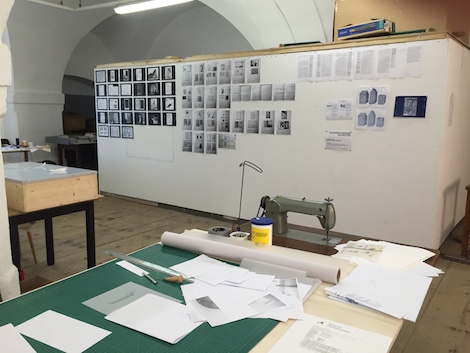
The first dummies are finished. You can see them on every table in Bernhard Cella’s artist book making class. Observing the class for the past week I am still amazed by the speed in which they produce their ‘dummies’: little semi-finished booklets somewhere between a prototype and an experimental byproduct. Whenever Bernhard Cella and his co-teacher Anton Stuckardt are not in conversation with students, they are working on their own dummies, too.
“I will also work on something. I want to create a studio situation where everybody works on something they are interested in. With their questions and what they are interested in unlike in a school situation.”
“So what are you going to work on?”
“I am going to do exactly the same exercises that you are doing. When I work with a group it is important to me to work, too. It is a completely different experience. I can watch you working, but you can also watch me working and then we can get into conversation.”
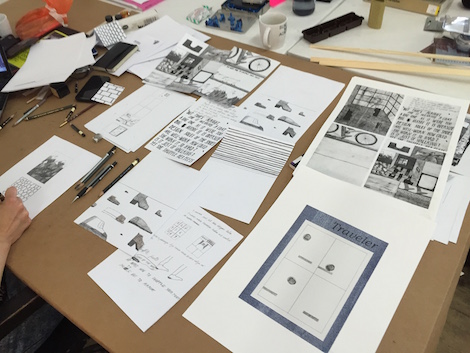
Throughout the course each participant will create two books. The first task was to select a book from the academy’s library and make a book about this book. The exercise should give a feeling for the medium and its possibilities and limitations. What is the book about? What are you interested in when selecting it? How do you construct and re-construct it? The second book will be based on materials were collected before the course. Between two conversations with students I catch Bernhard Cella for a conversation on dummies, content and doing things yourself.
What is important to you when you are teaching?
Often when I meet students from art academies, they can tell me a lot about art, but they barely have a clue how you make art. Learning to make art is not about learning some technique like life drawing. It is about perception, experiences and forms of work that cannot be conveyed in a technical language. Instructions like ‘you have to do this’ or ‘this is how it is done’ don’t work. Rather than that learning art has to do with reflection and with a particular headspace. Only if you are confronted with a headspace, with some kind of void you have to fill, you start to ask the right questions. One of my teachers at Vienna Art Academy when I was a student gave me the instruction: ‘work in this room for a week and do something and after one week we meet again.’ He would leave the question what to do entirely to you. So you had to produce content and to deal with the question: what is my content? It gets really interesting when you start to wonder: what are the things that really concern me? Do they have some kind of relevance?
How do these considerations inform your teaching?
It is really important to me that in my classes there is a balance between different kinds of movements. Firstly, the students have to move themselves. I don’t influence this, they all come with their own skills and projects. This focuses on the questions: what did you bring with you? At which point are you at the moment in work? And how can you develop that further? Another kind of movement is confrontation. We present techniques and the processes in which books are made, from the first concept until the finished publication. And thirdly, there is one concrete task that gives people a problem that they have to deal with. It is not so important to have perfect publication at the end, but to start producing. Our exercise was to make a book about a book. The idea here is not to produce some kind of review, but to come to a reaction to the book with one’s own means. The question how to do it yourself is also important to me. As an artist you want to be able to carry out the creation of an aesthetic object mostly by yourself. Even if you don’t do everything yourself, you want to develop the competence to judge if something gets better or worse throughout the different steps of production.
How does the process of creating these imperfect publications look like?
It is really important to me that we build dummies. I really try to get them to translate their thinking process into an object. There is no thinking process without an object. I don’t want to look at something before they can show me something concrete. It is really important to collect your own mistakes and errors. I want them to have to every mistake they make a corresponding object. In other words, there are no mistakes, it is all about externalizing and manifesting processes that you can deal with afterwards. If you don’t have that we get stuck in some kind of a wonderland. There must be a difference between artistic production and a more general reflection about the world.
So there are always intermediate products or dummies?
There are always intermediate products. Sometimes these intermediate products are more interesting than the final publication. They often show the movements a work goes through and the mistakes that disappear in a final work. One of the most important moments in art is the appearance of the mistake, of that what doesn’t work. But we live in a time where mistakes are disregarded. Mistakes are not allowed, because if you make mistakes you are not professional. I think the opposite is true in art: you are professional when you make mistakes, when you permit mistakes. If you do not permit mistakes you are not taking enough risks in your work.
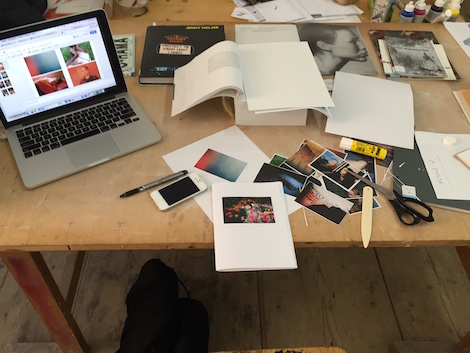
After our conversation I go back to the studio and suddenly feel a great sympathy for all those dummies on the table with their edges, design mistakes and apparent flaws. They are exactly not ‘raw diamonds’. But even better, they are documents and traces of risk taking. A raw diamond simply points to a possible future. A dummy points to both: a refined future and an act of courage in the past. Diamonds are products, dummies are processes.
11 / 30 Grounded Lions
The one class that remains a secret to me is Raimundas Malašauskas’ on curatorial practice. And it is bound to remain one, as it has ended on Friday. It was probably the most secluded class and when I wanted to visit them earlier this week, I found this:
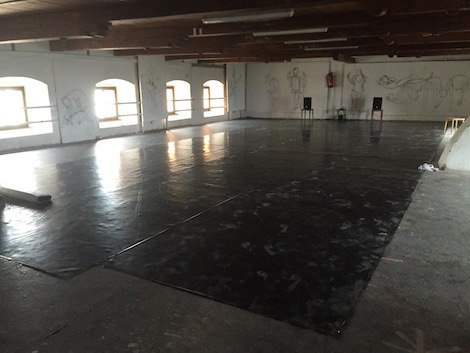
Apparently, they had decided spontaneously to go for a trip to Munich. Despite their seclusion and absence you could hear all kinds rumours about the strange things happening there. This is a collection of chit-chat that I had with and about students from the class:
“One exercise was to speak out all your thoughts aloud for two minutes, without thinking. Everybody had to do it, so it was a huge mix of sounds and words. You couldn’t concentrate on what the others said, because it is really hard to actually do that.“
“Today we would think about all the sounds that we could still remember from yesterday.”
“We had a hypnosis exercise. We had to imagine how it is to be in the mouth on the tongue of somebody else and explore that space.“
“Every morning we listen to music for half an hour to feel our body. Some people stretch, some people lie flat on the floor, others dance. The basic idea is to extend your self.”
As elusive as these descriptions of their work sound, as elusive was the presentation of their work on Friday. The group was dancing and would dance with everybody who entered their studio space. Luckily, I run into Maja Lundberg, one of Malašauskas students at the exhibition drinks on Friday. She explains me their invisiblity and how to be a good chameleon.

“We were talking about the bad chameleon. You know chameleons have two states of appearance: either they adapt their appearance to their environment doing camouflage or they convey their feelings through a particular colour. When they are sad they have one colour and when they are happy another one. And then we spoke about that. Either you should show your own feelings or you adapt and become invisible. A bad chameleon is one that cannot decide and tries to do both at the same time. Shall I try to show how I feel or shall I adapt?”
The English word chameleon is a simplified spelling of Latin chamaeleōn, a borrowing of the Greek χαμαιλέων (khamailéōn), a compound of χαμαί (khamaí) "on the ground" and λέων (léōn) "lion". The Greek word is a calque translating the Akkadian nēš qaqqari, literally "lion of the ground". A grounded lion is always transparent. Either you can't see it at all or you can't look away.
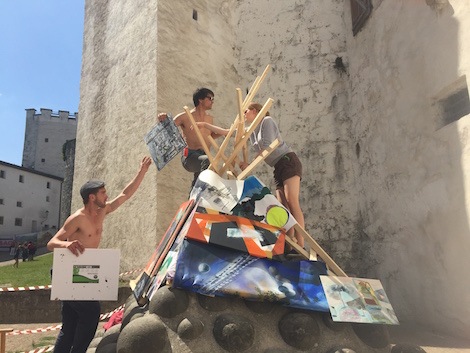
This tension between adaptation and expression was also at the centre of Bernhard Martin’s final exercise. His students had to merge their individual works into one sculpture. Throughout the class it became clear to me that many of Bernhard Martin’s exercises were about letting go control. Letting go control over one’s own ideas what an images might be, but also about how to handle a canvas.
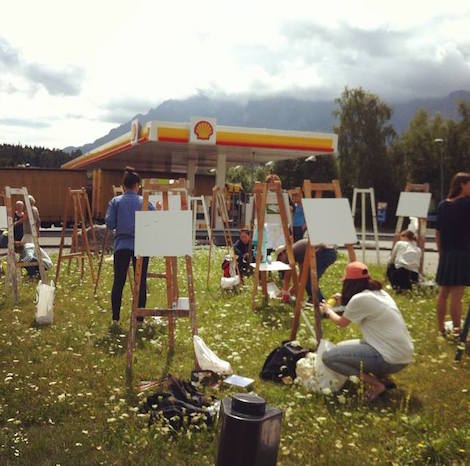
The day before the class was painting at a truck stop at a nearby highway. In certain intervals they had to exchange their canvases and continue the paintings of somebody else. Such a literal collaboration is unusual for painters. When I talk to them, they tell me how much they enjoyed it: this forced abandoning of their own artistic intention. Is this another ‘extension of self’ as in Malašauskas’ class? I am still thinking of chameleons when descending the Festung this night.
10 / 30 Real Questions
“We like lists, because we don’t want to die.” (Umberto Eco)
To Umberto Eco lists are the origin of culture. It is the most common way of human beings to deal with an overwhelming reality. Whenever we are confronted with something infinite or incomprehensible, like death, we start lists to create order. Black lists, red lists, pink lists, green lists. From bucket list to playlist, from shopping list to legal text, lists have two functions: to order and to externalize an inner process of thought and thus make it manifest.
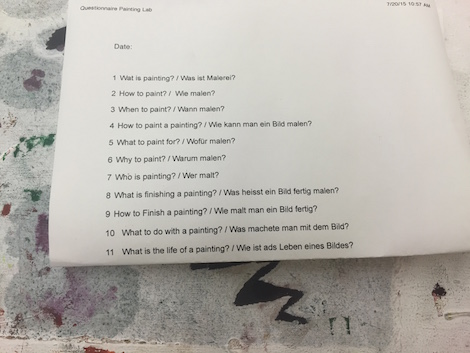
How does one cope with the infinite demands of creating something new? When I visit Varda Caivano’s class I am told that several lists have left their traces here. This was one of their first exercises. Each of the students was given a list of questions about painting that they had to answer for themselves. Later, they should write a list of questions on their own, collecting all questions that come to their mind during painting.
- What am I painting?
- Where is the focus?
- How do I balance the composition?
- Should I describe that more?
- What about the edges?
- Is there enough variation?
- How do I create space in the work?
- Should I put a line there?
- How do I finish the work?
- What does it need?
- How do I frame that piece?
- What am I communicating?
- How do I use a palette knife?
- How do I define what I am doing?
- What do the colors transmit?
- How does the work translate?
- What am I communicating?
A personal list from one of Varda Caivano’s students
What is the first thing you do when you meet a new class?
First you have to find out who your students are and what they need. What I did in the beginning with my class here is to hand out questionnaires, just to prepare them for these two weeks. Then they should develop their own questions. So instead of confronting me with their questions, they first confronted themselves. They were very basic questions like: what is a painting? What is painting for? What is the life of a work? The questions are resources for them. What I try to show them or help them to find out are things about themselves. And make them feel more confident as well. So it is about giving them both freedom and at the same time make them feel stronger as artists and basically tell them that they are artists.
Tell me more about this process.
Artists feel either really good or really bad about themselves, but there is neither a here or there. It is a process like doing research. There is a method and in certain moments you evaluate while in other moments you make. And then there is a lot of context, your personal and material context. These things are quite easy to quantify. It is not like ‘anything goes’. There are things that you can name. It is a little bit like in science: you can’t change everything at the same time. It is possible to talk about all these things and it is possible to organize even the things you don’t know and even the failures and the downs and the problems and to put them in a place and come back to them later.
Can you give me an example for these questions?
It’s often really pragmatic. If you don’t have a big studio and you don’t have a lot of money you paint small. You don’t think about big paintings then. With art many people get troubled. I want to give them resources for them to find out what they have and what they don’t have and what they need.
What did you do afterwards?
I divided them into different groups, so they can help each other. That means they realize that they have resources to look at the work of other people. And when they look at their own work in a small group their relationship with their work changes. Their thoughts become more objective and they can legitimate their own work better. I don’t really believe in teaching as such. So either we practice the really old fashioned way where you as a teacher give technical advice, which I think is very useful and important. But it is more important that they realize that they can go through that process also with other fellow artists. And the reality is that to some questions I don’t have an answer.I can’t tell you what painting is. The questions are just a resource.

