
9 / 30 Your layers of the real
Jayce Salloum’s class is probably the one that I have spent most time with until today. They are at the moment in the process of finishing their prints for their final exhibition on Friday. Between several discussions with his students, I met Jayce Salloum to talk about his teaching and how it relates to his own practice as a photographer.
How is the class going?
I think its going good. I am mostly basing it on print reading sessions. So we would look at work and not just critique it. We rather look at it and try to understand exactly what was going on with the photographer or the student. We try to learn from the images and about the photographers: where they are at in their life, what their relationships are to other things in the world and to their photography.
You said several times that it is important for you that the people in your class understand themselves as agents in a social context.
For me that is the most important thing, working photographically means working with layers of the real. It means always working with your social context: where you are in society in relationship to your working. If you are doing street photography or if you are constructing images, what sense are they making? Because otherwise if it is just a snapshot for a photo album, that is fine, but that’s not what I am interested in.
Tell me more about this process of analysis. So in your class you look where people come from socially, but you also look out for their anxieties.
Yeah, where people come from, but also their state of their being. As a photographer I am taking pictures and then look at those pictures and I reflect upon them and self-analyse my stuff and my situation. I learn from them, trusting that the photographs are some steps ahead of me. If I am working a lot, firstly I am collecting pictures in a stream of consciousness, or rather a stream of unconsciousness, just collecting intuitively. And then I use that as some kind of a self-constructed tarot card in some way.
So you say that there is some kind of an anticipatory mode in the photos that you shoot.
Yeah they are ahead of their time. We can learn from them because they all become self-reflective: self-reflexive, self-reflective and auto-biographical. That is the thing about photography, like in painting, it is all coming from your self. However, photography has to do more with appendage. It is coming out of you through the way you are framing: how you are holding the camera, what you are pointing it at, what you are shooting. And then it is also coming back at you when you are printing it. Looking at the photographs, they are anticipatory in that you can look at them and find out where you are at. So, they are leading you. They are ahead of you. When you are working, it sometimes takes a few months to realize what is in a photograph. Unless you go back and look, you get stuck in a way of perceiving that is formulaic.
If I get you right, this practice requires very different modes of observation. A kind of observation when you take the photos and a mode of observation that comes later when you edit. How do they differ? And how would you describe these modes of looking for something?
I try to teach that when you are out there gathering images that you are not presupposing, preconfiguring what it is you are looking at. So that you are trying to get beyond the baggage that you are carrying with you and just repeating the same image in different setting each time. A lot of people do that and they make their fortune and fame from that, because they have made a strong set of images, but then they just keep on repeating. That is what the commercial art market loves. But if you are using photography as a tool for growth and for inquiry about the world then you don’t want these repetitions. You would think about where you are going beforehand and then just take pictures not thinking so much about that. This is also why we did this other exercise: not looking through the camera.
On the second day, Salloum went out to the streets with his class. The only instruction was to take as many pictures as possible without looking through the camera. Later the students selected a series of these photos to discuss them in class.
I found it fascinating how the camera, even if you are not looking through it, becomes embodied in a certain way in that exercise.
It becomes an appendage, like an eye at the end of your tentacle. For some people this was amazing. Even though they weren’t looking through the camera or looking at the image, there were always images that were still quite unique to each one and some were related to their previous work. But this was leading them somewhere else and leading them to new things.
What do you mean when you say photography can be medium for personal growth? Is it about getting to know yourself better or is it also about getting to know something about the world?
It is both, but it starts with the self. If you don’t know who you are yourself, you are not going to be able to figure out anything else in the world. Oftentimes we need re-assurance. We need to know what we are thinking is actually happening or actually real. You know, sometimes we are so lost that we are not able to move forward. People many times in their lives are trying to put things together. They are juggling life and their work and their passions and things that they have put aside for years maybe. I think at any stage in our life we can use that process of photographing to find out things, to look at the edge of things.
8 / 30 Breaking Patterns
This post reaches you with a delay. I had to leave Salzburg for the first time during my residency to go to an ice cave. Yes, you read right: an ice cave. This is where the first excursion of Bernhard Martin’s painting class went yesterday. For an hour the Eisriesenwelt close to the village Werfen became their studio.
“It is all about breaking your own patterns as an artist. To do something that you would not do usually and then see what happens.”
For Bernhard Martin moving your workspace to unusual places is such a strategy. Coping with the very own working conditions of an unfamiliar space leaves traces in your work. The space helps to break your patterns.
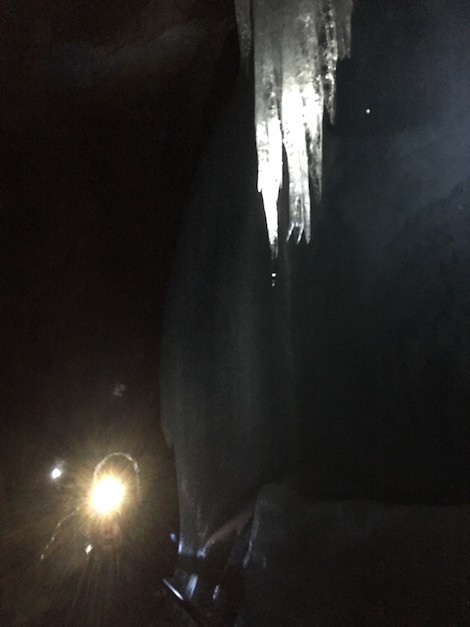
We arrive an hour before the official opening of the cave. We want to have the tourist attraction to ourselves. A heavy iron door protects its entrance. When it is opened a strong wind blows out of its maw. Inside it is pitch dark. The only sources of light are our torches. The figures and domes of ice are an impressive foreign landscape. Their features are in constant motion as only our torches illuminate them. Everybody brought their canvases and a selection of colours.
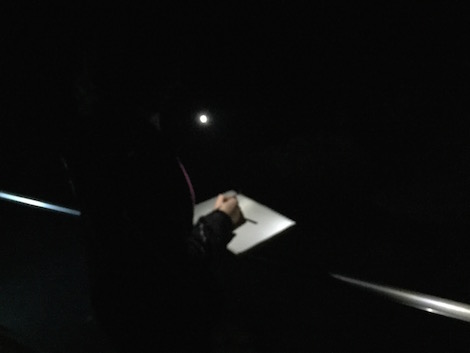
When you start to paint, you have to decide if you cast light on your canvas or on the object that you are painting. However, also the lights of your neighbours determine what you can see yourself. Observing the group and painting a little myself is a metaphorical experience: the process of catching the instable and fleeting appearances of a reality with too many layers to grasp. For a few moments it seems as if the ice domes have a life of their own. Maybe I understand for the first time what Plato means in his cave allegory, when scribbling the shapes of an icicle into my notebook: seeing is seeing appearance, not substance.
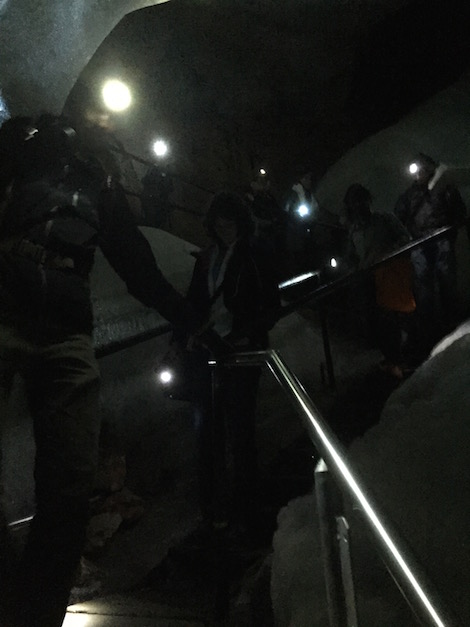
Again I realize how much there is an ‘art of exercise’ and how instructions can be artful themselves. Just as Harun Farocki’s instruction Labour in a single shot brings forth an entire archive of documentary, the ice cave studio has an aesthetic quality independent from the artistic products that result from it. Is not the exercise an embodied re-enactment of Plato’s allegory? And a re-connection to the oldest form of painting: the cave painting? Tomorrow the course will paint on a traffic island.
You cannot bear much more than 45 minutes in the coldness of the ice cave. Afterwards Bernhard Martin throws a round of Jagertee, a fatal after-cave drink consisting of mulled wine, rum, a fruit schnaps, a tea bag and a tiny bit of boiling water. It for sure is as much of pattern-breaker.
7 / 30 Memories
Our memories are a product of the present, not of the past. Every day they re-construct themselves, with every experience that we make. Yet, we have the feeling that we have a past. We feel that we are a person, with a name, the same person that we have been from our first memory.
And yet, the truth of our memories is different from that of material reality. A place that seemed gigantic to us as children is a mere stone’s throw when we re-visit it later. The truth of our memories is also different from that of the media that we use record our lives with. A moment that means everything to us looks banal on a photo and a moment that has long been forgotten can become a photographic icon.
It would be far too easy to say: memories lie. They have their own truth. This truth is as much tied to the present moment as it is tied to the totality of all experiences, all sensations that we felt. The process of remembering is thus a continuous rendezvous: a seeing yourself as another, a careful re-visting.
This is the difference between recalling something, being reminded of something and remembering. Remembering is the process of exposing everything that you have ever felt to the sensations of the present moment. The etymology of ‘member’ points to that. To be a member means both to be a person, but also to be body. Remembering means the continuous process of becoming and remaining a person and becoming and remaining a body.
“I blocked my past away for a long time and then I found these photographs at the house of my step-grandmother and everything came back. I wanted to see the places from my earlier life and to see what is still there. It turned out they were very different from my own memory.”
This afternoon I visit Jayce Salloums’s class again. His assistant and co-teacher Antoinette Zwirchmayr presents her two latest films. The first one is called The pimp and his trophies. It is a documentary about her grandfather, who was a pimp in Salzburg when she was young. None of the associations that the title evokes are part of the film. Rather than a scandalous piece about the red light district of Salzburg, The pimp and his trophies is a subtle journey into the personal memories of Zwirchmayr.
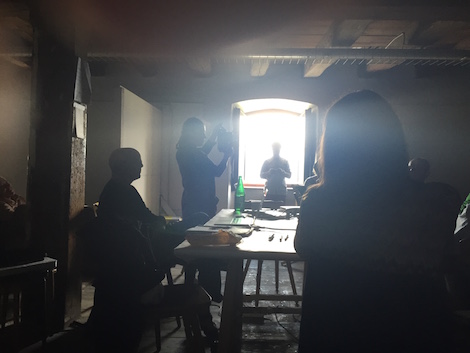
“You do not see the actual places. I wanted to find images that fitted the images of my memory.”
At any point you can feel the careful construction of every image. The cinematography of the film is exceptionally controlled. It was shot on a 16mm analogue camera that highlights every texture, every reflection in the image.
A sequence of three hunters posing for a photo, strikes me particularly. Although the hunters are posing, you can see the small movements of their bodies in the act of posture. It is an image that is really hard to grasp, somewhere between a photo, a family film and a perfectly composed tableaux vivant.
These perfect memories are narrated by the voice of a professional actor. Also on the level of narration the process of re-creation and re-construction is highly present. She tells us later that she collaborated with a writer to edit the interviews that she had recorded with her grandfather.
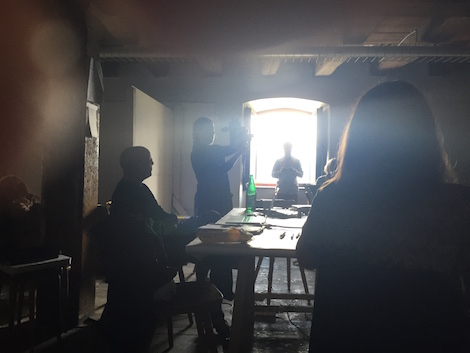
The second film we see is called Josef – my fathers criminal record. Together with The pimp and his trophies and a film that Zwirchmayr is going to shoot in Brazil soon, it constitutes a family trilogy. Josef is a documentary about Zwirchmayr’s father, who robbed a bank in the age of 17 and never talked about it with his daughter.
“The whole process was difficult, asking these questions that were not allowed in my family. I knew that there had happened something in the past. But my father would always made this sound when I asked about it: psssst, somebody could hear it.”
Only after consulting the local newspaper archive she stumbles upon the story of a bank robbery her father was involved with. From the court records she learns a about a story that did not take place in the memories that her father shared with her. Again, we witness the process of a memory construction. We witness this process with all its idealizations and affinities for closure and its most beautiful unreliability.
After the films I wonder how many untold stories linger in my own family history. And how much they form and inform who I am: my remembering.
6 / 30 Meeting Bernhard Martin
Fakes aren’t lies,
lies aren’t fake.
Squish the fibers,
break the beat.
My interview with painter Bernhard Martin is dangerous. At least according to the prude blogging software that I am using for this blog. The terms 'por.n.ography', 'por.n' and even 'trans.vestite' are apparently blacklisted as "illegal content". Particularly, in the case of 'trans.vestite' this is annoying. I wonder what anxiety made the software developers impletment this feature. No, please don't bring the "but who thinks about the chilrden" red hering. The kids are all on Instagram these days anyways.

“My art has a user-friendly surface, but user-unfriendly content.”
“I am a fake, we are all fakes.”
“Nowadays everything is por.n.ography.”
“What people pay for my art? I cannot tell you that would be indiscreet. All I tell you is that my art is expensive. Art is a luxury. It’s for maximally 5 per cent of the population.”
These are a few of the sentences still on my mind, when I am on my way to meet Bernhard Martin. They are from his lunch that talk left many people baffled. Rather than showing his art Bernhard Martin let loose a storm of images and provocations at his audience: screenshots from computer games, film stills, details of paintings. It was never entirely cear, if the image that he showed was one of his. We meet for lunch at a restaurant called Zum Wilden Mann (to the wild man). And we eat Beuschel, an Austrian specialty that primarily consists of finely cut pieces of calf lung and a dumpling. Only afterwards I cannot imagine any other, any better set up for a conversation with Bernhard Martin.
What is important to you, when you teach painting?
The central thing is an artistic intention. An artistic intention develops from the desire to found something, to create a new aesthetic, because you are not satisfied with the status quo. This is something like the artistic Urtrieb, the one drive behind all artistic intentions. The first question that I ask in every class that I teach is: why do you want to become an artist? You have to be really clear about this. When there is no desire behind that wish, then you should try something else.
What kind of answers do you get to that question?
Oftentimes the answers are very cloudy. Most of the time people talk about personal issues and sensitivities that they have. And then I say, these sensitivities don’t belong here. Leave your issues at home. Never wash dirty linen in public.
There are only three answers that I accept: I want to be famous, I want to be rich and I want to be a great artist.
When you get a new class of students like here in Salzburg, how do you help them to arrive at their artistic intentions?
By talking about life. Surprisingly, the desires are always the same. Most of the time, life experience has just evened them out and either someone becomes really modest or a manic. Then it is important to locate and accept your intention. This is the most difficult thing about art. Because accepting your will or your intention has consequences. The freer you become in your way of thinking, the more you get restricted from the outside. Real freedom is not permitted and not desired by society. It only suggests you freedom. A real freedom of spirit is not permitted, because it is a risk to society. Thus, you are always struggling with resistances and you have to bear that. This can mean isolation or loneliness. But you have to be aware that that has to do with your intention and then you have to bear it.
L: Alright, I’ll give it a try.
Y: No!
Y: Try not.
Y: Do!
Y: Or do not!
Y: There is no try.
Yoda to Luke in Star Wars
Departing form an artistic intention, how do you create something then?
Human beings only have ten fingers and only one brain. So whatever they create ends up being more or less the same. Only through changing social spheres and through changes and improvements in technology something really new comes into existence. The more you accept what comes from the inside, the more honest you are with that and the more striptease you do all the time, the more radical you become. Only then you can really make use of these external changes.
What would be techniques to come closer to one’s artistic intention?
We already talked about striptease, but we can also talk about travesty and about role plays. They all share the same notion of a radical change of self, of pushing something over top, but also a form of radical acceptance of the self.
And this is also what happens when you are painting. During the act of painting you transform into different kinds of persons. Sometimes you are focused and even anxious, other times you are really relaxed and just let everything happen and give up control.
This reminds me of what David Bowie said in an interview once. Although he wrote a lot of music for other people, in the beginning he was unable to write music for himself and as himself. Only after inventing different alter egos, it became possible for him to compose in such a way. Only through these creative masks. Can you relate to that? Do you have to become an other in order to produce something?
I was always an other. I was always somebody else. I was never completely myself. We are all the products of our upbringing and of our education. We are the products of our parents. Then today you have other influences like TV, the Internet or propaganda. This means you are only five to ten per cent yourself. And these ten per cent you have explore and discover. You have to locate these ten per cent, this rest of yourself, that is not just the institutions that you are living in. And then you have to exercise them and make them your practice.
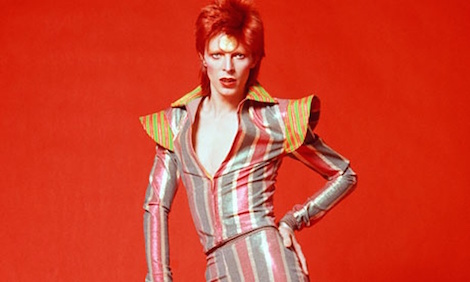
And the transformation into other personalities could be technique to discover these ten per cent? Because then you realize which layers stay with you and which layers come from the outside?
Yeah, through this intentional alienation you come into a position to look at yourself in a different way again. Sometimes I am the macho in front of the canvas, sometimes I am a trans.vestite and sometimes I am a woman when painting. Every day brings other moods with it. When you are working in an office and do standardized work, that is relatively simple. The mood in which you are is completely irrelevant for that work. This doesn’t work with painting. When a mood derails you have to catch yourself again and to develop strategies to get over that. And if you can use this and turn it into some creative force than you start to work. The people who work in offices want to be left alone; they don’t want to deal with themselves.
What is it then that makes a good artistic performance for you?
It has to be contemporary. It has to be up to the technological developments of the contemporary. It has to be up to the contemporary discourses. And in the best case do away with it, but only few ever manage to do that. This again comes back to artistic intention, only the artistic intention counts. The more extreme you want to make ‘your thing’ out of something, the greater is the chance that you succeed. Only if you do it in an extreme manner, you will get attention.
Das Lied was du am nötigsten hast,
ist das Lied das du am wengisten magst.
Darum Rückzug,
vor der Feigheit.
(Die Sterne – Hier)
The song that you need most,
is the song that you like the least,
thus retreat from,
your cowardice.
(Die Sterne – Hier)
5 / 30 Le dernier cri
Trigger Warning. This blog post features violent dolphins and a strange metaphor. But let me tell you before what has happened today. The first classes of the academy have already come to an end. Joanna Warsza’s curating group and Ben Katchor’s visual narrative group presented their work during an open studio session this afternoon.
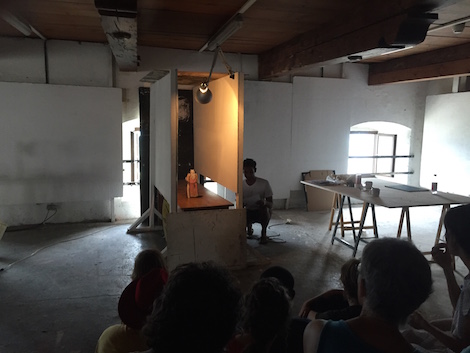
This is David Mathew narrating the story of his comic puppet theatre. The final task for the students of Ben Katchor’s class was to build a paper theatre and to write a story that could be performed in it. David’s piece is the story of an old man losing grip of his memories. As you can see below the stage extends to the Alps. In each scene the protagonist revisits a moment from his past. In reiterations a once coherent story falls into its single parts and creates ever more absurd memories.
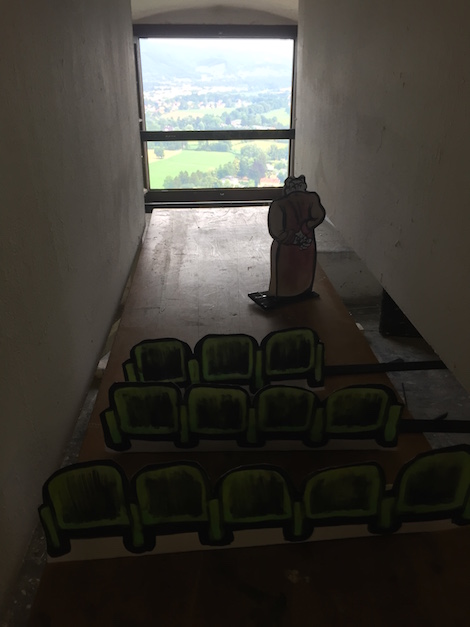
Although paper theatre and shadow theatre have the reputation of being children’s entertainment, Ben Katchor’s students show that it also can be a medium for deep reflection and revelation. David and some other students form Ben Katchor’s class who live in Vienna already plan to continue to meet up and develop the format further. One of the visual narration students tells me after the performances: “This is a great tool for the development of stories. You build these little figures and then start to play around with them and in the end you have story. It is great for exploration.”
Exploration. This is my trigger word and it has been on mind for the past few days. It seems so much more suitable to describe what the students learn to practice at the summer academy than observation. I know, Mr. Kokoschka, you initially called the academy ‘Schule des Sehen’ (School of Vision). But ‘simply’ learning to see, learning to observe, seems to be insufficient. It is an active seeing, a constructive and deconstructive seeing that is encouraged during the classes: a playful attitude towards the visual space and a consistent trying to come to terms with one’s intentions.
That observation is not enough becomes even clearer when you look at what the words ‘to observe’ and ‘to explore’ literally mean. To observe comes from the Latin verb ob-servare, for servare meaning “to watch over”, but also “to keep”, “to store” and “to preserve”. In contrast, the word explore comes from the Latin verb ‘plorare’, which means ‘to cry’ and initially meant a to set up a loud hunter’s cry. Storage versus hunter’s cry. Observation versus exploration.
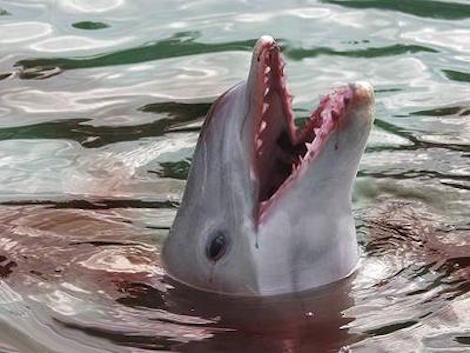
When you google hunter’s cry, one of the first results is an article from the year 2000 that describes how dolphins use their ultra high pitch cries to disorient prey fish. You might know that dolphins as much as bats release these cries to orient themselves. When their prey is confused by these sounds, the dolphins attack and eventually devour them. Exploration for a dolphin thus entails: to locate themselves, to confuse and finally to catch a prey. To locate, to confuse and to catch an idea. Is that the process of artistic creation?

