
4 / 30 Seeing what is there
Probably you did not notice, but you have been sitting on something precious today. At least, if you were at the Festung, and if you took a seat on one of the chairs. Tiancheng Cao has made them the protagonists of a photo series. He calls it ‘Found Art’.
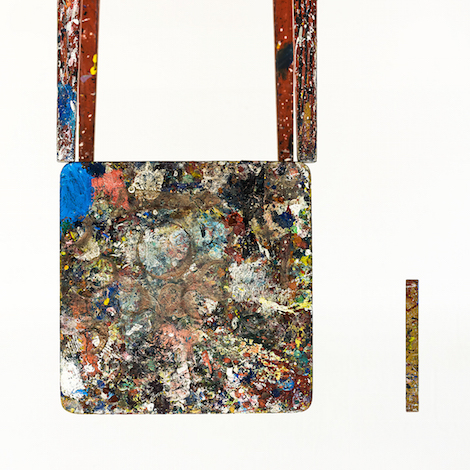
“For me photography is not a channel to a real world, but an escape to get away from it. I always want to get away from everything. I want to get away from China to get here and I want to get away from the academic routine to this summer school. But it is not about escaping from the real. In the process of getting away something happens.”
“So, I try to create situations in which my pace doesn’t always overlap with other people's pace. I am creating this gap, so I can maybe hide myself in there. It is something really personal. I just gravitate towards discrepancy, to be not synchronized with the rest of the world.”
I meet Tiancheng Cao and Abraham Oghobase in the studio of Jayce Salluom’s photography class. The day at the academy is coming to an end and only a few students are still around. Despite the long day Abraham and Tiancheng are in deep discussion. Tiancheng shows a series of photos of fire extinguishers that he took at the 65. Biennale in Venice. He tells us that he was exhausted by all the art after some time. To calm down he took pictures of 65 extinguishers. As the pavilions are run by different countries, their fire extinguishers apparently are country-specific. Growing up in China Tiancheng now studies humanities in the Netherlands. He has worked as an English teacher in Beijing for several years to finance his studies in Europe.
Abraham is working on series of self-portraits. He is fascinated by the religious statues in Salzburg and wants to re-create their postures to turn them into self-portraits.
“The figures are everywhere and they give you this feeling of a powerful past. A past that is more powerful than the present. When I take these postures, they become something else. Look at me, my skin is black and all the identity I carry has a different kind of history. I want to bring them into a different present.”
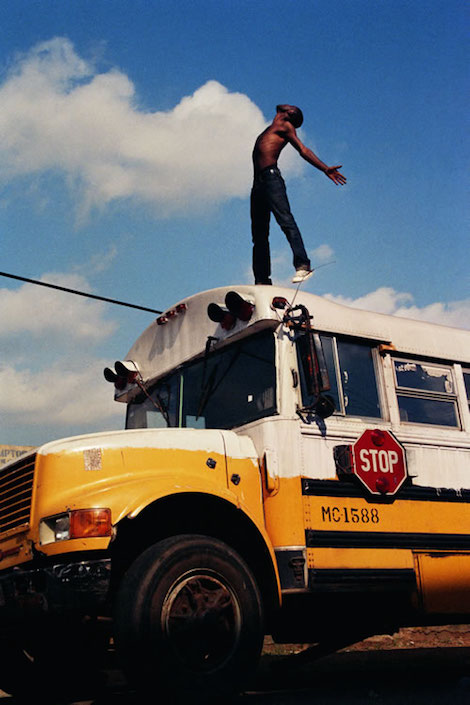
This is an older self-portrait of Abraham from a series called Ecstatic. His photography is often auto-biographic and concerned with his life in Nigeria and his journeys to Europe. He lives and works in Lagos and when I met him for the first time, he told me that it annoys him when people ask, if he would like to live in Europe or in America. “I would never exchange my life in Lagos for one Europe. I am not rich, I live a decent live, but I want you to know that normal people live in Lagos.”
After our conversation I look at the statues on my way back home. I feel the more dramatic the gestures of the statues here, the more reduced the gestures of their passer-by.
3 / 30 Political Syndromes
When do we tie a city's name to a syndrome? Either in the case of abduction or in the case of tourism.
Paris: a transient psychological disorder exhibited by some individuals visiting or vacationing in Paris, severe form of cultural shock.
Florence: a psychosomatic disorder that causes rapid heartbeat, dizziness, fainting, confusion and even hallucinations when an individual is exposed to an experience of great personal significance, particularly viewing art.
Stockholm: a psychological phenomenon in which hostages express empathy and sympathy and have positive feelings toward their captors, sometimes to the point of defending and identifying with captors.
Lima: a psychological phenomenon in which abductors develop sympathy for their hostages, converse of Stockholm.
Jerusalem: group of mental phenomena involving the presence of either religiously themed obsessive ideas, delusions or other psychosis-like experiences that are triggered by a visit to the city of Jerusalem.
Venice: the gentrification of inner cities through mass tourism and real estate speculation.
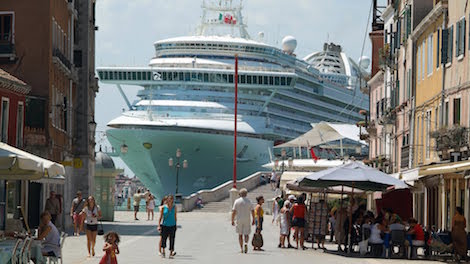
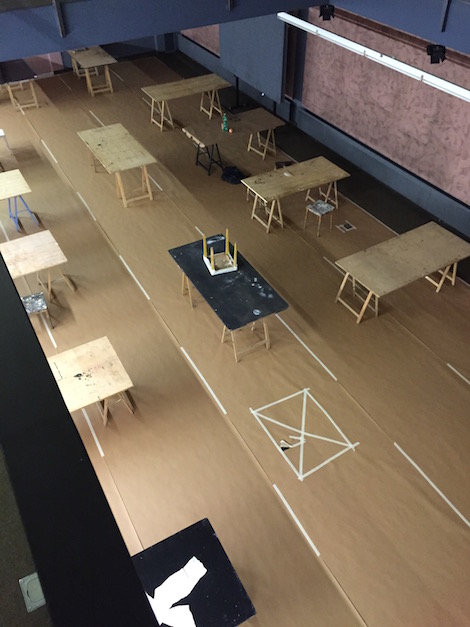
Tourism can be a dangerous endeavour. This becomes graspable after Andreas Pichler’s film Venice Syndrome. He presented it tonight in the performance and urbanism class of feld72. The location of the screening was at the former Baroque Museum of Salzburg. The museum has moved some time ago and left a abandoned space that is used by the course of feld72 for the duration of the academy.
Pichler’s film shows the gentrification of Venice from the perspective of some of its remaining permanent inhabitants. Over the last twenty years the number of them has dramatically decreased. This leaves Venice with fewer permanent inhabitants than after the Great Plague, yet every day over 70.000 tourists visit the city. Real estate speculations, but also this arrival of flat-rate tourism transformed Venice into an unoccupied Disneyland: overrun by visitors during the daytime and uncannily quiet at night. I look out of the window of my room located in the very centre of Salzburg. It is dead silent. Venice is everywhere.
I wonder now how a post-gentrified city might look like. ‘Experts’ predict for several years now that the mother of all real-estate bubbles, London, is about to burst, yet the investments seem unaffected by entire neighbourhoods without inhabitants. Will a city after gentrification look like Detroit today? Or is London already post-gentrified? And what is role of art in all this? Accomplice or insurgent? I remember the quotes that I scribbled into my notebook during Florian Malzacher’s lunch talk on 'useful art':
“Today it is easier to imagine the end of the world than the end of capitalism.”(žižek)
“Art is not a mirror to hold up to society, but a hammer with which to shape it.”
(Trotsky, Brecht, Mayakovski, ...)
2 / 30 Revelations
The heat of the day does not let go of Salzburg at night. The streets and buildings emanate it and in my street everybody sleeps with open windows. I am sitting on the sill of my open window, too, and listen to the interview that I have recorded this afternoon. The voice of Ben Katchor fills the room from my laptop speakers. I wanted to talk with him about his experience as a teacher and his role as a comic artist and performer in the contemporary art world. As I revisit and transcribe our conversation, I realize that it subtly addressed something much broader: the question of how to create something. Once you interrogate material long enough, it reveals these other questions.
Tell me about your experience as a teacher. How is it for you to teach?
The first eight years when I taught part time, I tried to make up pure exercise like gymnastic exercises to make students produce work. Because I found the biggest obstacle was that there is so much ego involved in making anything. And there is incredible procrastination that comes with it. There are rarely people who have absolutely no obstacles at work, most people do. And I said I just make pure exercises like in a gymnasium. It doesn’t matter what the quality is. The main thing is to force yourself to make pictures and to write. So that was my idea to make these crazy exercises. Often my exercises are based on the experiences of my students. Like an essay on: I was an accomplice to a crime.
And then I found that even that wasn’t always enough. Sometimes they were even paralyzed with that. How do I start writing? And then I would give them very tight fifteen minute exercises. You have fifteen minutes to write this thing. If you cannot do it, you have to force yourself. But I found even that was not always enough, so sometimes I would break it down into even smaller steps. Like somebody who is crippled, who has to learn to walk. I would do some exercises that were very short goals. Anybody could do them and then you could look back and say: I did this thing. Somehow I did not even know I could build up to such a thing.
If you really want to work with students properly it would have to be very individualized. It’s like going to doctor, everyone has their own problems, Everyone needs their own guidance. So, if teach people who have build a big body of work it is more about a re-thinking of what they know what they can do. Seeing how that can be enriched in some way. So if it is people who have never done it, it is a whole other thing. And everywhere in between people have strange drawing habits or ideas of what a story is. And then I say: that is not a story, what is that? Is it maybe a demonstration of something rather than a story.
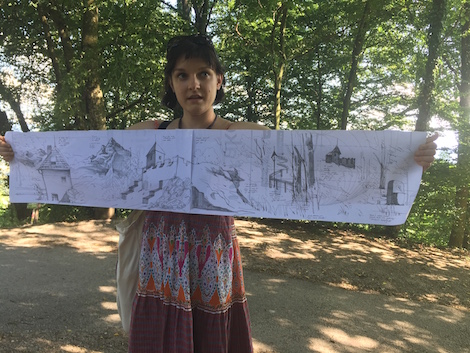
We are sitting on a bench in the park of the Festung. From time to time students from his class come and join the conversation. They are scattered around the Festung to draw panoramas. Their task is to draw a 360 degree perspective of a place and to write down their thoughts during drawing into the picture. I am fascinated by the interplay between the text and the pictures. You can see the time in which different parts of the picture were drawn unfold through the text. In contrast to an illustration, both elements coexist and reveal new aspects of each other.
So, how do you teach to find a story?
The exercise is the beginning, but I don’t even like to think of story, because this conventional idea of story has this story triangle. I don’t want people to think of that. This is completely of no use. I think about demonstrations, more of scientific demonstrations or instructions, very utilitarian. How do you convey information in a really clear and interesting way? And if that information also happens to be a revelation, then call it whatever you want it is an amazing thing. It will have structure. It has to. If you explain how you make an omelette, it has a dramatic arc to it, plus the eating. The cooking, the getting the ingredients together and it builds and the climax is putting it on the fire. If somebody thinks: I have to tell interesting stories, I think it paralyzes them. I would say, don’t think too much about that.
Tell me a little bit more about what you mean by revelation.
It means that you realize something. Revelation is a strange thing, because there is a revelation by a newspaper headline. There is no more work needed. ‘Salzburg destroyed in a earthquake.’ That would be a revelation to people. They would read that and say: oh my god, Salzburg doesn’t exist anymore. But then there are other kinds of revelations, connections between things that you never saw, that are much more subtle. So, it goes from all those levels, it is the hardest of all the metrics I have. Everything else can operate at zero. Like a bad piece of journalism: the information is the revelation. It does not have to be written well. Salzburg wrecked destroyed. Earthquake in Salzburg. It doesn’t matter how you say it.
Then there are these kinds of revelations where the revelation is absolutely through the other metrics: the spatial description, the object description, how you talk about time. When the revelation is in these metrics, the actual event could be nothing, insignificant: two people sitting on a bench. And then there is revelation in what they are looking at or talking about. It usually has to do with these unknown connections between things: if you can establish some relationship that no one ever thought of or that people did not pay attention to. And those are pretty invisible things.
So you would say this is the task for anybody who makes something.
Yeah, that’s where the revelation factor comes in. And the way to arrive at these things is purely through interrogation. You just keep questioning the thing you are talking about and if you stop questioning, you have an action adventure movie, some stupid plot, where somebody wants to kill somebody. But then if you investigate why do they want to do it and who care why they want to do it, you keep interrogating the premise of what you are writing about, you will get to some interesting revelation. But I think a lot of people don’t have the energy to do this. And you have to throw away a thousand ideas and maybe if you keep thinking about it you will hit one.
Listen to the full interview here
1 / 30 Anticipations
Sometimes when you come to live at a new place, you are given a new name. In my case, my name has been consequently Austrianized since arriving in Salzburg. Rafael Dernbach became Rafael Dernbacher. And as Rafael Dernbacher I am your blogger in residence for the next six weeks. From today I will write for you once a day about the academy in Salzburg.
This blog is a collection of my fieldnotes. Fieldnotes are descriptive. They do not add what has not been there. However, they document subjective encounters and exchanges rather than objective certainties. They are stories intertwined with materials, and materials intertwined with stories. Already from these terms - field, observation, exchanges - you can guess that my blogging is guided by a set of methods. My methods here are anthropological. Anthropology is the study of the everydayness of a particular social space. What happens every day? How does it happen? What are the concerns and hopes of people? What is shared and what is not shared?
Often we know exactly what we do, but have no idea how we do it: driving a car, surviving a job interview or playing an instrument are only a few examples. All these activities happen semi-consciously. They constitute our everydayness. We learn them every day in more or less oblique ways. This is also true for art. And I am going to observe the more and less tangible ways in which art is taught at the summer academy. My fieldnotes thus aim to go beyond the obvious, by paying utmost attention to it.
J: You want to be what?
J: A diplomat.
J: Are you rich?
J: No.
J: Can you legitimately add a famous name to your surname?
J: No.
J: Then forget diplomacy.
J: But what'll I become?
J: Curious.
J: That's not a profession.
J: Not yet, travel, write, translate. Learn to live everywhere.
J: Begin at once.
J: The future belongs to the curious.
Truffaut Jules et Jim
“Everydayness is a knowledge that lies as much in the objects and spaces of observation, as in the body and mind of the observer.” Michael Taussig
The first image that strikes me in Salzburg is a larger-than-life picture of the concerned faces of Angela Merkel and Wolfgang Schäuble. A 3x2 meter LED screen at the train station reminds everybody: don’t forget, we are still in a moment of crisis. Merkel and Schäuble, these icons of austerity don’t leave you alone in Europe. There is no public space without them. After their serious concern a logo appears: Kronenzeitung.
As soon as I leave the train station I feel the humid tropical heat of the city. The sky is covered by dark clouds. They strew the thinnest summer rain over the city that I have ever seen. This is my first sensual experience of Salzburg: you can walk for thirty minutes in the rain without getting soaked. I meet some of the teachers and staff of the academy for dinner at Gasthaus Hinterbrühl, an Austrian restaurant at Schanzlgasse. Everybody is standing outside in the summer rain, watching the interplay between clouds and sun and avoiding the heat inside the pub.
S: So what are doing?
R: I study observation.
S: Don’t we all? And I can tell you this will never stop.
I am surprised to meet several people that have been part of the summer academy for more than 25 years. I did not imagine that an institution that physically only exists once a year for a few weeks has such continuity. Stephen first came as a student to the academy in 1985. Through his class he got to know a collective of print makers from Salzburg with whom he started a long-term collaboration. He also met his wife at the academy and eventually became a Salzburger. I am impressed how his American accent in English switches from one second to an Austrian accent in German. During the summer he works as technician for the academy.
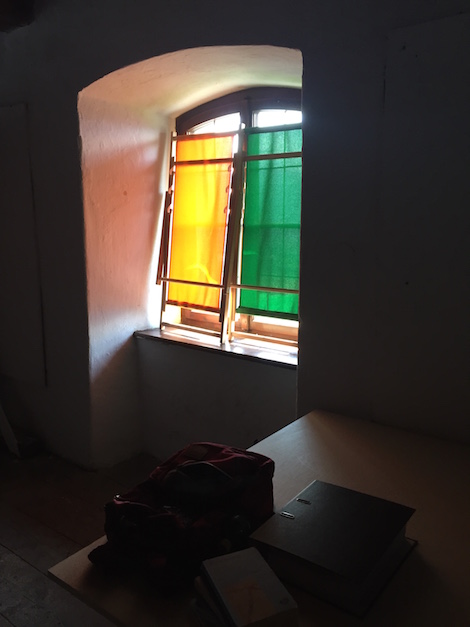
The room is too bright. Although photographers are the painters of light, they need the darkness. Not only for their work and practice, but also for reflection. This is the window in the room of Jayce Salloum’s photography group. Two chairs to protect the sparse light of a projector.
“Anybody is jetlagged? No? So we are all in the same time zone.”
Jayce Salloum sits at a t-shaped table, to his left his assistant Antoinette Zwirchmayr. All the students are assembled around him.
“I take years to develop one work, so everything here is going to be compressed.”
“We are going to look at how images play off with each other.”
“What does it mean to produce images in an image economy?“
Somebody comes late to class.
“Did you get arrested? Or kidnapped?”
“I am sorry, Europe is so scientific.”
“Yeah, in Europe, people don’t do hand gestures a lot.”
It is interesting that talking about failures is an important aspect of Salloum’s classes. He tells that he wanted to become a National Geographic photographer as a student and only when realizing that this was not “his thing”, his practice entered a new stage. He creates an atmosphere of mutual vulnerability with his stories. A careful, caring but also a demanding vulnerability.
“If we are all taking the same pictures, then there is nothing to look at. If we are all thinking the same, somebody isn’t thinking.”
Luis Camnitzer
"When we talk about art we generally lump a great many things together to the point that we end up not knowing exactly what we are talking about. If I would ask anybody, the response would be that there is art making and art appreciation. The latter, in turn, is roughly subdivided into collecting and marketing. The main division organizes the population into producers and consumers. Both groups are very small if measured by world population standards, and belong to the educated middleclass. The makers are actually very few, and those appreciated among them even fewer. I would like to add another category pertaining art, which is art thinking. This one I believe is the most important one since everybody should share it. Art thinking actually is not a discipline, but a meta-discipline and it should inform pretty much anything we do because it’s where cognition takes place." (Luis Camnitzer)
On Tuesday, 28 July, at 8 p.m. Luis Camnitzer will give a lecture within our lecture and discussion series "The production of meaning" in the Künstlerhaus.
See here a short clip of Camnitzer talking about "art thinking" in the Guggenheim, New York.

