My precious attention
My precious attention is absorbed by scandals today. Kuśmirowski's public art course closing party at the Vogelhaus has ended with the complete destruction of the Mirabellgarten with people littering it until the sun came up and then taking a bath in the Pegasusbrunnen. The chief gardener allegedly said:“Public art - never again!“ I call at the Gartenamt and nobody knows about any party littering scandal until I get connected with Ms Sibr who says that when she entered Mirabellgarten at 6.30 in the morning the artists were cleaning up and it was „a bit disturbing“ that two of them were dripping wet from having taken a bath in the fountain. But people taking a bath in the Pegasusbrunnen happens. The artist David Q was photographed swimming naked in the Pegasusbrunnen in 1992. The secret director of the Summer Academy, the artist Stephen R. Mathewson has been witnessing real excessive parties at the Summer Academy in the past 30 years. On an excessiveness-scale from 0 to 10 he puts the Vogelhaus party at 0: juicy but tame, no blood, no fighting.
There is another boring party scandal occupying my mind. At the students home a party allegedly got out of hand with people taking drugs, nudity, carnal knowledges, destruction of the rooms. Everything sounds exaggerated like the 200 Euros cost for cleaning up. So I call the students home and Ms Leitinger says she has not heard of anything like that. Honestly I think if such a party would have taken place anywhere I would have been there myself. Since no party complaints have reached Ms Leitinger when she asks my name she immediately finds my complaint in her database that I orally brought up at the reception: the crashed fake window sill at my room that hideously injured my back, my legs and broke my left ring toe. I will send her a photo of the window sill.
Even if there was any recent excessive partying it was nothing compared to the infamous debaucheries that took place in Salzburg peaking around 1995. Hallein, the former„Loft“ in Salzburg, the former „Paletti“ (now the comparaply slick „Republic“), the former „Jazzkeller“. Real crazy parties just echoing when Ben Becker swings his naked member on some rich people's table. In the mid nineties there were house parties where everyone danced on the table naked in Salzburg, people jumped out of the window with nothing but a pair of skis on their feet a Salzburgian told me who knows all of the 16 families that actually rule Salzburg.
So with these fake Summer Academy scandals consuming my attention I am wondering how the cigarette man trick was played on me. The trick comes from theater and is always applied to distract fire police commissioners at their obligatory pre-premier inspection when there is a real risky theatre effect that the stage director does not want to have banned by the fire police. Short time before the beautiful but risky effect would be tried at the final rehearsal there would always be some actor just behind the stage who would light a cigarette triggering the fire police inspector to interrupt the rehearsal telling the actor not to smoke. The actor would then act furiously enraged, picking a fight with the fire police inspector, telling him how important the backstage cigarette break was for his performance all the while in front of the stage the risky real fire effect would be rehearsed. At the end the actor would give in, facilitating an experience of control for the inspector who would remain ignorant about the real danger.
The cigarette man trick is a model of how scandalization works. It consumes your attention like at today's staff meeting while the real issues receive less attention.
What is the real issue today?
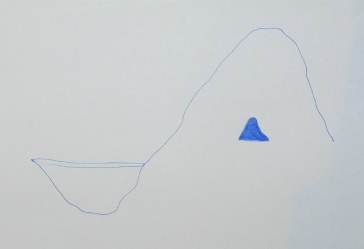
The artist →Jessica Posner has produced a drawing of her own mind after reading the introduction to →Daniel Paul Schreber's →Memoirs of My Nervous Illness for Doug Ashford's course on the Non-Human:
Disturbing Death
In the evening a group of artists dealing with the non-human and two artists dealing with the third meaning linger at the entrance of the Summer Academy chatting, giggling, smoking.
Suddenly a very tall man dressed in black approaches the little assembly asking everyone to be quiet. The giant black man is the Death from the play Everyman. He says the loud noise caused by the artist's conversations is disturbing the play and that the artists should instead come see the play. The artists take the occasion and ask how they would get cheap tickets for the play which is known to be expensive. "Just tell them at the entrance that you met the death and you get the reduced price." the Death says.
The artists wonder about the acoustics of the place. Their laughing and chatting up on the castle is disturbing the Everyman play down at the cathedral? When the Death says goodbye he salutes:"Have fun with your art." The artists answer to the Death:"Have fun with your art!" After a while Bärbel Hartje passes the entry of the Summer Academy. The strange encounter is reported to her and she informs the artists that this Death was not the famous Death from the Everyman play downstairs at the cathedral but the other Death from the parallel Everyman that is staged just around the corner up on the castle.
I personally was not witnessing the whole incident but two attendants of Doug Ahsford's course on the non-human have independently narrated it. Being the Summer Academy's blogger in residence I am dependent on other people's accounts for stories. I am sorry for being inquisitive but that is my job here. Yet when I asked why an artist would only come to the Ashford course in the afternoon and she related my inquisitiveness to the Stasi I felt wronged.
We live in peculiar times when the failed working up of the most recent german history leads to the equation of a reporter's work with that of a torturing and murdering secret police.
Vision and Hope
Didi was the first to introduce skateboards on the german market in the 1960s. After surviving kidney cancer he was diagnosed with parkinson 10 years ago. Didi has attended a couple of painting courses at the Summer Academy. This year like last year he participates with Norbert Bisky saying that Bisky got a bit stricter with his critique compared to last year.
Emmanuel has lived for three years on the streets of Daressalam, Tanzania, before he found his path to painting. He is the project coordinator of the Vijana Vipaji Foundation that is dedicated to "empower artists through local held workshops that enable them to interact with local and international artists in the expression of creativity."
Didi: "We had lunch together and I thought it was a good idea to do something together."
Emanuel: "It is kind of challenging because we work in different styles and we also have different ideas how to do art. I feel very excited to work with Didi because I had to bring my own kind of abstraction to it."
Didi: "There is something like a border in the middle. Emanuel painted on the left side, I painted on the right side."
Emanuel: "We didn't have a discussion like we are going to paint this and this. We just put the plain canvas on the ground and throw the colours."
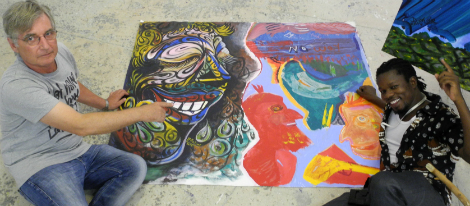
Didi: "The two figures on the right are the politicians who talk. Left is mister Obama and right is Merkel and in between is a revolver. I don't know who shoots whom."
Emanuel: "My figure on the left is responding to the picture on the right. There is a block for many developing countries to come to Europe or to America. But the picture is having some hope because now there are a lot of changes. People now are collaborating, they are working together in terms of economics doing business, people are travelling like this exchange program of artists coming here. So this image has a lot of hope. It has all the colours of the different nations to see a hope for fairness in the future. The eyes are closed because when you feel a very important feeling you close your eyes. Such a feeling you can just visualize by yourself inside. Hope is not visible."
The painting was auctioned and Jean Marc from Switzerland got it for a good price.
Emanuel: "It will have more value for him. The art will remain there. It is not like food that will expire."
How to destroy Salzburg
Drinking with Norbert Bisky was fun but risky. I was too brisk drinking and not listening to Bisky, if I would have listened to him it had reduced the risk. The absinth of course should have either been mixed with water or set on fire for a while as my friend Johnny Bliss did together with the gorgeous painter from Thessaloniki, a city with a recovering alcoholic as city mayor by the way. After swallowing a cup of absinth without any water or fire interference I lie in bed until 4pm the next day.
As my suffering has ended I walk over to the Mirabellgarten where I meet Mister Schaden, the city mayor of Salzburg admiring the artwork "The Gallows" by Roman from Robert Kuśmirowski's public art movement.
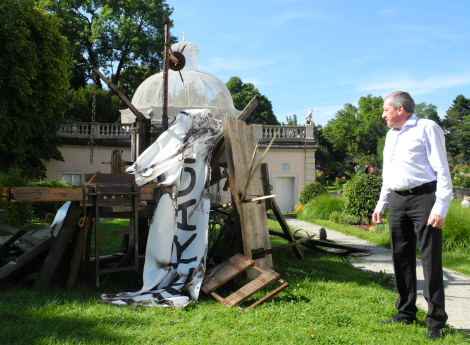
Next to Mister Schaden Stefan leans in the sun.
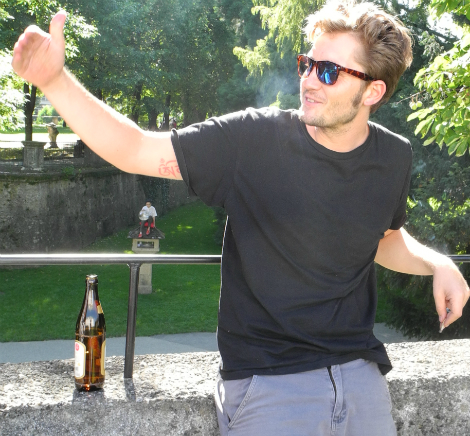
Stefan has cut out something from the grass.
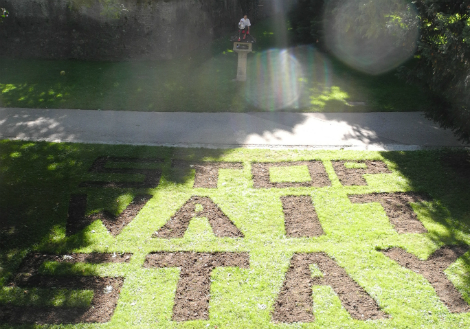
Behind Stefan's "Stop Wait Stay" South African artist Megan Mace sits on a bird feeding house with a fish bowle on her lap.
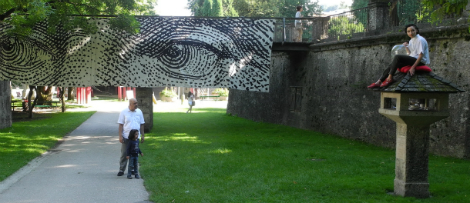
Some goldfish is swimming in the bowle and under Megan in the bird feeding house three more smaller fish are swimming in another bowle on a romantic dinner setting. Megan sits like this for a few hours. "I try not to become attached to the fish. You form a relationship with the fish though, not becoming the fish, that is a cliché, but people look at you the same way they look at the fish. The fish becomes a performer, a spectator and a performer, you look at the fish but at the same time the fish looks at you."
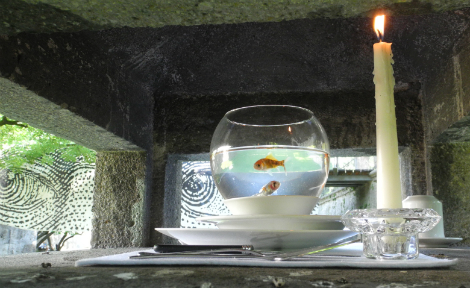
Megan Mace compares the bulgy eyed fish in the bowle with the tourist. Both are somehow secure and fragile at once, locked in a condensed space unaware of what is beyond this space, beyond the glas bowle or the lense of the photo camera, a bubble of reality that remains ignorant of the social politics of the space. The fish has a memory span of 3 minutes very much like a stimulus satiated tourist.
Megan Mace's performance is titled "How difficult can it be to produce public art with fish and bowles?" Megan has been working with fish bowles in public for the past 3 years. Now she is completing her Master Arts program in Johannesburg, South Africa. When she talks about the topic of her thesis it makes me think of →Kevin Dooley.
Blowing in the wind
I meet the artist →Carl Bajandas at a party in the Vogelhaus. He tells me that in between his undergraduate studies in Texas and his graduate studies in Pittsburgh he managed an animatronic dinosaur company. Once he made a reproduction of a military drone with pillow material, a work he titled →soft power.
After the Hurricane Kathrina Carl Bajandas volunteered in New Orleans for 2 weeks. He cleaned out three houses and cooked food for around 900 people. „After a 8 hours drive from Dallas where everything was perfectly normal I was in a place that was totally destroyed. The rules that normally apply to reality just don't apply anymore. So this disconnection between the watcher and the actuality is something that has really interested me.“
In Salzburg Carl Bajandas attends the public art course by Robert Kuśmirowski.
What is the public for you?
„You are the public. I am the public. We all are the public. We are part of a larger thing, the humans, that is the public. Often in art the public is thought about very specificly like 'other people', the sort of mindless thing. But I disagree with that. I think that the public is everyone and the public should be respected in a way that it is expected to be thoughtful. I expect the public to want to engange with the world around them."
How did you develop the idea for your artistic project in Salzburg?
„I was reading the current news and I was looking at the wall of the castle and thought about the economy of this place."
Carl Bajandas and Professor Cäcilia Brown visit the administrator of the Salzburg castle to inquire about the possibilities of Carl's idea to be realized: