Dear punk,
I hope you have a place to stay for the night and everything goes well with your attempted manslaughter accusation. I thought it was a bit strange when you very vocally disdained the poor street beggar on the bridge over the Salzach while you yourself are ... a beggar. When I came home I looked at my bed that you left with black crumbs of dirt. I took the bedsheet and stepped with it on the window sill to shake it out. After shaking the bedsheet I stepped again on what I thought was the window sill. "CRASH!" I fell down on the floor my foot locked in between the window frame and the metal cover for the electric lines. The piece of trash that looked like the window sill was a useless metal sheet glued to the window frame that would only carry light flower pots. My thigh and by back are swollen purple now. My friend Johnny says that you are a fucking rocking roll legend. Looking forward to show you the purple blotch on my body.
Sincerely, blir
Cinéma Copains
While I prepare my apartment for a pancake loving visitor the students of the cinéma copains course are euphorically rushing to shoot their first 16mm movie. Yesterday they had a theoretical introduction into how the cameras work, today they get practical. The participants drew from a lottery one of the 3 cameras: two different types of Bolex and one Krasnogorsk.
Christine, Kamil, Simone, Vera and Verena drew the Krasnogorsk camera. They have 15 meters of 16mm colour film, which make 1 minute and 20 seconds. The group collectively plans the sequences. As the topic of their film they choose water. Because today it rains again and again.
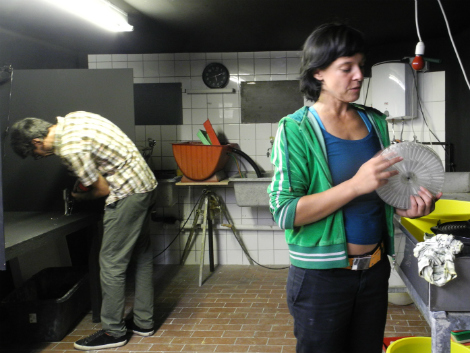
The group after shooting the final scene of their first 16mm film:
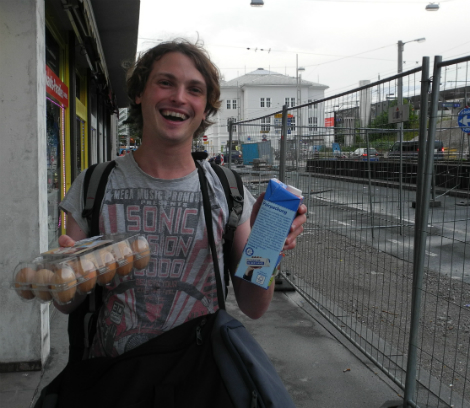
Before we make pancakes I want to show the castle to Johnny. So we take a walk to the city center. In the passage at the Universitätsplatz a begging punk sits on the ground. We offer him some of our red wine and he tells us that he just escaped from Vienna, where he defended a pizzeria occupied by anarchists against raiding police. Johnny Bliss, the punk and me walk up the Salzburg castle to take a look from there east and west. The punk tells his story: he started to drink at the age of 9 becoming alcoholic at the age of 14. When he was 16 the girl he loved was killed by her father accidentally by car when her father was drunk. The punk used to sleep next to her grave at the cemetery and the police would wake him up in the morning telling him he had to leave the cemetery yet he returned to sleep next to where she was buried. His girlfriend's father was a nazi like his own parents are nazis, a fact that would unite the young punks against their parents. After the girl's death the punk would go to her father's house and beat him up every other evening for half a year, the police regularly dragging him out of the house handcuffed. Until one day the girl's father committed suicide. For 8 years the punk has not communicated to his parents. His rage and anger about what they have done to him during his childhood is growing ever since but he thinks they could apologize and ask his forgiveness one day.
Although the punk is being sued for attempted manslaughter in relation with him →defending the occupied pizzeria we let him stay with us at the Mozart Haus. It is raining outside. We will have pancakes for breakfast. On our way home we see firefighters extinguishing fire at the Café am Kai.

How to begin
Sarnath Banerjee enters the room. All of his 17 students and his co-teaching artist Nina Prader have already assembled around a big round table. Sarnath has a cold. His sneezing interrupts his relaxed welcoming speech. Next comes a round of introductions. The first student considers to make an autobio graphic novel and Sarnath elaborates on the merits and limits of the autobiographical approach that carries with it the danger of self-indulgence. Asked about his particular interest in the graphic novel course the next student says:"Theory. I would like to go up on top of the mountain to get an overview."
Sarnath immediately transcends this metaphor. "There are people who have an even greater overview than from a mountain top. They have seen things from an airplane." And he then compares the two kinds of overview: from the mountain top you can see the whole way that led you to where you are now. From the plane you have an overview over a landscape that you have not gone through yourself. In this way Sarnath already links the topic of the first student (autobiographical approach) to the one of the second (theory). Theory remains abstract as long as you can't connect it to your own experience, is how I understand it. The third student is interested in how to create a universe for a comic story, the fourth student works as an electric engineer, the fifth student wants to accelerate the introductions and works as a journalist, the sixth has troubles with how to end a story.
Sarnath connects the topic of universe-creation with the other topics that are already on the table. He asks the electric engineer how electrical diagrams are visually appealing to him and after the journalist has questioned the very deep going and thus slow round of introductions the answer is that this kind of round of introductions is right: deep, slow, connective. The journalistic work of "objective" truthtelling is in a crisis Sarnath elaborates further. The need for subjective and honest truthtelling is served by the graphic novel. I am amazed by the way Sarnath turns the round of introductions into a lecture about all these aspects of the particular art form.
The session before noon is intense. I meet Kamil from Moscow at the coffee machine. He is the only male student in the course of cinéma copains he says with a smile. When I remind him that he has a girlfiend he says something interesting.
When painters meet sculptors
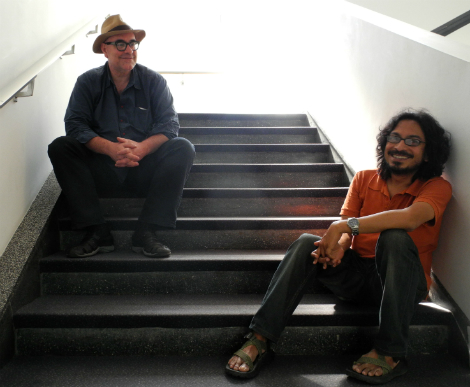
I have an appointment at 4.30pm with Bärbel. We want to meet at the glass terrace where →everything started. Bärbel has a car and drives to the stone quarry at the Unterberg where the painters visit the sculptors. But then I fail to keep the appointment because I bump into 2 gentlemen who just arrive at the Mozart Haus.
Talking about financial constraints: after missing Bärbel's car drive opportunity yet eager to see the stone quarry I take the bus thinking I could spare to buy a ticket. I happen to meet a ticket inspector on the bus. She wants me to pay a fine of 87 Euro. I can't pay the fine due to financial constraints.
At the final station I ask the bus driver about the stone quarry. He has no idea about any stone quarry. So I walk around for a few seconds to search for someone local with stone-quarry-awareness. Suddenly a grey van comes rapidly around the corner. Who sits behind the wheel? Imagine! It is my main suspect for the →crime at Fotohof! (I still don't know wether that was a coincidence or something else.) I mount the suspect's car and the car mounts the mountain up to the stone quarry.
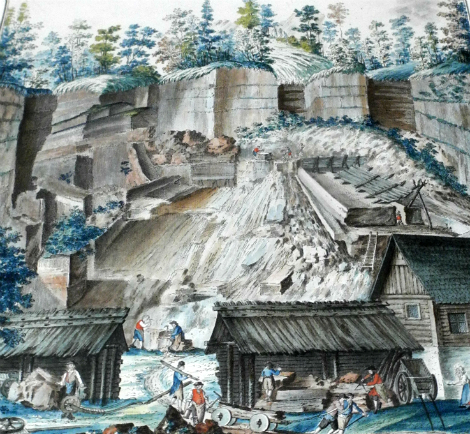
Once upon a time the stone quarry at Unterberg looked like this:
Now it looks like this:
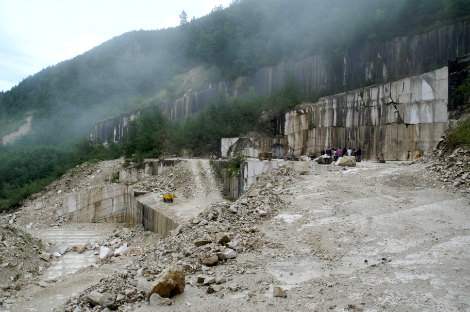
After a thunderstorm, a delicious feast and a guided tour through the quarry the painters and the sculptors get very convivial. Talks about the advantages and disadvantages of 2D and 3D art production reveal that there is a huge gap between the painters' and the sculptors' worlds. The painter Norbert Bisky says his life is flat like his art, that sculpting is too complex and too complicated for him but that he admires the drawings that sculptors make. The sculptor Peter Niedertscheider says that he has a lot of respect for painters and he confesses that he sometimes paints secretly in oil but that he does not consider the results to be art.
The weather at the stone quarry:

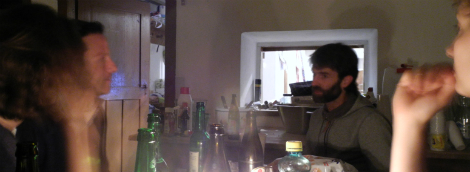
Norbert and Peter discussing:
It is always about completion
There is completion happening at this funny SUMMER academy.
The expanded painting course (Ellen Harvey), the conceptual art course (Jermolaewa/Chernysheva), the curatorial course (Anders Kreuger) and the photography course (Paolo Woods): all completed.
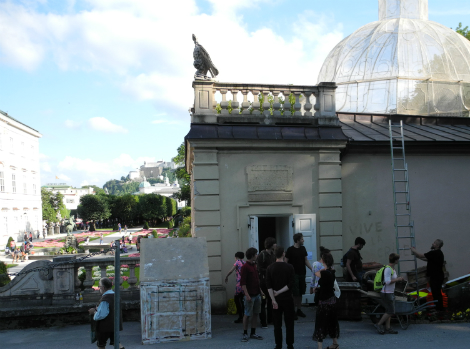
The sculptors, the painterly painters and the public art people are still working. Robert Kuśmirowski removes a ladder from the birdhouse and walks with his public art course up the castle to see the exhibited works:
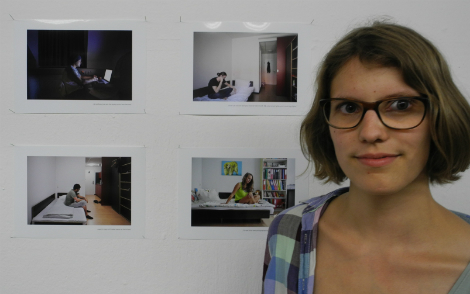
From the 20 participants in Paolo Woods' photography course only two used the darkroom for developing their own analogue photos. One of them is Kamil from Moskow. He went to the trainstation and asked a train operator wether he could take analogue black and white pictures of him. The train operator said: "No." because he was too tired from work.
So Kamil instead took a random train to a small town over the border in Germany where he made digital photos. When he came back he met the train operator again. Kamil told him that he had been in the german village and the train operator said: "You have been to the village where I was born!" Kamil showed the digital village pictures to the train operator and the train operator let Kamil enter a train's engine showing him around the railway switchyard. Kamil took analogue black and white photos of the railyard. He and Paolo Woods are happy with the results.