
Harun Farocki 1944 - 2014
The artist Harun Farocki died on Wednesday at the age of 70.
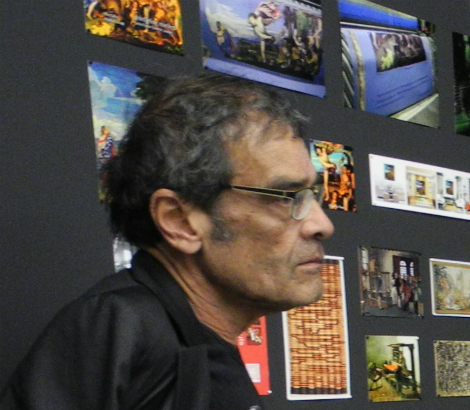
"We admired him and we loved him and we learnt from him, always." Kodwo Eshun writes about Harun Farocki. I happened to participate in some of Farocki's courses at the Academy in Vienna and receiving the news of his death it is hard to write anything. Farocki's philosophical, political and artistic standpoint, his precise and enlightening films, texts and installations are and will remain alive.
At the moment you can see three of his works in Salzburg: "Schnittstelle/Interface" from 1995 and "I Thought I Was Seeing Convicts" from 2001 at the Museum on the Mönchsberg and "The Silver And The Cross" from 2010 at the Rupertinum.
The museum is reacting to the sad news and will also show "Bilder der Welt und Inschrift des Krieges" from 1988 on the Mönchsberg.
Harun Farocki came here to the opening and gave a talk just 4 days before he died.
Meeting Ylva Frick
Let's meet 24 year old artist Ylva Frick for an interview. The first 19 years of her life Ylva lived in a small village in Sweden. Her mother worked as a nurse and later started a window renovation company. Her father being a judo champion retired from his job as computer engineer and now helps Ylva's mother with the company and does some more administrative work at the judo club. Ylva like her elder sister went to a Montessori school. She played the drums at a school orchestra and founded a punkrock band with a friend when she was 14.
After school Ylva went to Gothenburg to work and stand on her own feet. She entered Gothenburg →Konstskola with dreamy drawings and paintings inspired by Frida Kahlo and Salvador Dalí. Ylva now refers to this period as dramatic. After a performance workshop that Ylva experiences like "Yes! This is something!“ her art production opens up to other media.
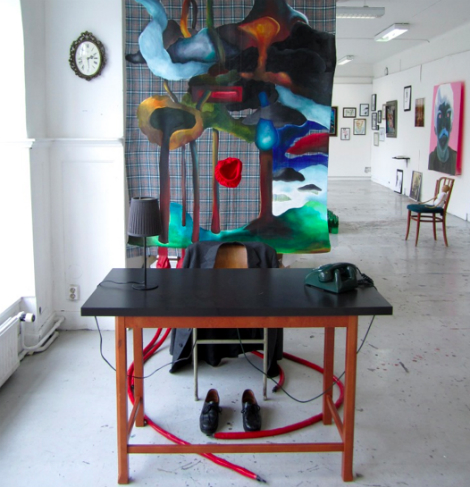
"Slututställning våren" May 2011, from →ylva.frick.blog.se
Two years ago Ylva decided to move to Iceland to study at the →Art Academy in Reykjavík. After the summer she starts the final year of her bachelor's program.
How do you perceive Iceland?
Ylva: When I first came I thought it was not so different from Sweden. The languages are related but Icelandic has a totally different tone. Anders Kreuger could hear that I have an icelandic accent in my english. I had to start an icelandic course and learn as fast as possible to get anything out of my education there.
With the financial crisis and the protest movement shaking Iceland Reykjavík has gotten a former Punk musician as mayor and the country is being regarded for having wise laws on open government and transparency now. How does this political environment have an influence on your work?
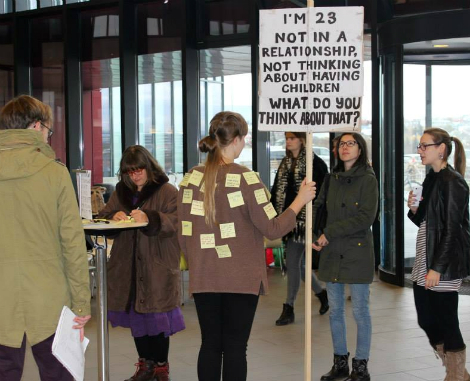
There are two sides to this. On the one hand it is very easy to go out in the streets and do a performance and get accepted, get encouraged. It is very easy to just go out and do things, people will think it is great. On the other hand when you do a political piece you want to break some kind of barrier, you want to work against something and sometimes it feels like there is nothing to work against! Of course icelandic society is not perfect in any way. But it is a big difference going out in Gothenburg or Reykjavík.
How did it happen that you are now here in Salzburg?
Our school regularly receives the program of the Summer Academy. The program with the courses sounded great and I also met people who have been here. I wanted to come last summer already but I was in Sweden then so I applied this year. And I received an Austrian grant.
What was it that caught your interest in Olga Chernysheva's and Anna Jermolaewa's course?
I read about the course „In Search Of An Image“ -how to visualize the heart of an art piece, connecting an idea to an image. I have arrived at a point where I don't want to think too much about a concept, but I want to trust the feeling and I want to trust my eyes, creating my own visual language the course sounded interesting to me.
How does the course go so far?
I really enjoy it. We have very interesting discussions. It has practically been us showing each other both older pieces and also what we are doing right now. From when we meet in one day to what has happened until the next day. We go through anyone who wants to show something and that can be someone who wants to show another artist's piece just for inspiration or to connect it with something that we talked about. We are a small group of 9 people and we are really lucky because otherwise we could not have this format of getting to know each other and talk in the way that we do.
And your course is also focussed on reading quite a lot?
We have not been reading too much. We read three of Walter Benjamin's essays and we were working visually from them. And we are working with Anders Kreuger's curatorial course. All of the participants in his course have written descriptive texts based on images that they got. We received their texts but not the images and we are supposed to create images from the texts. I am still working on how to visualize it. First I considered to visualize it by just drawing or painting it. I did it rather abstract but it just felt like an exercise. Then I made a digital roman mosaic through a website. The text that I chose is a very precise description of a woman's portrait. The description is more exact than when you would talk about a person. Now I have put up an advertisement saying:“Hi there! I am in search for a person that fits this description: pale blue eyes like the summer sky, warm and receptive, a brow line that tips forward casting a soft shadow and dips sideways towards the right shoulder, a sway of terracotta red hair that moves gently in the other direction with rube red lips that are calm and compassionate. If you yourself fit this description or know someone who does please send an email to ylva.frick@gmail.com. Best regards, Ylva“ I have put up 50 of these ads all around town. The course is called „In Search Of An Image“ and now I am in search of a person.
_
After I switch off the microphone I ask the artist were she has been in the night between the 23rd and the 24th of July 2014. Ylva Frick refrains from answering that question.
Salzburg from behind
We meet at Cafe Central in Dreifaltigkeitsgasse 3.
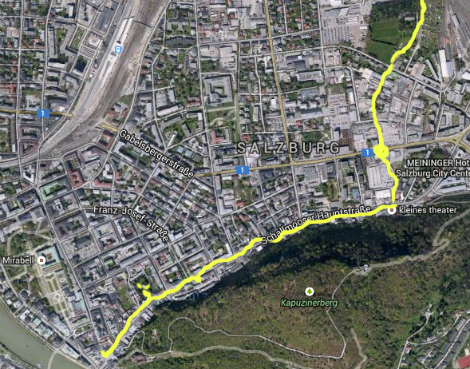
Three members of the →Bureau du Grand Mot sit at their Wednesday 3pm regular's table placing thirty fingers on the round table's surface. Slowly their fingers begin to flounder. The three friends' hands stretch hesitantly to the table's middle. They →touch in the middle and all of a sudden their arms draw back and now the knees gradually start lifting the bottoms. The movements' choreography is steered by the six eyes of the friends. They won't speak a single word for the coming 75 minutes. They speak solely through the body, eyes, shoulders, feet. Now they get up from the table and the walk starts. A group of 30 people follows the three performers into Linzer Gasse. The silent walk touches sites of →memory: the deportation and murder of Salzburg's jewish citizens, a visit to a graveyard where a silent game of hide and seek gives a glimpse of how to mourn the loss. From the graveyard we walk to a former grafitti wall that was painted white by the city. Then we enter Peter Handke's regular bar where we listen to the jukebox →playing the Beatles. We continue to the concert venue Rockhouse, the salzburg experimental academy of dance and the kleines theater and learn that it was only in 1971 that the ban on alternative cultural events during the Salzburger Festspiele was lifted. We meet Mozart who rhymes God with fraud and receive a blessing by a romanian orthodox priest in a chapel made of wood. At the end of the beautiful walk we occupy a pizzeria and since it is the end of ramadan we eat and eat and drink and drink.
Thank you Bureau du Grand Mot! For me you have solved the biggest problem of european thought: the separation of body and soul. You prooved elegantly that mind and matter are one.
Waking up at war
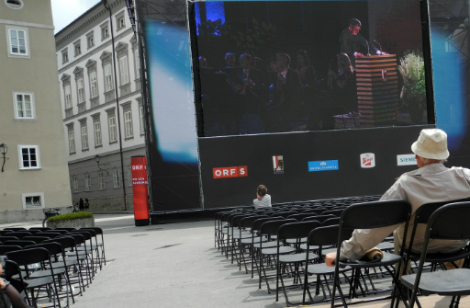
Today 100 years have passed since the emperor of Austria declared war to Serbia starting the unimaginable mass murdering that is called the first World War. "Either man will abolish war or war will abolish man." The quote by Bertha von Suttner was quotet at the official opening of the 94th Salzburger Festspiele. The tidy speeches were rhetorically stirring but the level of analysis failed to touch the current complicity of the local elite in fueling armed conflicts all over the world. Austria is an arms exporting country. If you want to abolish war, stop selling bombs!
So when the historian Christopher Clark talks about how the outbrake of the first World War surprised everyone - when the Reuters news agency received the telegram "Sarajevo Ferdinand Assassiné" they interpreted it as a Grand Prix horse race result, the winning three horses named 1.Sarajevo 2.Ferdinand 3.Assassiné - the speech serves as chilly entertainment only reminding us that peace is never for granted.
Who really listens to what the historian has to say?
War is the absolute crime. I think it is possible to get rid of it one day. But isn't it necessary to abolish violence and crime at the roots? If we don´t solve smaller crime how will we solve the biggest crime of all?
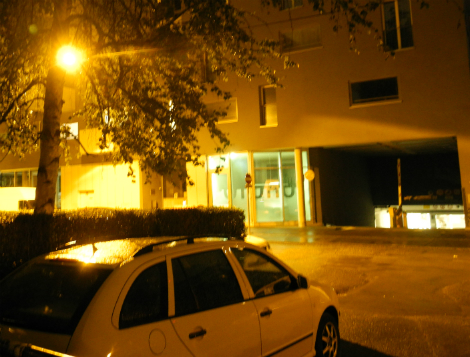
Here is the scene of the burglary ↓. I am waiting for a call from the police.

Sleepwalking
On my fourth day in Salzburg I felt homesick for three minutes. Now that I survived the first week I feel at home here. You do find viennese people a lot in Salzburg these days though. The editor of the newspaper der Standard walks with his son by the shop Salzburg-Salz, where you can get whole brick stones of salt cut out of some mountain. The director of Vienna's People's Theatre sits at the Café Tomaselli where you can get sweet strudels that are just ... perfectly expensive so I only have one a week. Tomaselli is in the house where Mozart's wife raised the kids after his death. On the street between Tomaselli and the University's law faculty a little skeleton is dancing and singing "Tutti Frutti, oh Rudi!" The skeleton produced from carved wood is skillfully made to sing and dance by the puppet master who pulls the strings. The art dealer Ursula Krinzinger is enchanted by the show and throws a coin into the suitcase on the ground. She walks leisurely from the Churfürststraße into Sigmund-Haffner-Gasse and on the corner to Franziskanergasse she puts on her sunglasses just to take out her purse again and she hands some money to a beggar sitting on the ground. On the very corner I see the politician Peter Fichtenbauer, member of the extreme right party FPÖ. As people's attorney he lately surprised positively: he stepped in for an asylum seeker who had waited 18 years for having his asylum application answered. Now he asks a policeman where to find a cash machine. Ursula Krinzinger walks on into the Rupertinum. She visits the exhibition Art/Histories and takes a look at the photos that show the house where Leo Trotzki lived exiled on a turkish island from 1929 to 1933.
I meet the main suspect of the crime at Fotohof at the bar Denkmal. In order to study him I take him to an art opening and make him drunk on the way. At the bus station we meet a young lady, a fellow student from the Summer Academy who smells of booze. I share a bottle of red wine with the main suspect and he tells me about his art: photo shooting. On a bicycle trip he had met a homeless man who blabbered him full for an hour while the suspect made only three analogue photos. I think that is strange, I just made ... like a couple of hundred digital photos within the same time period. Is the probability not much higher that I have a cool photo? So we chat about such things and the suspect says that the photographer Paolo Woods who gives the course at the Summer Academy once was abducted by some Taliban which made him stop reporting from war zones. We walk along the pond at Leopoldskron and around 9.30pm we finally arrive at the gallery opening. A painter from Kraków is exhibiting, Bogumil Ksiazek. The gallery owner says she had to protect him from all the women around because Bogumil is admired for his physical appearance. I say the two sentences that I can say in polish to Bogumil: "Luckily I am not an artist. My life would be difficult if I was one." Bogumil tells us about the clochard Hermes who lives on the streets of Kraków. Bogumil befriended Hermes and painted him repeatedly in oil. We continue redwine. The gallery owner and her husband, a doctor in Hallein, want to take us to their appartment. Here there is even more art, she shows us the room of her son without asking him or knocking and the dog starts barking like mad. So we thank them and leave together with a chinese piano professor. It is late but I still don't know enough about the suspect so I take him to the Felsenkeller, a steamy club inside the mountain. I don't know very much about what happened there.

