Establishing the darkroom
I need to go for a pee. But first I have to write this down, because I have to get it out.
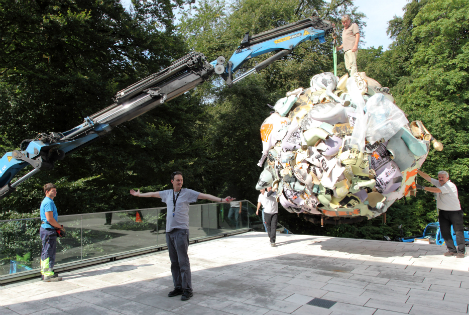
Although Salzburg looks like a very peaceful place crime is happening here. Rainer Iglar took the photo the other day of Andreas Siekmann pointing where his sculpture should stand. I had no camera and could not take a picture myself, so I suggested to him to go over here and there and here and take this or that or this photo. "I don´t take directions!" he said. And I had the impression that he was under some kind of stress that had nothing to do with the scultpure or the sculptor or the photo taking.
I was right. Now I know why Rainer was stressed. The night before someone broke into the →Fotohof and all the computers were stolen. So far there is no clue to who did it but it happened between 8pm and 8am. The nonsecurity locks were broken up, computers gone, no art stolen. The data is safe anyway somewhere on a server. But it is a real annoyance and it makes me sad. I asked Rainer wether there are no pix from surveillance cams. "We have no cameras at the Fotohof." he said.
Immediatley I started to feel Sherlock Holmes. I asked all people where they had been between 8pm and 8am the night between 23rd and 24th of July 2014 and I started to suspect everyone. There are 150.000 people living in Salzburg with a couple of x thousand visitors.
What is the police doing?


Privatized Trickle
What does the public want?
Ellen Harvey, the british born US-based trained lawyer and installation artist is an excellent speaker. But when she said the sentence "All art is public." at the lunch talk (that is open to the general public like all the lunch talks at the castle) she made me frown. I think of → this.
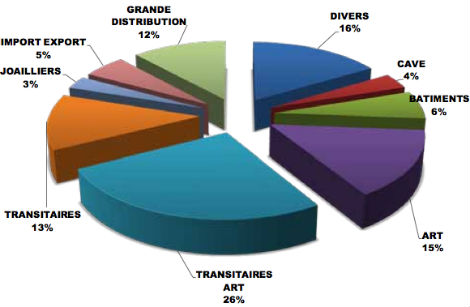
For me it was the most horrible cultural experience I had in the past years. The organizers wanted to squeeze as much as anyway possible out of the participants by establishing a 24/7 round the clock event program in an almost criminally inhuman manner. I remember Anna Jermolaewa's fresh movie about the social upheaval in Moscow having its screening around midnight.
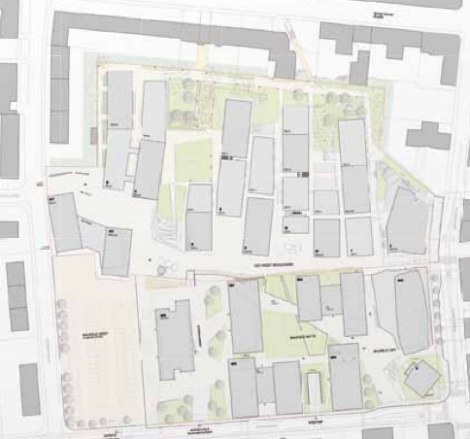
I was reminded of this when Sarah Untner gave her guided disctrict tour lecture and Andrea had to translate. Sarah repeated a few times that she had not expected so many people to turn up for the tour and her euphemist PR-talk sounded accordingly. Every time I asked a question I would fail to get an answer.
Day number 2 - Pancakes is possible
Dear Johnny,
I will make some pancakes for you. I got milk, I got flour, I got eggs. My room is number 230 in the Mozart Haus, named after the composer guy who never was an Austrian. The pan in the kitchen is tiny though as the kitchen is itself. My apartment has one fork, one spoon, one knife. It is a space for the lonely life of upcoming violin virtuosos.
When I woke up this morning I already felt at home here because of a sound.
It went "Härrhhhhääääääääääääääääääämmmmmmmhhhhäääääähähähähä!!!"
And then "Täkkkkhhätttääkkätäkätäkätäkätäkätäkätäkätäkäätäääääääähhhhh!"
Next to the Mozart Haus is a construction site that sounds just like the one next to where I live in Vienna. The nerve wrecking noise starts at seven in the morning. In between the drilling and hammering I heard sparrows this morning that I don´t hear in Vienna. Since the carriage horses in Vienna are obliged to wear diapers their excrements are no longer soiling the streets and the sparrows can´t do what they fancy so much: picking the oat grains out of the horse dung. In Salzburg you have horse droppings on the streets and the sparrows twitter about everywhere.
I go to this thing, the, well, I went to the - yes! - the Summer Academy of Fine Arts of course. That is why I am here. Today is day number 2 and Gabi Winter invites me to join the daily staff meeting in the director´s office. I am told that everything that is being said during the staff meeting remains confidential and shall not be reported on the blog.
So what can I report?
I am slowly realizing what this whole Summer Academy actually is. Honestly, it is a megalomanic enterprise. In the year when Joseph Stalin´s heart stopped beating and two guys from Nepal and New Zealand were the first to climb the top of Mount Everest a 50 year old art dealer who got big selling art stolen by Nazis and a 67 year old painter who had volunteered for World War 1 after his girlfriend broke off - she had already survived her husband, a composer and opera director and she left the painter for an architekt who himself was a founder of the most revolutionary art school of the century and she left our painter so deeply heart broken that 3 years after the break up he had for himself produced a body size puppet of his ex-girlfriend to overcome the loss - well, the painter and the dubious art dealer started a school to learn how to look properly at the world from the almost 1000 year old castle of Salzburg. In a nut shell.
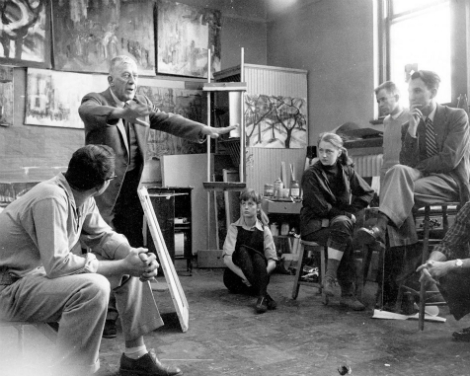
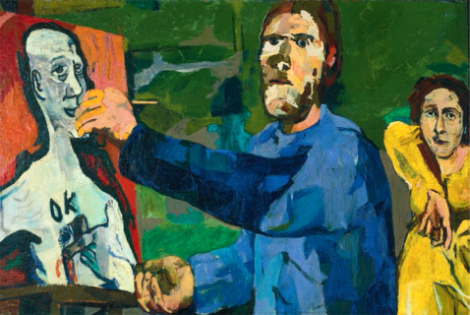

The other evening we talked about this picture. ↑ It actually does not show what people thought it would show.
Birth, Death, Art, Life, get ready for some existencial shit when you come to Salzburg, Johnny!
Welcome to Salzburg
My father´s family name being Tagwerker, and my given name Lukas, I now call myself blogger in residence, or blir if you will. Until the end of August 2014 I will write for you every day from Salzburg.
How did I get this job?
Thanks to my former flatmate Irene who had forwarded the email announcing this job I met the director of the Summer Academy Hildegund Amanshauser for an interview. She openly adressed her fear of me mocking the Academy with cynicism. I spoke of two kinds of cynicism, the first being cold, bitter and resigned of the world; the second hot and sweet, amplifying contradictions up to a melting point of reconciliation. I promised not to engage in the first kind but that I would apply the latter.
Now, very recently I had a conversation with a refrigeration engineer. He told me that cold does not exist. If that is true then my thermodynamic metaphor for distinguishing mental attitudes is flawed. My theory of hot and cold cynicism worked well as intellectual imposture. It helped me become blir. But how to go on with the problem of cynicism? The power of accurate observation is commonly called cynicism by those who don't have it, somebody said. If the temperature of my moody writing goes against your thermal needs, I ask you to comment. That shall be our remedy.
I will practice accurate observation without damaging my →brain.
In the train from Vienna to Salzburg I read Hofmannsthal´s play →Everyman, a crying baby distracting my attention. When I was about to get back into the text´s rythmic rhymes the baby´s mother would unplug her shiny nipple from the baby´s mouth and the greedy little kid - older than one year - started to cry again. So I read Everyman with interruptions. When the child was drinking its mother´s milk I was with Everyman and his struggle with death. When the mother unplugged I had to unplug from the drama. I found the play very silly. If you haven´t noticed by now that you are mortal Everyman will teach you a lesson though: you are mortal. The idea that only work and belief give relief in the hour of death make the play a pseudoprotestant meditation. In the end Everyman´s works are too weak to save him, so he is solely saved by his belief: pure roman catholic salvation ideology, welcome to Salzburg! I brought luggage for the coming six weeks and if I had planned the place in front of the railway station I would not have hidden the taxi stand behind the luggage deposit containers.
I come 15 minutes late to the dinner party. At the entrance I look up and see all these teaching artists through the glass floor of the terrace.
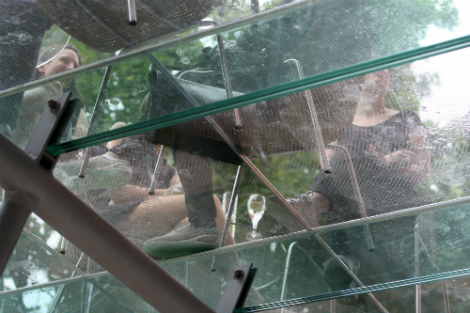
The athmosphere at the gathering is between overexcited and underrelaxed or is it the other way round? Some kind of tension is in the air. All of the artists have days filled with multiple tasks ahead of them. All but one: Raimund Stadlmair prepared everything for the summer academy and will soon go for holidays. Being the only really relaxed artist at the dinner he speaks of → Ikaria, a greek prison island where 13.000 communists were incarcerated during the greek civil war, among them → Mikis Theodorakis. Raimund visited the island some years ago, then he got involved with the Summer Academy, then the financial scandal rocked Salzburg, then the budget of the Summer Academy was reduced so that this year there is no teaching activity in Hallein, which gives Raimund the chance to spend the summer on the former prison island.
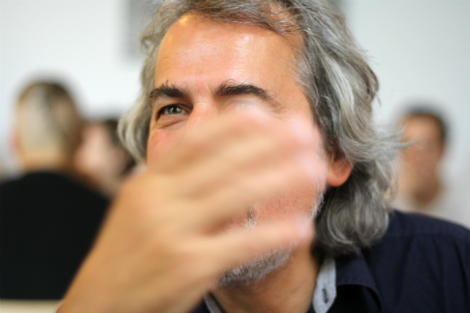
Raimund´s dinner is steaming from the plate while he summarizes Salzburg´s history for me. Napoleon secularized Salzburg in 1803, Mozart never was an Austrian. While Raimund talks about his PhD thesis in history his dish, the delicious fish cools down. Raimund researched Austria´s printmaker´s unionizing between 1847 and 1914, the printmakers being the first to build a union. The fish is finished, a curd cheese dessert is served.
A group of artists stays longer and wants to go to a pub called →Andreas Hofer. We go there and find it already closed. At a kiosk next to the river Salzach Raimund invites all of us for some beer and two tiny little mice flit around on the pavement adding to our entertainment.
Guess whom I met the next morning?
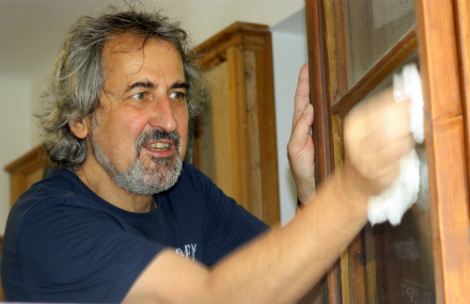
"When the students arrive everything has to be clean!" Raimund says wiping the window.
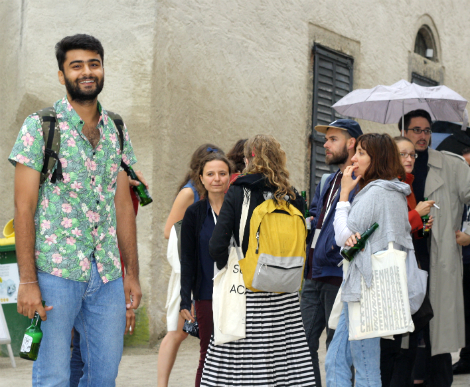
And here they arrive, 114 learning artists, some facing their mortality with their work, others with their belief, all go through registration. There is a hustle at the office of the Summer Academy: a phone call for the milk, another one to find out when the New York Times is coming, Kalim from Moskow wants to change 100$ into € currency and Kathi rushes to collect lunch orders for the next day.
I want to see the Galerie 5020, where Robert Kuśmirowski´s public art course takes place. After searching for it I realize that I better should have written down the adress. I thought I would remember the spot on the map in the city centre so I turn and turn again in between the same narrow alleys until I bump into Prateek, his name means symbol or sign and he is hungry. The first time I met him was an hour ago at the Summer Academy when Prateek was thirsty and I ensured him of the tap waters drinkability. We get to know each other a bit eating and walking through the city. Prateek says it can happen that the more you try to be yourself the more you move away from yourself and that he is amazed by his room´s window handles that not only open and close but can also tipp the window. When we return to the Summer Academy inside the Castle of Salzburg Pakreet is reminded of the Portughese built fortress on the prison island of →Diu in India. Another prison island talk. I tell Raimund with whom I had the first prison island talk about my second prison island talk and he compares the location of the Salzburg Summer Academy itself with a prison island.
Welcome to this island! And feel free to stay!