Austrian Eco-Label

After an almost 2-year-long process, we are very proud of being awarded the Austrian Eco-Label for adults educational institutions. That means that our programme has qualified as "education for sustainable development" . The process included working on a mission statement which now presents our ambitions in terms of social, educational, and environmental aspects.
Next Summer Academy
will take place from 21 July to 30 August 2014. Application will be possible from January 2014 on.
The end , part II
KP: So, where are you now?
KP2: Vienna.
KP: All in all, are you a professional?
KP2: Shut up.
…………………..
I knew about the trick from last time, from the ending of the open day of the first group. I knew about the end even before the second group of classes started their work and decided not to be so attached. Passing few classes in Alte Saline and at the Hohensalzburg Fortress I wondered sometimes how the students will take their works back with them, or even if they will take them. After all, we know that the Heinzelmannchen are probably working on cleaning the space faster than I am coming up with words to describe the last open day of this year’s Summer Academy.
The day started earlier then last time. This time we had three different locations to visit, and the Kiefer Stone Quarry was the first on the list. (KP: Oh, mention the weather, this seems to be your thing. KP2: It was sunny.)
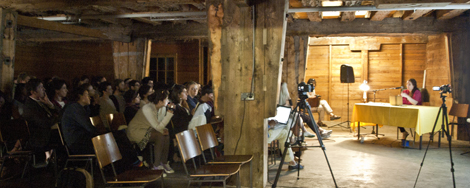
To visit the stone quarry in the morning, was what I needed. The small gallery space, underneath the rooms where students were sleeping for four weeks, showed us some of the work that the students did. The collaboration between two students, Nina Nowak and Ragnhild May, continued and it showed itself to us in another video work. What was really nice to hear is that the two students who met here will go on to exhibit the video made at the Stone Quarry in Denmark. This is just one of the amazing things that happen at the Summer Academy. People meet and decide to continue on together.
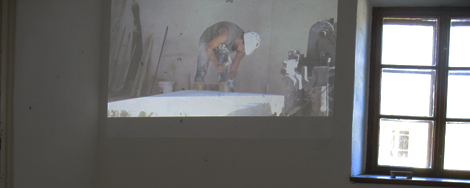
I enjoyed seeing that the quiet atmosphere of the space, and I know that this is really a paradoxical idea since probably this was the loudest space to be in during the Academy since the early start of the working machines would carry on for few hours, was not disturbed. Some of the sculptures of the students presented to us close to the entrance of the quarry, differed really slightly from the stones that were there before the students came and worked on them. The difference would be noticed only if you come in close, look and touch the polished surface of the stones. Again this subtlety in the intervention at the stone quarries and in the way of working with stones is in the end very important for the lecturing artist who for the first time took over the sculpture class, Doris Schälling and Jörg Enderle. The works on display did show us that lingering and important idea.
The visit later to Alte Saline was a surprise. It seemed to be more buzzing and with maybe more things to see. The building was truly used to its last capacity. Well, this is what I thought since in relation to the last time more rooms were used, the ones I didn’t even know existed. The photography class of Katharina Sieverding at the entrance hall to the building transformed the space with the printed large scale photographs. Black and white on the white wall, I got the feeling straight away that this group means business and it was not surprise to hear about the great team work and the open spirit of the lecturing artists and her assistants. The focus was photography but some students decided to showcase video works as well. This openness was evident in all other classes at Alte Saline in fact and there was a lot more to see so you could not help it but walk around the buildings many times.
The Hohensalzburg Fortress came later in the day and it was nice to see that the atmosphere was also very much alive, even though by the time I got there most of us were feeling the strains of the time we spent here.
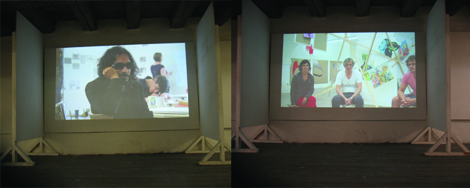
The works of all the classes stood with this aura of professionalism. I know, one needs to be aware that this is not simple word to use but I feel comfortable in using it here. The video works of the Olga Chernysheva and Anna Jermolaewa class really requested time from the visitors and it was great to see that they got just this. Visitors didn’t give the works the usual glance that is more often than not noticed at different art openings. People were sitting down and were engaged in the space and the works. This was also evident in the two other classes at the Fortress,” Narratives through text and image” by Sarnath Banerjee and “Rock the Paint” by Hanspeter Hofmann.
Let me admit that while I am writing this I feel like I don’t want to exclude anybody or leave out any work or class. This is something that would make this text go on for miles and miles and at the moment it seems that it could go on forever. So, I need to finish and think about writing something more again. What happened here requires time for all of it to slowly come down to the bottom of my cup and give my words its flavor. The flavor of the Summer Academy in Salzburg requires time to process and no rushing.
As I hate goodbyes I will only say, I will write to you all soon.
soon we return home
KP2 to KP: I will read it out loud to you, it is no problem...
Dear Ksenija,
We are really thankful for your interest in joining our team. We received over 229 applications and it was really difficult to make a choice for the top candidates and later to finally choice the person that would be able to take on all the responsibilities that the position calls for. Unfortunately, and regardless of the high quality of your resume, this time you are not the right person for us.
Sincerely,
Cultural Center REX team, Belgrade
KP :https://soundcloud.com/summeracademy/sound-of-disapointment-wma
............
The fear of returning home is something that just got stuck in my mind from the lunch talk that lecturing artist Sarnath Banerjee gave to us on Tuesday." The full letterbox with unpaid bills, dead flies in the window, will I have internet when I get back, and did I turn all the machines off..." It echoes in me and I notice that everything that is happening now, here in Salzburg,has this melancholic element of something coming to an end. There is this element of the rush, students are working for the open day happening tomorrow, technical staff is coming in and coming out from the different doors and the photocopying machine seems to be working more than usual. Similar to the rush felt at the end of the part I but this time for some of us that were here from the beginning it is this final goodbye.
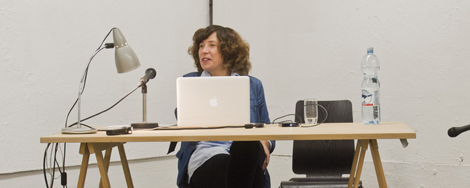
Sarnath Banerjee during the talk told us many different stories. He opened the talk by saying that he is not so good with words, possibly a trick to play the expectations down, but from the moment go we were transported into different world and words of Berlin and different cities in India. They all have a common element to them and that is the style of the drawings, few repeating characters that accompany Sarnath Banerjee's column written for an Indian magazine. At the moment his writings are helping him get the sense of the city he lives in today. Feeling that he doesn't understand it, and maybe doesn't want to understand it, he decided to accept the invitation to write. Sometimes, similar like the character of Rambo, he receives the call telling him that the art world needs him and then he starts to feel like an artist. On other occasions, he is the graphic novel artist, writer of books, father, husband, slow bicycle rider.
"Is there next? Is there going back?"
With greater political sense and more immediate urgency these questions also echoed the lunch talk of lecturing artist Anna Jermolaewa. She moved from St. Petersburg to Vienna and slept on a public bench for five days. She used the same park bench and in her video "Research for sleeping positions" (2006) reenacted her attempt of sleeping on it. Without the biographical element this video would have a very humorous note attached to it but once the information was given to us the work receives a different meaning of different destinies, different cultures and this disturbing note of moving away in search for something better.
When you move you are still hoping that something back home will change. Unfortunately the ongoing project that Anna Jermolaewa started in 1996 "Five year plan " where the artist on her trips back home to St. Petersburg films her metro station and people on the escalators, shows how little some things do end up changing or maybe ( to be a little bit positive here ) how slowly these changes happen. To the artist, once she showcased four channel video projects it was interesting to see just this.
The reality of her world is really an opposite to the reality we all seem to have here during the duration of the Summer Academy. This was more than evident in the video she showed to us "Methods of Social Resistance ". The existence of something else then this is what echoed in me, the idea of the unguarded space of the "real "world.
http://www.jermolaewa.com/works/video/methoden.html
The Summer Academy seems to be this little bubble from the rest of the things you know as yours. It is a welcomed change, escape for some and place of freedom, experimentation and art production. The things form the world you left behind at the start of it all slowly are creeping up for all of us here. Plans are discussed where to go next and what to do next, but until all of this happens the show of the works created in the second half of the Summer Academy is on display tomorrow. Three different locations, Hohensalzburg Fortress, Alte Saline and Stone Quarry will be places to be in. And then, we will again meet with the Heinzelmannchen who will , like with magic, make it possible for all to be reapeated next year.
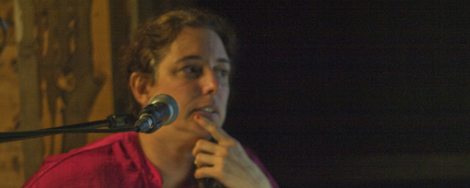
The talk
KP: It finally happened.
KP2: Finally. Not that the lunch talks before were not interesting. But this one left an echo, bitter taste, for some admiration, but a lot of questions for sure after it was finished.
.....
Even on Saturday evening, while most of us enjoyed our white wine and Aperol spritzer, the topic of the lunch talk organized by Tania Bruguera and the discussion that followed the talk with Christoph Draeger popped into conversation. A day later and it still caused heated reaction or at the most interruptions in so far very polite politics of first listening and then asking or answering.
The talk on Friday concentrated around a topic of "Useful Art" (Arte Utile)" by which artist actively introduce art into society's urgent social, political and scientific issues". Just introduction to the burning questions is not enough to be useful art; it requires sustainability within a very specific and localized community where the burning issue in a sense originates from, evident change after the implementation of the project is carried through and in the end a solution to the problem. If solution to the problem is not provided then it is not useful art and the search for the solution is still on.
Two very different stand points of what art is where presented to us. On one hand the idea of the autonomous art and as its counter point useful art. The two differ in their approach to problem solving. Questioning and internalizing of the dialogue leads in Tania Bruguera's point of view to an autonomous art, art for art sake, while the approach in a more active manner to problem solving leads to the idea of useful art. This caused many questions and I am not sure how many people Tania Bruguera managed to convince. A lot left the talk questioning the use of art esthetics in such a project, definition of art, role of the art. Is this concept a new concept? Is what we consider to be socially engaging art just art of raising awareness? All the burning questions that happen when a certain shift in the look at the function of art happens. But in the end, question was asked, is art moving into a completely different spheres that of social work and politics. A social worker was in the audience during the talk and she was not able to answer if the examples given are examples of social work projects or art projects. Tania Bruguera founds this ambiguity to be a good sign since the set definitions are becoming more and more blurred.
Christopher Draeger quoted Ad Reinhard and explained that this is his favorite quote on what art is "Art is art. Everything else is everything else." It seemed that for every point during the discussion a possible counter point created itself. Two artists for sure presented their different points of view in a convincing manner but both were open to listen to the other points or questions from the audience. Such questions were considered very useful.
It is evident that Tania Bruguera has a big project in mind, the one that she herself worked on for many years on and off. In the last two years she decided to focus her attention, to use her gained name in the art world to raise awareness and create a change. Many leaving the talk mentioned that they are interested in seeing how all of this will unravel but also there were others that reacted very emotionally to the talk and were not at all taking what the talk was about with ease. Let us see what will happen.