Thousand words
KP: Hey, KP2, do you remember when you were a young girl and you used to ask your mother what you should dream about before going to sleep?
KP2: Yes.
..............
Everybody is working on the works for the show. The last week of the first set of classes came faster than I thought it would. Some say they had enough time, some say that the process for students and their work has only now began. The working rooms are buzzing and I do not dare to enter. We all know what it is like.
It is really beautiful to see that the hands of students listening to the today's lunch talk of Leya Mira Brander are dirty. The ink is underneath their finger nails. As the students and the rooms that they work in changed so did the lunch talks as well. There is less and less talk about the questions of who is who in the art world and I must admit that I like this more. This way not only do you learn more about the lecturing artist and their method of working you are also left with a sensation of what are the main issues that the artist focuses on.
For me, the lunch talk today was like entering into a carpenters shop and looking at all the things from a magical and dreamlike land. The combinations of the copper plates that the artist uses for her create a sound. It is this game that she is interested in, in the little shifts that not only change the rhythm of the work but also the perception of the work even for her. She likes to be surprised even though the process of printmaking is not really one that you interact with and just relay on chances all the time. The process and working in the printmaking media truly takes you into this world not only of magic but science, mixing of different elements and for sure dirty nails that you are proud to walk around with.
The works today showed us a very personal approach to her art production. Leya Mira Brander is still using copper plates from the beginning of her carrier and she mixes them with the new one she makes. Similar to the project she calls "Thousand words (Mil palavras)" she confesses that she must have around thousand copper plates as well. She uses them in different ways, printing them all together or taking for the next print just the words from the previous image and mixes with new or old plates. The act of cutting into the plate and cutting into the paper to create these three dimensional works is to the artist action similar to the surgeon cutting. The final product, popup book is to me a theater stage. The depth of the space is created by different layering of prints. Even the shape, the box, is emphasizing this idea of the stage and of storytelling.
The first night I came to Salzburg I felt that all around me is a stage and that I am only one of so many puppets on the string that move around and tell a story if somebody is there to listen to. The city, beautiful and almost frozen in another time of hoarse carriage, monumental sculptures, fortresses and fountains is like a popup book. I am just one word in it.
How to cope with reality
"Art is rebellion or it is nothing" Mike Kelley
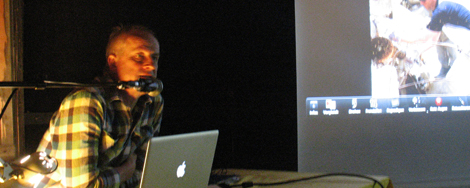
This idea of demolishing and creation after the destruction is something that seems to be important to the lecturing artist of today's lunch talk, Thomas Kilpper. He started working first in the media of printmaking but today he invited all of us who are interested in that side of his work to visit the house that will at one point be demolished where he is working alongside with his students, now entering the third and last week of the first set of classes. He chose to concentrate more today in showing us and talking later with the audience about his projects that are in a sense more political and more community conscious.
He doesn't consider himself a political artist even though he believes that every piece of art is in a sense political in its nature and he tries to reflect at things politically. The projects he spoke about today reflected the questions that he seems to be extremely interested in and that is the role of the art today and if it is possible to create a piece of art work in a war occupied environment and to make a difference or to start a change in that community. On one of the project he worked alongside with the Palestine community in creating a sculpture of a horse out of the scrap metal. The metal spoke many different stories of tragedy in the war stricken community and one of many is a story of a doctor that died in the ambulance car. The piece of the ambulance car is now part of the horse that was carried through the streets. The horse in the Palestine community is the symbol of freedom.
His interest in acting globally in a sense but as a means using something that could easily be considered as a universal symbol found his way in a project he started working on in relation to the question of immigration at the island of Lampedusa. Up till now the lighthouse he wanted to create for this island, this big rock, as a symbol of welcoming and undermining the European policy to block the passage to Europe is not done on that island. A model of how the artist would wish the light house to look like traveled around different cities in Europe. In that way the idea even if it is not completely finished is still working in this manner as a symbol and a metaphor to the issue he wishes to put a focus on.
The ongoing conflicts of inequality in the world are something that pushed the artist to move away from his medium and to start working on big pieces for the public space. That for him was a must. No questions asked. It would be easy for him to accept to work on a project in Palestine and to continue painting or printing in his studio but in that way his hands "would not be burned". Thomas Kilpper is aware that he is living in the space of reality and that our world often is not a normal one.
"We have to do what we ought to do...This is reality and we have to cope with the reality. I am not living in the place beside reality and I am part of it. I think art is part of all societies and I think art always deals with the contemporary otherwise it is not art".
So using the words of Thomas Kilpper that he used to start the question part of the lecture talk acting as a reality check for most students "It could be a very good idea to go back to work as we are having a show on Friday".
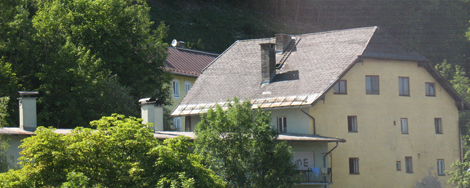
Start of the course Stone quarry intervention
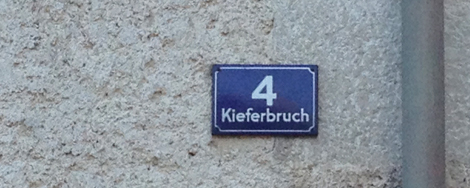
Story goes that stones speak to us and heal. Some approach them to release the objects inside it and some to emphasize the beauty of the stone even further. Nevertheless, working with your hands and having a real sense of the material in front of you must be an amazing feeling.
Already after the second day of the start of the Summer Academy I was looking forward to visiting the third location of another class organized at the Kiefer quarry in Fürstenbrunn, run by Doris Schalling and Jorg Enderle. I was not the only person interested in visiting the place where there must be stones and sculptures of the last years of the students work everywhere. Well, that is what I imagine it to look so far. And so today an email comes my way...
"Dear Ksenija,
I hope you had a nice Weekend! Greetings from the quarry! Everybody has arrived safe and sound. Our course has started. All the best."
Soon for sure I will write about this place.
Days of occupation
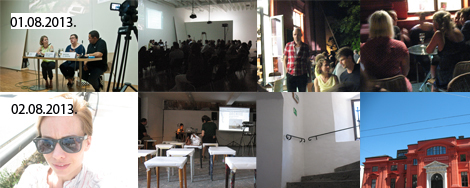
For my feet in this summer heat it would be so much easier if the Academy had one, possibly two things organized during the day. In a sense it does as there are the lunch series talks and lecture talks but let me tell you there are so many more things going on that writing this blog is proving to be a very difficult task. Please don't get me wrong, I am not complaining I just don't want to leave anything out. This feeling automatically recalls to my mind Paolo Woods's lunch talk from few days ago and the story about his long time friend and colleague Claude Baechtold.He believed in the importance of every photograph he took during his stay in Afghanistan and later produced a video called "Sublime Afghanistan". Like him at least for this blog I don't want to leave anything out and here I give you a little Flicker Text (the title inspired by Charlotte Cullinan "Flicker movie").Please if you can read it really fast.
Day 01.08.2013.
18:45-post the blog
19:24-bought an ice cream
19:30-20:45-Lecture series "Everything is going to happen here. You're going to love it ".Anne Szefer Karlsen, Bassam El Baroni and Barbel Hartje discussed issues in relation to the art education, fundings and in a sense motivations behind the art production. The idea of the Ignorant School master and the moment of questioning authority came up.
21:00 - Join students and professors at the Terrace of the Caffe Cult. As usual, stay for one drink.
" Bringen Sie mir Weis Sprizer....Bitte noch."
22:00- Talk with Stephen Mathewson and organize with him to exhibit the next day at the Alcatraz Gallery.( Remember I wrote to you about the small space next to the space where from the inside it reads " Today I am a king, tomorrow a slave").
00:30- Realized I am tired and that I will write tomorrow.
Day 02.08.2013.
08:45-Drink coffee. KP: What is this? Already the second week has passed? No, I think it has rocketed by.
10:30- Presentation of the class finishing after two weeks. Bassam El Baroni and his students during the time of their class investigated the ideas in relation to the re evaluation of the curatorial studies, art narratives and language and now in the space of the lunch talks at the Hohensalzburg Fortress are presenting their projects. Unfortunately I need to leave after the first talk. Visit briefly Hubert Scheibls's class. They are also packing things up today. The room smells of oil and pains.
11:56- For the first time catch the bus 170 to Hallein.
13:00- Lunch talk of Robert Kusmirovski. Transformation of the space in his work is incredible. On purposely the artist is playing with this idea of fake and original. What is beautiful for him may not be for some as he often transforms the space into old bunkers, animal testing hospitals, rotten and ruined facades. He dresses up in "costume" to further emphasize the importance of the complete feeling of the space and situation and also composes sound that quietly accompanies the works.
14:30- Lunch and needed coffee.
15:00- Stephen and I speak about the show I will organize. I visit the small gallery space and I am pleasantly surprised. The walls are freshly painted white and the smell of a "proper" gallery is present. Oh, the nerves kick in, will they like my works?
16:30- Presentation of the works of another class finishing after two weeks. Paolo Woods and his students showcase the works that the students made during their time in Hallein. Number of works on the wall, on the floor or on the table. Did they really do all of this here? Yes. Couple of his students spoke to me about the challenges they faced here and how they felt like they are stepping out of the comfort zones and were pushed to try to do something different.
17:30 - The Show. The music was great! Thank you Stephen and Teer, it was the best version of the Moon river song I have heard. The official hand shake and putting the sign of the gallery on the door made me realize that this event is marking its 18th birthday!
18:17- Catch the train with two amazing women. First stop, RoN, Landesteliers, exhibition " Kristall".
19:30 - Second, no third opening of the day, gallery Eboran and exhibition of the work by Thomas Kilpper.
20:45-Cevapcici, drinks.As usual stay for only one drink...Oh, ok bitte noch.
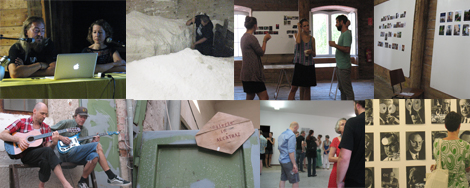
Our space
KP2: So, you feel that your sentences are too long?
KP: Yes.
KP2: So, maybe you should not continue in this way for long.
KP: I refuse to use copy paste.
...........
As we all know it is difficult to be present everywhere and all the time. For me this is more than clear since as a Blogger in residence you on one hand run around and catch the feeling of the day in the air or you decide to sit and listen to the lunch talk and take something from the talk as a starting point that takes you through your day. Maybe it is this thing that triggers you from the talk and then you start thinking about it during the rest of the day and you find ways to connect all the dots.
Norbert Bisky spoke to us today and showed us his works that range from paintings, watercolors and stage design. He explained that this range is easy for him as he tries to be reachable, open to new suggestions and projects. In accepting these different projects he prefers to choose something that is new to him and something that will produce tension for him so that he can grow from that spot and not repeat himself. His work is very personal yet at the same time it is open to different viewpoints and possible ambiguities. For him as an artist all the personal experiences, of death, of loss, of violence, human catastrophes and situations that make us react purely by instinct are something that he needs to explore and ask what they mean.
(KP:Note to self: The trigger from the talk- Relation to the space.)
When exhibiting his paintings Norbert Bisky changes the space by painting the walls of the space different colours. Some colours are the ones he sees in Sao Paulo that he spends some time in. It is this contrast world for him that he enjoys.It moves him out of his comfort zone something that he has learned to do years ago as one of the students of the Summer Academy taking a class of the artist Jim Dine. He was pushed on by Jim Dine to be brave and act "Come on, you can't think about it, just do it."
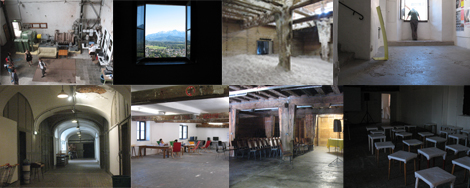
As I was triggered during the talk about the idea of the space and how we relate to it I started thinking about the two locations of the classes, Alte Saline in Hallein and Hohensalzburg Fortress. What was great today is that I could share and bounce of my thoughts with another freelance writer who is here. Today was her first time to see the space and get the atmosphere of the Academy. One of the first questions she asked me was about the space and if I have the feeling that it is too closed off. I could understand her point of view as somebody from the outside that is looking in. But if I switch and start to think from the point of view of the students the space that is available is very inspirational. If you come here just to focus on the production of the works it is in fact this small yet very open world.
As we heard from the talk today, the experiences here can stay with you maybe for life.