
The view
Where do you look from? Is it from the boat, is it from the train, is it from above or below, from the outside or at the front line? The positioning of oneself to what is going on around is never an easy task but if you decide to participate in solving a problem or at least pointing to the existence of such a problem, it should be done as a process and you must know that it will take time.
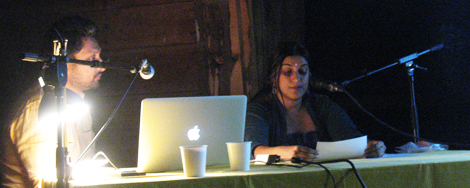
The collaborating artists and partners Shaina Anand and Ashok Sukumaran spoke to us yesterday and introduced us during the lunch talk titled "The boat medium" to their methods of working, view points and topics that inspired them. They opened for us a world, as Thomas Kilpper pointed out, of complexity that is something new and different to what he has learned to know and therefore he found it to be difficult to respond to.
The world of trade is the space where their project lives. It is a collaboration of different members of the group" Camp" and at their roots is the idea of the exploration of the technology, its history and its possible future. Shaina Anand and Ashok Sukumaran are as they said at one point during the talk, front men of the group but they never forget who is helping them to work on a project and help it develop. A great sense of collaborative work was felt and of different mediums coming together from many different sides in producing the final piece. They presented to us a short insert from their film "From Gulf to Gulf to Gulf" and also spoke to us about the publication of the book that came prior to the film that documented all the ships and the loads they were carrying on them in the space of 4 years, starting from the year marked as the beginning of the financial crises. The ships are mediums of trade but also they should be viewed as machines with their own end and a space of their own accord.
But even with this in mind there is a great sense of community, of coming together. The film is similar to a collage piece of work. It is created with the use of archive footage, video recordings from the sailors collected via Bluetooth upon meeting with them in some of the ports, of Indian music and their lyrics, of recordings made by the artists of the ships leaving. It is the medium that they work with, as they explained it to be "collective film journal".
The lunch talk hit something very personal for me. This idea of seeing the world that you can't quite grasp made me think about where I stand in the world that is mine. It made me also think about my own position at the Summer Academy and where is my view. With this I mean what is my position here and where do I stand? This position is a very interesting and a new one for me since I am somewhere in the middle and I am challenged. This feeling of being challenged is not something that I am the only one experiencing here. During my talks with students I have learned that a lot of them are challenged by their professors to step out of their comfort zones and to do something that is completely new to them.
So we are all here in a sense as collage pieces ourselves. We have the old, the new and something borrowed as well. But let us also not forget the other view, "the view from the other boat" that flips again the experiences we have and creates this inverted world while our world still can exists.
Welcome to Itzling

Yesterday was a day of small shifts. The day started with talking about the notion of small shifts and of actions that are radical in a sense but not to the point of total erasing of the other or also of what was there before.
I understood that this form of action very similar if not the same to the idea of the palimpsest, influences in his manner of working and curating the lecturer of the lunch talk organized yesterday Bassam El Baroni. He, like so many before him that spoke on the questions linked to the lunch talk series, didn't provide many answers to the questions of the professional, mateur in the art but gave us possible view points and different counterpoints to each argument. Similar like with palimpsest, the art world with this desire to change and to evolve, to become something new or to be proclaimed as dead yet again is existing in this space where everything is accumulating and re evaluation of actions and possible desires needs to take place. We are in the time of the crises and our actions should not be like "writings in the sand "but they should also not be so determined as to become rigid and almost fascists in its nature.
From the very theory based lunch talk I found myself later on in the day on the streets of Salzburg. It was second of the Walk and Talk tours organized during the Summer Academy. Unlike the previous years where the desire was to introduce the students with the cultural institutions in Salzburg, these tours introduce us to the side of the city and the parts of the city that may not be so attractive to the tourists.
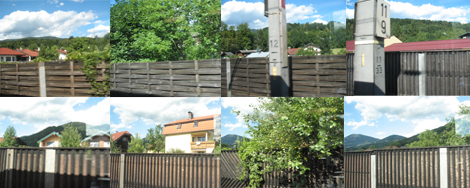
All of us present yesterday in the part of Salzburg called Itzling enjoyed the stories and experiences that, freelance actor and theatre- maker Dorit Ehlers had while organizing three different projects in this area in the period of two years.
Dorit Ehlers for many years was also living in this part of Salzburg that is located close to the train station. Riding her bicycle through the main street, Elisabeth Street, she noticed how many of the shops on that street would change, new would be popping up and soon enough close. Most of the shops stayed empty and this emptiness existed not only in the buildings but also in the community as well as people were losing their meeting spots and because of this just lost touch with one another.
The projects that she organized used the spaces of the empty stores. Different shop windows had different projections of different movies show casing different stories that Dorit Ethler collected from the oldest generation of the people living in Itzling. In one store that they ended up using for the three different projects, the space was changed like a theater stage would change depending on the play performed. The first time it was a space to warm up in winter, coming home from the train station with performances around the idea of what a miracle is. The other time it was a post office,Postamt Mitzl, a space where you would receive help from people " better " with words then yourself to help you write a letter that you find difficult to write and the third time it was a space of a hotel, Grand Hotel and its lobby where you can come in and read different names of the guest, different name of the different story that you would be told if you ask " Who is this guest?".
The projects to the organizers were something between art and life. They used theater elements like dressing up and organizing performances in the space but in the end the most important thing was to be honest. Even if in the costume of a hotel receptionist not to be in that role but to be sincere in the manner you approach the community of Itzling. The space of the shop was more importantly a meeting spot for the community members.
The end of yesterday was a great shift from the scenes that I would normally see during my days in Salzburg. It felt almost like a break from the "serious "questions asked during the lunch talks and it also gave me a new understanding and more interest to the city itself. One of students during the walk said to me that he can't find anything wrong to say about this walk and he normally always tries to in any situation. This project that the Summer Academy is organizing was really inspiring to me and if you are ever given a chance make sure that you go on one of these walks.

Who is the serious one here ?

KP: So, are you starting to feel like a professional blogger yet?
KP2: Shut up.
........
It is back to the drawing board as they seem to say. It is coming back to the task at hand. Difficult questions need to be answered yet again and again. Who is the amateur, who is the professional? Who the genius is will not be discussed as most of the lecturers before, similar to the lecturer of the today's lunch talk, Paolo Woods, decided to dismiss.
Like the lecturers before him, Paolo Woods questioned at one point if we have already created too much images that we don't know what to do with.
" Taking photos like the Japanese and we all have become Japanese".
"The time today is the time off the overload".
"We have a lot more photos of elephants then we have elephants".
"What we need, is it out there already?"
Taking part in a workshop last year during the Shanghai Biennale the question of the overload came up as well. One of the curators of the exhibition, Boris Groys, suggested that the new role of an artist is not to create anymore but to document what has been done so far. On the other hand today, Paolo Woods suggested not the stopping of the works produced but different approach to this creation, point of view, thought and role of the work. "The main role of the photography today is recognition".
But what about the question of the professional, amateur position in the art. It was great to see that at one point , while talking about " this punk" Claude Baechtold, Paolo Woods recognized how much he did learn from somebody whom he thought to be a complete amateur when they met and started working together ten years ago. "I am the photographer. I am the serious one here." How serious can we take ourselves sometimes?
The talk went on and questions about the use of text were raised as well. It was really interesting to hear that as somebody who uses text in his works, he considers text and photography as different entities to each other. To him, one photo is not the same as thousand words.
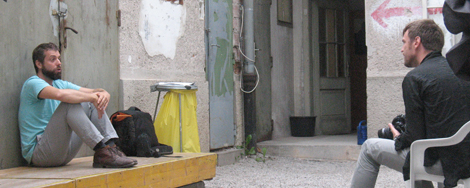
But what in the end left a mark for me today is what happened after the talk while Paolo Wood was giving an interview. He was asked by a photographer to pose for the profile photo and both felt uncomfortable in the roles that they had at that time. It was difficult for the one in front of the lance as well as the other behind the lance. One was nervious because he must have felt like an amateur while the other must have felt purely as an object. For a second or so maybe without the feel of possessing the control. It made me laugh when Paolo Woods was directed to cross his arms in a particular manner when all in fact had to be natural.
So what is it that we are creating today? What do we need to spit out, as a cliché, so that we can start a new something?
Look up
The first weekend in Salzburg showed itself as a clue to the fact how fast time flies but also and more interesting to me, how much we miss to see.
During the working days of the Academy I am not a tourist even though this is my first time in Salzburg and in Austria for that matter. I am a woman on a mission and my focus is getting from point A to point B. But what became evident to me during the first, so to say, free Saturday in Salzburg, is how much I was not aware of the town around me. It is that interesting point or question I ended up asking myself of when did I stop looking around me and why? When did the monuments and sculptures that Salzburg is full off just disappear as it is the case with most of the park sculptures, monuments that I can see in Belgrade, meaning that I am just used to them?
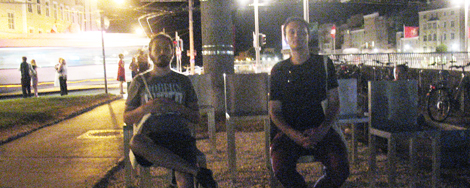
It was a surprise to me last night once I realized that for the past week almost every day I have been passing next to the work of Marina Abramovic "The spirit of Mozart" without even seeing it. I did notice the stainless steel chairs lined in a group but I missed to see the big tall chair overlooking the group of chairs representing the spectacles. The work is located next to the beginning of the main bridge that connects my side of the town to the side of the Hohensalzburg Fortress and the old city. And it wasn't that I was the only one that missed this work but also two of my new friends from the Academy as well. Yesterday all three of us felt that we are finally starting to relax and that we are slowly feeling more comfortable with our new surroundings and tasks at hand. Adaptation phase seems to have passed and because of this we can begin to see all around us more.
What I have noticed is that possibly this focus on the task at hand can at the beginning make us a little bit closed off to what is around us. I don't think that anyone wants to miss what is going on but it does take time to get used to where you are and to more importantly start to relax. This for sure is the reason why most of the students during the first week did stick with their own groups and professors. It is this but also the focus and desire to create something during the time that all of us are here and together. We are all challenged here but in meeting the challenges let us not forget to look up, down, right or left and explore. Explore by living.
Willkommen in unserer Welt.
Today is the day of storytelling. These stories are not gossip but in fact they are true. All that you will read bellow I was told and in every word I have decided to believe.
Story no.1
One day the devil got angry for missing one soul that he wanted to take for his ever hot and ever smelling world. The devil, so free in showing us his desires and needs, got angry and he punched with his big fist into the mountain. The big mountain fell underneath the mighty anger of the devil and separated in two.
The mountains I speak about are called Barmstein Mountains that are in fact to the right, just look up, from the entrance to Alte Salline in Hallein.
Story no. 2
There used to be an alternative exhibition space organized by Stephen Mathewson in Alte Saline in Hallein.Anyone was allowed to exhibit. You would just need to sign your name on the piece of paper and in the courtyard where students are gathering today, there used to be a space of show casing your work to your peers, of exchanging your ideas and music. The location of the previous gallery space was located next to the door where from the inside you can read "Today you are a king, tomorrow a slave".
Story no.3
The bridge in Salzburg with key locks and names is not a following an urban legend but in fact it dates from few years ago. Most well respected person living in Salzburg would not be caught dead writing couple of names down and closing the lock on the bridge. This idea may or may not have been brought to you by numerous tourists that you can see walking everyday in Salzburg.
Story no. 4
Sometimes life in fact is hidden in the details. The right to intimacy is still not lost. In the art world where it sometimes seems that the art market may be the new big artist, Lucy Sarneel decided to show us few moments, memories of her life. Not in a pretentious way but in the combination of something that can be considered both an object and a piece of jewelry. There is maybe one request that she asks of you and that is not to place the object in a drawer. They should not be closed off as the energy between us needs to flow. The exchange of this energy happens between the objects that she made reflecting herself and to your own being and your own consciousness so that you can give it a new meaning and a new face. There is no need to speak a lot about them. In that way they will be done and they would not have the ability to transform and be something just for you.
Story no. 5
There is much more to the town of Hallein then you may think. A river stopped running through it and few houses speak to us straight away and explain why they were created and what they have to offer us. You can also find a column where people used to spit the disobedient and a street with a narrow path in an old poor part of the town baring the name of something that glitters and shines.
Story no.6
Tonight the first week of the Summer Academy has ended. Time for sure flies really fast.

