Juan A. Gaitán appointed Curator

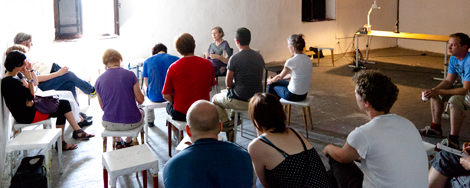
We are very happy to hear that Juan A. Gaitán has been appointed as curator of the 8th Berlin Biennale for Contemporary Art. The 8th Berlin Biennale will take place in spring 2014. Juan A. Gaitán, together with Maria Lind, run the much-loved curatorial course "You and me and the others" at this year's Summer Academy.
Next Summer Academy takes place from 22 July to 31 August 2013
Next Summer Academy takes place from 22 July to 31 August 2013

We are looking forward to seeing you again next summer. It will be a special one as we will celebrate the 60th anniversary of Salzburg International Summer Academy of Fine Arts, founded in 1953 by Oskar Kokoschka.
The very last day
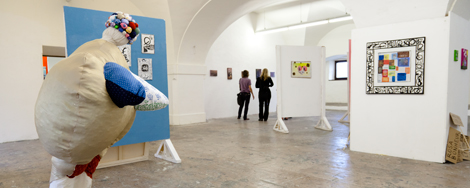
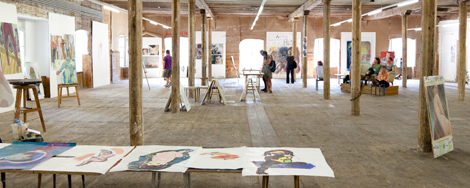
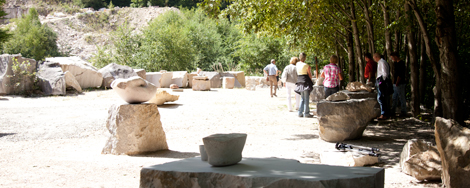
In each location the results of the students’ work was displayed. The atmosphere was one of a sense of satisfaction tinged with exhaustion. Matthew Wilson, a student on Manfred Pernice’s sculpture course, summed up the feelings of many: however long a work may appear to have taken, it actually took twice as long. The variety of work across the courses was remarkable, and even within courses students challenged the boundaries of their subject and media. It is impossible, and would be unfair, to attempt to identify favourites, although some works do stick in the mind: the speculative construction of students on Christopher Roth’s architecture course, who created an account of what may have happened to one of their classmates who disappeared halfway through; the drawings of the prolific Michelle Cioccoloni; and Ulrich Jordis’s Roy Lichtenstein inspired painting, which had my thirteen month-old daughter quite literally dancing with excitement (possibly due to the dog)!
In the evening this year’s proceedings were officially closed with a few words from Dr. Hildegund Amanshauser, director of the Summer Academy. She thanked the staff, teachers, and especially the participants, for their efforts. Over the last six weeks we have witnessed exhibitions, lectures and lunch talks which have brought together artists and students from every conceivable medium, to discuss and consider many issues and questions related to the arts in their widest possible sense. Local artists have opened their studios to us and discussed their work and the current state of the arts here in Salzburg. And most crucially, artists at every stage of their careers, from beginners to established names, have met and shared ideas. It has been a quite remarkable time.
Image, Photography and Book
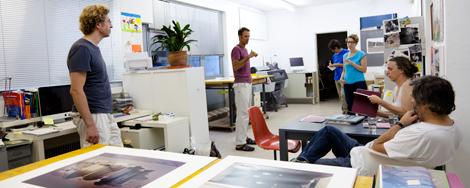
The last of our visits to local artists took us to the studio of American born photographer, Andrew Phelps.
Phelps, who has lived in Salzburg for over twenty years, discussed his working practices and showed us a few examples of his work. His studio, situated in the basement of his home, provides an ideal workspace for his needs. In addition to a dark room, he recently purchased a top of the range Epsom which can produce prints of the highest quality.
He has worked during the difficult period which has seen the growing dominance of digital over analogue in professional photography. In the face of the increasing cost of producing analogue - both in terms of the film itself and the processing - he has recently begun to embrace the positives of digital technologies, while still maintaining the techniques and qualities he found with analogue. In addition to photography, he also curates at the Fotohof Salzburg, where he is also a member of the board, and has a great interest in photography books. His studio facilities enable him to have great control over every aspect of the production of his own books, including issues of sequencing and layout.
He discussed one of his projects, Higley, which led to a book of the same name that was shortlisted for both the Arles book list and German Photo Book award. This work investigated the transformation of his home town in Arizona as a result of the housing boom - and became particularly pertinent with the housing crash which occurred soon after its publication. This has led to his newest project, entitled Haboob, which charts the town’s fate in recession.

Art with an emphasis in visual culture

The final lunch talk of this year’s Summer Academy featured Monika Schwärzler, who teaches art at the Webster University Vienna campus.
Webster University is a private American institution, which has campuses all over the world, The courses are accredited in both the USA and Austria, but the Vienna campus is run very much as an American university, marking it as quite different from other colleges in Austria.
Schwärzler describes the courses offered, which include the flagship BA, Art with an emphasis in visual culture. The course operates under four main headings: art history; art management; art theory; and studio practice. There is an emphasis throughout encouraging students to focus on process, rather than being pushed towards a finished product. They aim the course at students who have a great passion for art, but may not have the skills or inclination to work as practicing artists. Their students go on to work in many different parts of the art world, including curating and art management, while several have gone on to study for Ph.D.s in related fields.