Beyond the (traditional) studio
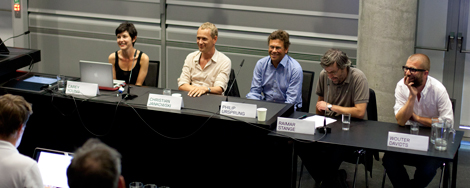
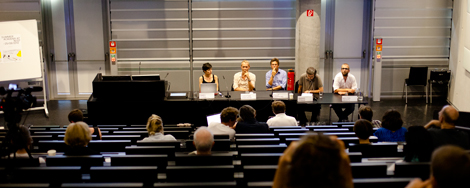
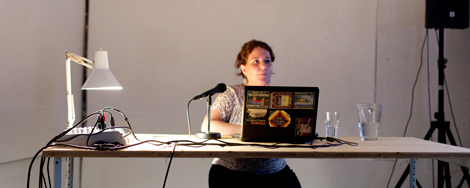
The final lecture evening turned to the general question of going beyond the (traditional) studio. The session was introduced and chaired by Raimar Stange, a freelance curator, art critic and journalist from Berlin.
The first speaker was Carey Young, an artist from London. She has never had a studio. Soon after leaving art school she found herself working for a range of institutions, from a management consultancy to left wing think tank, New Economics Foundation. The spaces and notions of creativity within these organisations inspired her to consider the boundaries and overlaps between culture, politics and business. Her work revolves around creative mental spaces, and the degree to which they have been colonised by corporate interests. She is also interested in ideas of law and legal process, and produces works which respond to the corporate and legal lockdown within our lives.
Philip Ursprung is an American born historian, currently professor of History of Art and Architecture at the Institute for the History and Theory of Architecture at the ETH Zurich. He spoke about Allan Kaprow, and notions of performance and participation. Kaprow’s own studio was quite conventional; but what is important is the socio-cultural context of his work. Ursprung described Kaprow’s “Echo-logy” performance project from 1975. The difference between object and idea in his work became irrelevant, leading to ideas of “immaterial labour”, and the conclusion that the studio is everywhere and cannot be a space protected from economic exploitation.
He was followed by Christian Jankowski, a German artist who is based in Berlin. Jankowski began by confessing that the only time he produced work in a studio, it belonged to someone else. He then recounted several studio experiences. One “studio” in Hamburg was a former shop front, which quickly became performance space. However, through his collaborators he continually found new working spaces. His first office-like working space was in Berlin, but once again he did not produce any work there. Within the space of the studio, he suggests, the artist can carry a godlike status, and the space can serve as a way for the artist to represent himself. But this is not something which has formed Jankowski’s own approach. Rather he seeks to reconsider how we view, interact and construct notions of the “studio”. He illustrated this with his film entitled “Cleaning up the Studio”, a performance piece set within and around the reconstructed studio of Nam June Paik.
Wouter Davidts, Professor of Modern and Contemporary Art at the Vrije Universiteit Amsterdam, rounded of the talks with a discussion about exhibition and the appropriation of creative space by galleries. He focused on the artist Sol LeWitt, who had insisted that “Banal ideas cannot be rescued by beautiful execution”. However, what happens when ideas turned into curatoral happenings? His example was an event at the Van Abbemuseum in Eindhoven, which hosted a project in which Danish art collective SUPERFLEX produced copies of LeWitt’s work and distributed them via a lottery. The entire project, Davidts suggests, raises difficult questions about participation and the relationship between artist and viewer, turning it into a spectacle of productivity which alienates the viewers. The notion that execution is a perfunctionary affair - integral to the conceptual art of LeWitt - and that the performance is merely an invitation, is compromised by this event.
The discussion considered a range of issue raised by the speakers, including: the ways in which the mythos of the studio is upheld and reproduced, as seen in the reconstruction of earlier artist’s studios in which original works are copied; the idea that the notion of the studio haunts both artist and curator; the studio as discursive space; and the ways in which contemporary notions of the traditional studio are themselves constructs which do not accurately reflect historical artistic practices.
Printing from life
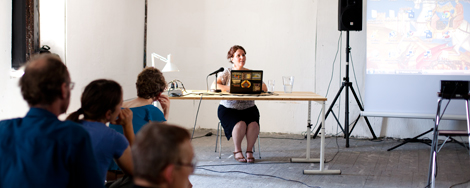
On Tuesday in the Festung, Leya Mira Brander discussed her development and experiences in etchings and print making. Born and based in São Paulo, Brander began working with metal engraving when she was 17. Over the last twenty years she has experimented with various forms of printing, with the creation of three dimensional images and incorporating prints into sculpture.
She showed us many examples of her work and the different methods she has employed. Her first work drew on the periodic table of elements, a motif which has repeatedly re-emerged in later works. Her interest in dealing with perspective and depth has led to various projects involving boxes with layered prints, and pop up books.
Brander also shared some of her personal experiences. Her studio is also her living place, creating a close relationship between the two. She described her teaching, which has included considerable work with blind students. Finally, she related what she called “the most beautiful story I have to tell”: the chance tale of how her former art teacher, many years later, passed on his own printing press to her. In thanks, she promised him that she would repeat the story whenever possible.
Friends in the Festung
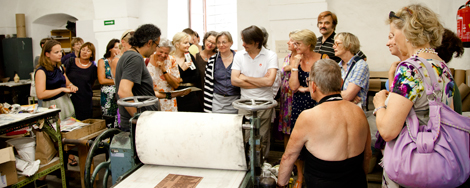
On Monday evening the Society of Friends of the Summer Academy toured the courses being held in the Festung Hohensalzburg. Members of the Society, which supports the Summer Academy through membership and events, took a keen interest in the work being undertaken by the students. The courses of Leya Mira Brander (Between etching and sculpture), Hanspeter Hofmann (How to paint), Matts Leiderstam (Self-portrait), Katrin Plavcak (Stealing from the best. Painting as inspiration), and Martin Schmidl (The practice of drawing), generously opened their doors to explain what they have been doing, and gave us the chance to see the startling variety of the work in progress.
Highlights included watching a student on Leya Mira Brander’s course print his very first etching, and a remarkable video self portrait by EJ, one of Matts Leiderstam’s students. The opportunity to see the process of the students’ work as they prepare for Friday’s open day allowed a fascinating insight into the Summer Academy as a whole. The tour ended with a glass of wine, over which students discussed what they have gained and learnt on the courses so far.
Surface and reality

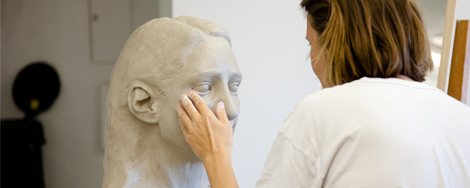
In Monday’s lunch talk in Hallein, Bulgaria born painter and film maker Mara Mattuschka discussed some of the ideas which underlie her work. She is concerned with contrasts between surface appearances and inner realities, and the ways in which art can express and represent these contrasts.
Mattuschka began with a few words about her studio practice. She currently has a studio in Vienna where she paints. There is a great difference, she says, between the painter, who is effectively fixed, in a physical sense, in one place, and the film maker, who is nomadic. When she uses her studio she has a fixed routine: at eight each morning she visits a certain coffee shop, where she talks with friends and acquaintances, before heading to the studio to work. Film making, however, requires quite different approaches, as the necessity to work with so many different people and places means that such routines are not possible.
The main body of her talk considered quite abstract notions of perception, identity, surface and personality. She is not interested in biography in the simplistic sense of biographical facts: writing a CV, she suggests, is just a “cynical gag”. Rather, it is the process of life that makes us who we are. Film in particular has the power to explore the depths of personality. She showed several examples of her film work, which sought to delve into these issues: for example, it is problems such as a “fear of looking” - the concern that in peering into another we reveal too much of ourselves - which so often bedevil human relationships.
She concluded with an insistence that art exploring such questions cannot be too abstract, as then it would not be legible to most viewers. Her work seeks to find a way that is obvious to express the mood or idea in question, so that as many as possible can understand.

Winning marble: the Kiefer Steinbruch Fürstenbrunn
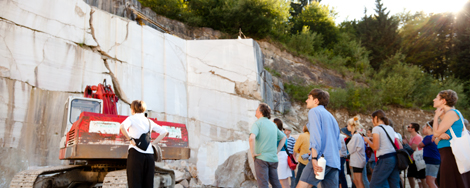
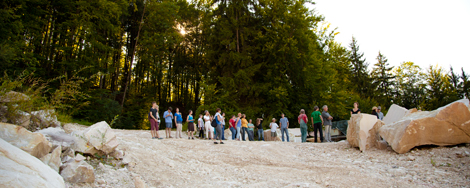
On Saturday the Society of Friends of the Summer Academy organised a tour of Kiefer Steinbruch Fürstenbrunn, the marble quarry on Mt. Untersberg. The quarry is also the location of one of the Summer Academy’s courses: the Stone Sculpture Symposium, directed by Susanne Tunn and Hagbart Solløs. The visit allowed members of the Society, and a considerable number of students from different courses in this year’s Academy, to see how one of sculpture’s most enduring materials is won from the mountain.
The quarry provides a high quality marble which has been used as a building and artistic material for two thousand years. Clemens Oliver Deisl, co-managing director of Marmor-Industrie Kiefer GmbH, who own the site, gave us a brief history of the quarry and explained the process of extricating the stone. The tour included the opportunity to examine the various stages of the extraction in different parts of the quarry, and the machinery which make this possible. He provided us with a fascinating insight into the industry, although he admitted that only about one percent of the marble is used for sculpture.
We also had an opportunity to see the work being undertaken by students on the Stone Sculpture Symposium, before our hosts treated us to refreshments in the magnificent surroundings of the quarry.