periscope:project:space
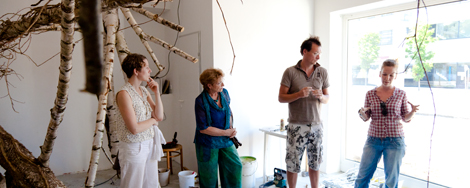
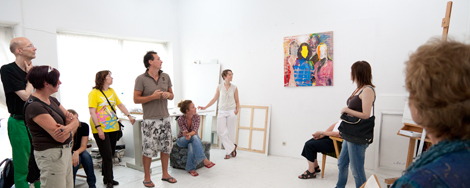
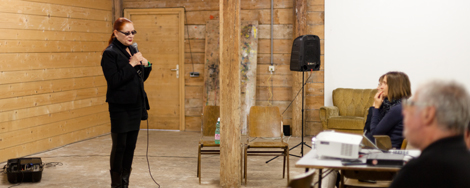
The series of studio visits continued last night, with a tour and discussion at periscope, a project space comprising work and display spaces. Two of periscope’s founders, Elisabeth Schmirl and Stefan Heizinger explained the ideas behind the spaces, and discussed how it reflects and plays a role in their own work. The idea of periscope in part stems from the tradition of studios which occasionally open to the public .
Much of the emphasis at periscope lies on the use and manipulation of space. The curators are interested in exhibitions which create a metamorphosis of the room. They have a full programme of exhibitions, as many artists are drawn to the freedom, and the challenge, that periscope provides.
Schmirl and Heizinger also shared examples of their own work, and the way they use the space. This ranges from practical issues such as light and blank white walls for viewing their work as they produce it, to more fundamental questions of process. Heizinger in particular is interested in the process, carefully documenting the production of a piece so that the process itself becomes the artwork. Schmirl also discussed issues of process, and explained how questions of scale, and the practical limits of size, effect her choice of medium.
Studio, image and the written word
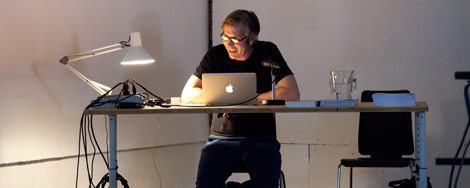
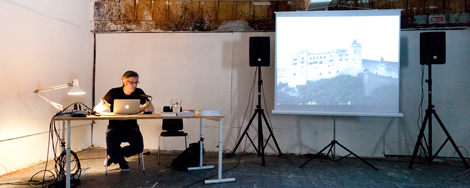
Martin Schmidl is an artist, curator, writer and art historian from Aachen. Yesterday he spoke to us about his work spaces and elements of his work both within, and beyond, the studio.
Several of Schmidl’s work spaces have had multiple functions: the studio can also be a gallery. He showed us various examples, including ideas of the studio as a work of art in its own right. In one workplace he “recreated” his apartment, to serve as both a working and display space.
In his writing he has attempted to apply the tools of the artist to academic questions; and at the same time he has sought to think of ways to bring scientific methods to art. The boundaries between the two need not be absolute. Schmidl approached issues of exhibitions in the postwar period from the angle of viewing them as installations; and he drew on his experiences at academic lectures to create his “Common Designs / Lectures” series, which allow for portraiture without a contrived situation. Other work leads towards journalism: the newsletter finger serves as a platform for artists to write about subjects connected to artworks; and his book Greater Los Angeles uses spaces “inbetween” to create an alternative portrait of that city.
In future works he looks forward to more books, motivated by the idea that he “doesn’t know yet how they’ll look”.
Artists at work
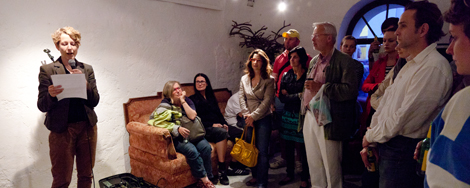
Amidst the many visiting artists, it is easy to forget that many of the people involved in the running of the Summer Academy are artists in their own right. Last night the Galerie der KG FreiRäume in Hallein saw the opening of an exhibition of work by assistants at this year’s Academy. The show was introduced by Bärbel Hartje, who also curated the exhibition. Titled “At Work”, the artists explore the notion of the studio as a “production sphere”. Each of the artists responded in very different ways, addressing the themes with a variety of media.
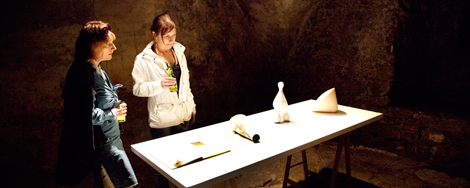
Noële Ody and Marcel Hiller presented site specific works for the exhibition, responding to the spaces presented by the gallery. In Katharina Karner’s photographic video loop we witness moments from a session working in the studio, while Susi Krautgartner and Bodo Schlack present images which reflect aspects of the studio as work space. Orson Sieverding’s photograph captured the process of creative production, while Frank Bartsch displayed an image of the afterlife of such a process. David Svoboda’s small scale sculptures challenge ways of viewing and interpretation, while Petra Polli’s graphics invite a process of viewing, and Ulrika Segerberg’s collage crosses and examines boundaries of media. Finally, Cäcilia Brown takes the consideration of space into the urban environment.
The evening allowed the assistants to present their own responses to the themes being investigated in the courses, talks and lectures. In an environment where everyone is an artist, it becomes all the more important that all may contribute.
Analogue beyond digital
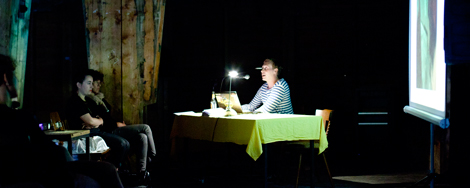
Today in Hallein Piers Erbslöh spoke about the world of analogue film making. Originally from Düsseldorf, Erbslöh now works in Vienna, where he co-founded the Vienna Filmkoop in 2009. He outlined the history of independent film co-operatives, which since the 1960s have been providing opportunities for artists and film makers to access the otherwise prohibitively expensive processes necessary for their work. There are now a network of film labs around the world - some 35 met last year in Zagreb - supporting the thriving world of analogue film.
Erbslöh is not against digital technology, but suggests that it is “something different”. It is “not film”. Film is something which can be touched - can be directly manipulated by the artist. He showed us many examples of recent films made by both himself and others. There is a wide variety of techniques, from scratching the surface of the film directly to alternative ways of printing, copying and editing, which lead to quite different results. Digital, in contrast, remains a very different medium. The fact that the mainstream film industry is becoming increasingly digitalised should not distract us from the qualities of the analogue. Erbslöh did admit that the possible collapse of Kodak caused by the decline in demand for analogue film will have a direct effect on contemporary film makers; but he did say that film co-ops are investigating alternative sources, even should it come to buying the patents themselves.
An integral part of the medium today involves challenging the strictures of traditional film making. After showing us footage from a recent meeting of film labs in Vienna, he remarked that this showed “a few examples of how not to use a film projector”. His advice to aspiring film makers was simple: get some equipment and “don’t read the instructions”!
Beyond Photography
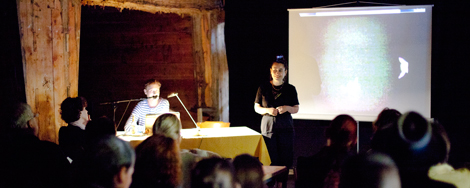
Katharina Sieverding is a renowned photographer whose work over the last forty five years has broken boundaries. She has always been interested in transformations, changes in the developments of both artists and art. Initially trained in medicine, she then turned to theatre and stage design. After working at the Salzburg Festival, political events inspired her to move to Berlin and embark on her journey through art.
At first she worked without a camera or a studio - instead using a nightclub photo booth, creating images that would become famous. It allowed a sense of immediacy, an instant production of the image. In the 1970s she became interested in monumental photography, which included manipulations of her photo booth images. The interest in transformation has always been an important part of her work, embracing film and projection, and she showed us images of the impressive array of machinery and equipment necessary. Working with analogue film involves quite different processes, and creates quite unique results, and despite the explosion of digital technologies there has been a renaissance of analogue techniques in the last fifteen years. Indeed, most galleries are interested in the analogue version of her works.
The role of the studio, Sieverding suggested, is also transforming. She explained the expansion of her own collaborative spaces, redefining studio practices to include different work spaces, archives, spaces for exhibition and even receptions and press conferences. Such space enables a different approach to photography, embracing ideas such as reflection and metamorphosis. She says she never wanted to capture “reality”, but to show the impossible, to make it possible in the lab.