
Printmaking, Portraits and Identity
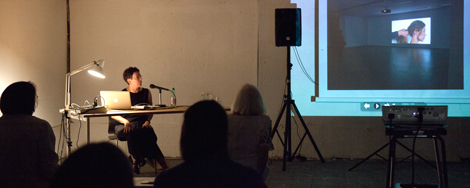
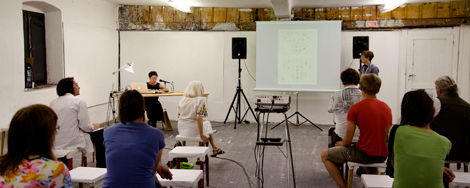
Yesterday afternoon Krystyna Piotrowska introduced us to the creative variety of Printmaking. While she has worked in a range of media, from photography and film to installations, her work is fundamentally based on Printmaking. The Art of Printmaking is by definition one of impressions - no two prints are ever identical, and the medium allows for challenging notions of original versus copy, and of originality itself.
A key theme in her work revolves around the concept of the self-portrait. The only face we can never see is our own: we view it only as a reflection, be it in a mirror or a photograph. We can only ever see a copy of ourselves. So she presents us with double images of the same face, one the “original”, the other a “copy”, or a mirror-image. These rival versions challenge the viewer. Sometimes distorted, sometimes re-arranged, they play with notions of identity, and our perception of the identities of others.
These themes are developed in one of her most recent projects, Margaret’s Golden Hair. At its centre lies the overpowering installation, A Braid, constructed from the hair of countless women, interwoven into one continuous line. The identities of these anonymous women are melded into a single object, collapsing the very notion of portraiture.
Talking about the Studio
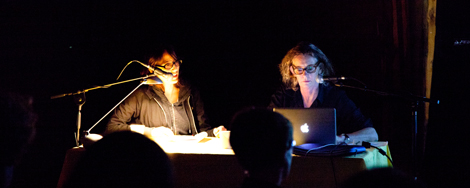
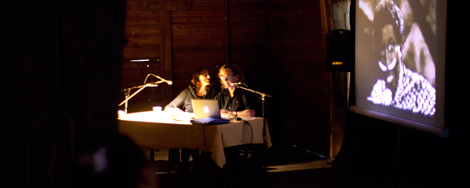
In the Alte Saline in Hallein today, Milena Dragicevic and Charlotte Cullinan provided us with a thought-provoking performance which probed the many nuanced meanings and roles of the “studio”. Their conversation was a performance: “We intend to energise you”, they began, and so they did. The dialogue swung from the conversational to the poetic, interspersed with a series of film clips ranging from Screamin’ Jay Hawkins to Woody Allen. The result was an impressionistic collage which challenged and provoked us into rethinking what a studio is.
The studio is the theme of this year’s Summer Academy, and our speakers revealed its complexities. They explained that the studio both is, and has the potential to be, many things. It is not merely a place, but also an action or a gesture: even the act of going to the studio, how you walk there, what you do and do not see. Issues of form and practice melded to those of creation and perception. The comparison with boxing, a recurring image in the conversation, was, they told us, “beyond metaphor”: in both painting and boxing the viewer participates, and in doing so both gives meaning and legitimises. These connections are fundamental.
The questions they raised reflect and dissect the very notion of what a studio is, what it represents, and how it can influence our perception of the creative process. Dragicevic and Cullinan have certainly made us think.
Constructing Destruction

Christoph Draeger opened the series of lunchtime talks today, with a revealing insight into his development as an artist and the nature of his work. His lecture was refreshingly honest, as he explained how his interests have owed much to personal preferences and experiences.
Draeger is a conceptual artist, who works across different media. He has been fascinated with the concept of “disaster” and “catastrophe” since childhood, and these ideas, in their broadest sense, define his work. There is no distinction in his work between the man-made and the natural, and he chooses to leave the “moral categorisation to others, to philosophers, to the press”. His early work, such as the prize-winning Catastrophe #1, focused on the paradox of “constructing destruction”, while also considering the ways in which memory of disaster functions. His ongoing Voyages Apocalyptiques charting sites from Heysel to Hiroshima, presents us with impressionistic images of the locations of famous disasters and how they have been reconstructed.
He also gave us an insight into the practical problems which face an artist: from the harsh necessities of his first studio in Brussels, to the frank admission that his original presentation of Catastrophe #1, glued to the walls of an Antwerp gallery “was unsellable - but an artist has to live”. This talk was an intriguing and a thoroughly entertaining introduction to an important artist and the way he thinks about his work.

And it Begins!
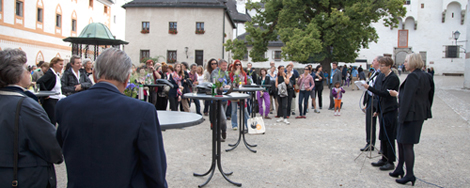
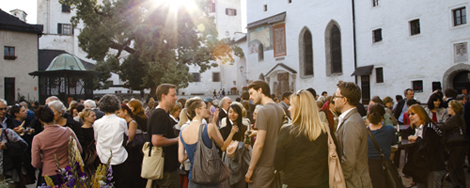
Yesterday evening 150 artists and students from around the world met in the serene surroundings of Hohensalzburg Castle for the opening of this year’s Summer Academy. The infamous Salzburg schnürlregen, torrential rain falling in strings of water, had given way to a balmy summer’s evening, and in the sunshine people chatted and sampled the wines and beers of Austria. Hildegund Amanshauser, Ingrid Hochhäusl-Scheidbach, and Heinz Schaden, spoke briefly, welcoming all to Salzburg. The evening was enlivened by a palpable sense anticipation for the coming weeks - and the free drinks, always popular with struggling artists!
It was a perfect beginning. The next month and a half promises to be a fascinating time, and all are looking forward to the lectures, discussions, exhibitions, tours and open
The 2012 Summer Academy's Programme of Events is online

