If We Can't Save the Planet, There's Still Space ... Or Not?
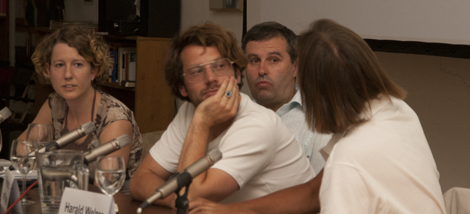
Wednesday night saw our last discussion round at the Künstlerhaus. Aptly titled Living with Climate Change, I attended the evening hoping for more distinct ideas than the usual spongy we have to change our lifestyle that is hardly ever followed up with concrete ideas. The panelists that night, Raimar Stange, freelance curator, art critic and journalist, Friedrich von Borri
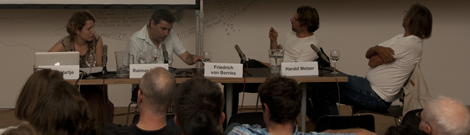
es, architect and involved at several universities, and Harald Welzer, sociologist and social psychologist who also heads research programmes concerning the so-called ClimateCulture, agreed with each other that we in fact cannot stop climate change, but in fact need to adapt.
The agreement stopped though. Small groups and communities were brought up and how they manage to start small changes that have the potential to snowball into something bigger, and art was assigned the potential to be a social conscience and show people realities, which are both tried and tested ideas, but in the end the panel, moderated well by Baerbel Harte, assistant to the head of the summer academy, fell short of being serious and at some point was nothing but elderly men bickering at each other, one more than the others.
What's missing, like always, is the practical aspect. If we think about what art can do in connection to climate change, why don't we start with ourselves? Sit down and think about, "What materials do I use in my art? How and where are they produced? What happens to the leftovers?" It's a small start but I believe this is how it needs to start, without lofty plans to safe the entire world at once but by individuals sitting down and examining their way of life, and then getting up to change it. Art can definitely help to start this process, but let's not raise it on a pedestal and promote it as a solution when it's very much part of the problem. [mp]
"A Lot of Things Happened Per Chance"
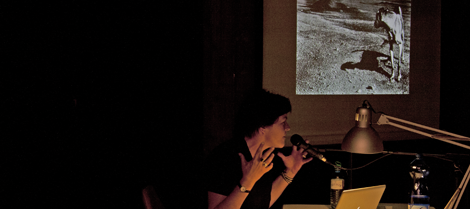
In the last lunch talk of this year, we had the pleasure to learn more about a fascinating photographer from South Africa, Jo Ractliffe.
She briefly explains how she got into working with what she calls "plastic toy cameras" because all of her other photo equipment had been stolen, using a lomo camera named Diana through the 90s until she came across an exhibition that said something like "take great, artsy, blurry pictures" and decided it was enough, returning to proper equipment.
No matter what she uses to take pictures though, she's always interested in reality. She doesn't go and constructs something with her camera, sh
e does precisely the opposite, like we could see in a series of pictures she took on one of her trips to neighbouring Angola after the civil war ended there in 2002. First one only sees a black-and-white landscape, something friends have lovingly called "blandscape", but then you start noticing funny little signs and the peace of the image is disturbed, going completely out of the window as the artists starts telling us that the images show minefields and the little signs on poles mark safe paths although one can never be sure as frequent floods shift the land mines around underground.
Jo always has a sharp eye for the reality, something that might come from growing up in the Apartheid government. As she says herself, "during the turbulent times in the 80s and 90s, every photographer automatically became a documenter of what was happening." She still works along those lines, but more subtle, with messages that still need discovering, which in my opinion is brilliant in a time when photos are first-of-all hugely blown up, using sophisticated technology and intricate photoshop processes and only then bumbles along the meaning,
We'll see this Friday how much of this way of working rubbed off on her students, at our open day, running from 2 to 6 pm. [mp]
Another Sneak Peak
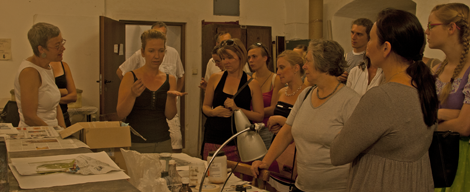
This Tuesday, once again the society of friends visited us for a sneak preview, a chance to talk to teachers and students, and to meet the people that had received the grants this second
term. This time we gathered in the fortress, for example getting an explanation on how certain printing techniques work in the printing class and a brief intro by Judy Fox who stated how she only teaches her students techniques for forming out of clay, no theory as they can find that anywhere themselves. We also visited the other three classes in the building whose teachers had kindly waited for us to give a deeper insight into their teaching methods and goal.
In the end, our stipendiaries presented themselves to the society of friends in the stifling heat of the lounge room before we were all treated to water, wine and breadsticks. It's always fascinating to see from how many different countries our awardees come, how happy they are to be here and what wealth of experiences they take back with them. Let's hope we can keep expanding our grant program in the years to come, as it's one of the core values of the summer academy, to make
art accessible to everybody. [mp]
Sowing Happiness
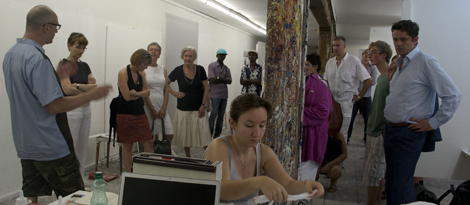
After practically acquainting us with their working methods last Friday in the Kunstraum pro arte, Véronique Faucheur and Marc Pouzol, two members of landscape artist trio Atelier Le Balto, delivered the theoretical background this Monday at their lunchtalk at the Alte saline Hallein. They presented 3 of their works, showingcasing gardens under different cicu
mstances.
The three gardens, one for the Palais de Tokyo in Paris, the other for the Ludwig Forum for international Art in Aachen and the third for the jewish Museum in Berlin, seem to be very different at first, but then one recognises in all of them the underlying working pattern of Véronique and Marc. For them, a garden is something that always grows. They would never import fully grown plants to have the whole garden up and running in a matter of months, but rather plant baby plants and then leave to grow over years and years, returning to their gardens to add something, or more often, to take it away. "The garden is a living organism that needs room to change and grow", as they put it. What they're not so fond of is the planning process. They make sketches of their ideas, but never precise plans as their ideas always change while they realise them. "We don't want to make plans, the time we spend drawing them can already be used on the garden." they explain their approach.
What they do love is getting their hands dirty. Lots of photos they showed of their gardens in progress pictured them cutting, planting and even moving stones themselves, actions they deeply enjoy as it makes them feel more connected to their gardens. Once they are finished with their class here in Hallein, they will return to Berlin to start their diaspora garden at the Jewish Museum there.
If you're interested in their gardens now, you can visit the one in Berlin starting this October, have a look at the backyard of the Kunstraum pro arte in Hallein, or simply visit their class at the Alte Saline Hallein on our open day this Friday, the 26th of August, starting at 2 pm. [mp]
And The Stones Waved Goodbye
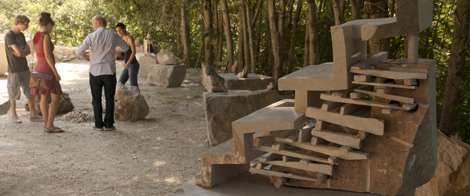
Where last year I had made my way there through pouring rain and gladly accepted the tea offered after a tour of the students works, this years open day at the quarry, held by the Stonemasonry class, could not have been more different. People nonchalantly strolling between the stoneworks, having them explained by their creators or touching the works by themselves, thenheading up the gravel path for a sip and a bite at the big marble table, joining the others already sitting there lazily in the shade.
The atmosphere was of great joy, but one could also notice the participants of the class were a bit sad to leave, which is only natural after they had spent a month up there at Fürstenbrunn together. But who knows, this year already welcomed some returnees, so maybe we'll see some yet again next year. [mp]