Once More, The Assistants Take The Stage
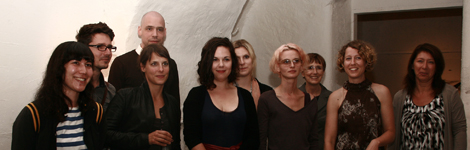
Last night, the exhibition Schauraum II opened at KG Freiräume in Hallein. Just like its counterpart during the first session, it features works of the artists currently providing assistance to the teachers at the Alte Saline Hallein. As Bärbel Hartje, herself assistant to the head of the Summeracademy and in charge pf putting the show together said in her opening speech "In this exhibition we want to put some focus on the fact that the assistants are themselves practising artists and showcase some of their work." She goes on to explain the process. "We simply asked them to bring a couple of their works with them that they would like to show and then arranged them in the gallery."
Joining the assistants is one more artist, TeER, who has been with the academy in Hallein for a long time, helping with technical problems and saving people from ill-minded computers.
All in all, last night revealed an interesting exhibition dealing with time and its perception and leakages from popular culture and design, amongst other things, shining a well-deserved spotlight on the people incessantly aiding our students and professors.
The exhibition will be running until the 26th of August at the Galerie der KG Freiräume, Bürgerspitalplatz 1. The gallery is opened every Wednesday from 7pm to 9pm, additionally this Saturday, the 20th of August, from 10am to 1pm and on Friday, the 26th of August, from 10am to 6pm. So when you go to Fürstenbrunn this Saturday to see the final presentation of the Stonemasonry class, or to Hallein for the grand finale on the 26th, why not take a little detour to experience this amazing exhibition? [mp]
Cities Live On Passion, Says the Man Who Has Plenty
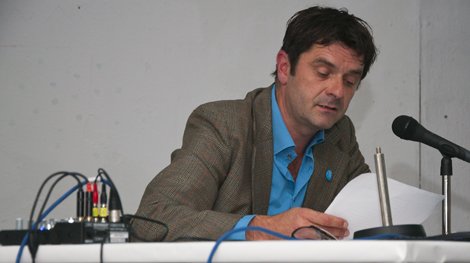
Yesterday saw another interesting lunchtalk at the Fortress Hohensalzburg as Christoph Schäfer, currently teaching the class Drawing as Wish-Machine there, stepped up to the podium to deliver a lecture he warned would last 5 hours. He then delved into explaining two of his recent projects, one of them still in development, that both deal with public space, the histories clinging to it and the way they are seen and represented, and more importantly, how to flip them and tell a story of his own. He splits these stories and features different aspects in 3 locations, unearthing new angles and adding dimensions.
After asserting people are still with him, he then dives into a completely different topic, a book featuring his drawings called Die Stadt ist unsere Fabrik - The City Is Our Factory that deals with the developement of cities, their roles and how they change people's way of thinking, but also with the specific development of Hamburg. A big topic for Christoph is also the right to the city, as the term has been coined, meaning to defend quarters from speculation and rising rents, trying to preserve grown structures and keeping art scenes from becoming cash cows and unwilling aides to development managers.
The artist keeps his talk interesting by showing illustrations from the book, reading from it and leaving out the parts that might be too specific. At one point the drawn image of a record pops up behind him, his cue to turn on house music as he feels that its DJ's revolutionised the relation between performers and audience and is thus very important in the whole context of urbanisation, and breaks into dance. He promised this beforehand, but judging from the looks of the audience most people thought it was a joke.
This little intermission makes me hopeful for the finissage, as a good party always needs a person to break the ice on the dancefloor. Christoph Schäfer might be just the man we need for that.
For those interested in his book, more information and excerpts can be found on the artists website: http://www.christophschaefer.net/ [mp]
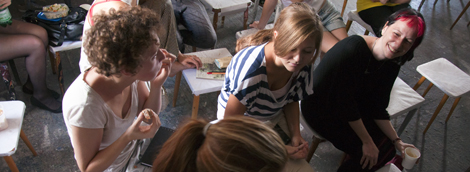
Initiation of the Young
Last Friday we got another chance to go where no lover of art has gone before - into the private households of people who also love art and have enough money to live with it, too.
This time we were invited into the house of a family living near the zoo Hellbrunn. The experience was once again different than the ones we had before. Their collection, spread over the vast house and into the garden, made a lot more sense than others, so to say. There seemed to be less "I need to have it, no matter what it is!" and more rational collecting on advice by art dealers and associates. The love for their art was there nevertheless.
What made this visit very interesting was also the youngest daughter of the house, that, at an age I would assess to be around 13, is already incredibly fluent in the terms and expressions of art, guiding around visitors and explaining how she loved growing up with the art and even being the one to stand the longest in front of old masters in a russian museum, as her father proudly informed us. Asked why she has such a big interest, she says, shrugging her shoulders " I just love looking at the colours, the lines ... Art has been there my whole live so I guess I just grew into it from the start."
She seemed to have been less happy several years ago when russian photographer group AES+F took an altogether different group portrait of the 4 children of the house on request from their parents, almost crying as she clutches a thankfully fake missile in front of an artificially inserted backdrop of the mountains and the cityscape of Salzburg. "Now I like it, though" she says. "It's a very unique representation."
Just as unique as the house, it's inhabitants and their collection we had the immense pleasure of exploring. A big thanks once again to the family for allowing us in and to the management of the Summeracademy for organising. [mp]
Nudity for the Sake of Exposure
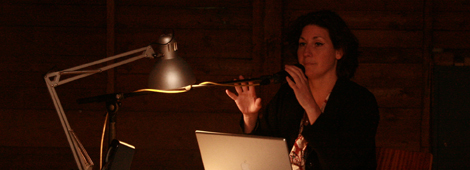
Katrina Daschner, returning to the Summeracademy after her successful class last year, used her lunchtalk to show her now completed film trilogy. Briefly showing the first two parts that were already known to recidivists from last year, Hafenperlen (harbour pearls) and Aria de Mustang that both feature burlesque scenes starring herself and others watched by a queer choir that displays different reactions. In the newly completed third part, Flaming Flamingos, the stage remains empty aside from spinning objects, leaving the action to the choir that, hidden by long streams of fake hair and dressed in red, delves into a giant make-out session.
She also shows images from her club burlesque brutal in Vienna, of the different performers, explaining their names and backgrounds and how their performances come together. Making a point to set burlesque, or rather neoburlesque, aside from Striptease, she says it's more like a tease, playing with the act of exposure rather than it being an up-front dance to stimulate the audience. Having first encountered the medium in New York in 2006, she says she quickly got interested. "When I perform" she says with a smile "of course I get stage-fright, but once I'm up there it fades fast ... I love doing this after all."
Another big part of her work is the role and image of the femme in queer culture, one that is interesting to her as "she's not that out there and obvious, so it's a lot harder for her." Katrina Daschner is thus on the forefront of helping to break the image of the tomboy lesbian, opening new awareness for women who simply want to love women and don't feel like shaving half their head to state so to the rest of the world.
Most of the audience left her lunchtalk deep in thought and still a bit befuddled by the images they had just seen. It makes one realise how free art has become, being able to show graphic scenes without once being questioned, and be thankful to Katrina Daschner for not using this freedom for cheap fame or thrills, but to convey an actual message. [mp]
White to Black, Or Black to White
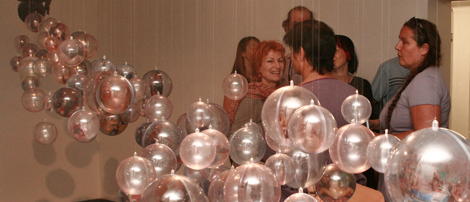
Tanja Boukal has done it again. One might think, now she has run out of ideas how use her knitting and embroidery techniques to make art with them, when she turns around and shows us once again, this time with plates covered in Organza and then embroidered with emergency measures in case of a nuclear fallout. These plates decorate the second room at Galerie Eboran where her current exhibition opened this Thursday, much like fancy plates would in a bourgeois household.
The entrance room, where the exhibition was also opened by Ulrike Guggenberger and Gabriele Winter, is given completely to one piece entitled Pandora's box. Bubbles traverse the room, tying together two ends of a spectrum - good and bad, innocent and corrupt - all the extremes that make the world revolve around their constant push and pull. Where is the beginning, and where is the end? I don't want to give away too much now, though, so you best see this truly interesting exhibition for yourself. It can be visited at Galerie Eboran until the 2nd of September. [mp]