Ready, aaaaand ... Take 2!
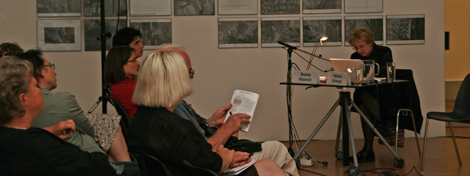
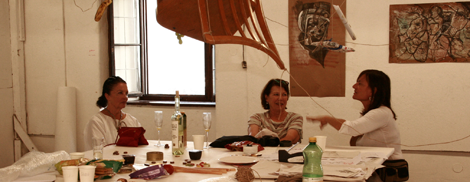
After the informal friends society tour last week the Alte Saline Hallein finally got its turn this monday to welcome a larger celebratory group as the second term of classes was started off at what staff there lovingly calls Tikki Bar. The weather was nasty, the salt was damp, but nothing could disparage the evening for our newly arrived students and teachers, some of them returnees, others completely new to the projects, some even sticking around for another class after already participating in the first term.
Things were lively, yet still a bit reserved. Over the next few weeks we'll get the pleasure to see everybody thaw, unleash their creativity, discover new ways of expression, make new friends, also ... and in the end, we'll all return to the Saline for the grand final party. Until then, let's look forward to a couple of fabulous weeks ahead filled with Lunchtalks, explorations of Salzburg, vernissages and discussions, and of course lots of great art. [mp]
The Stone Needs to Grow towards the Sky
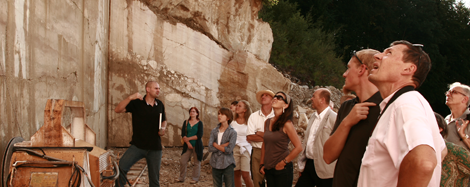
Blue skies and sunny - the perfect weather for a visit to the quarry this Saturday, I thought. Apparently I was not the only one as quite a few members of the society of friends found their way to the Kiefer quarry to learn more about it and take a first peak at the works being hewn at the stonemason's symposium taking place right there.
First, Clemens Deisl took us on a tour through the quarry, explaining how the stone had been quarried and how it's done now, but also went into the very nature of the stone, aided by Hubert Maier who happily talked about his favourite material. He also foreshadowed plans in the works for next year to let the visitor
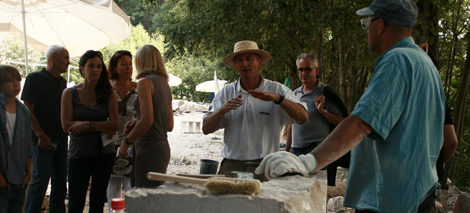
s witness the cutting and ensuing fall of a wall. This year the goodie was the huge digger he took quite a few happy visitors on a spin on while the rest of peacefully relaxed in the shade with a glass of water or tea and enjoying the delicious cakes Sonja, a returnee to the course from last year, had prepared for us.
Then Hubert Maier took the group on a tour through their workshop, presenting every person dedicatedly working on their stone, explaining the progress behind it. He also showed his makeshift furnace where he repairs and sharpens chisels, something he wants his students to at least have seen once.
As we were walking away from the quarry back up
to the table in the shade, the weekend silence of the quarry was once again filled with the sound of the stone relentlessly being chipped away.
The stonemason's symposium are having their open day on the 20th of August from 12 to 4 pm. I for one am looking forward to seeing some pieces finished and others that have not even been thought of yet. [mp]
Open Day Fortress
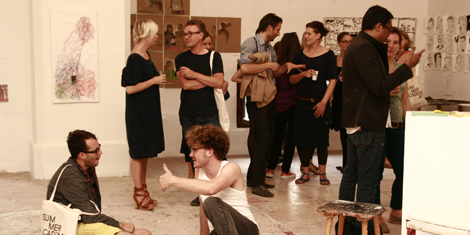
Hanging chairs, fruit, floating balloons and colourful drawings on the one end, a bare wall adorned with a piece of aluminium foil and letters saying "Today was not a good day for art ... but the pizza was tasty" on the other side, this was the spectrum one could discover at the open day at the Fortress Hohensalzburg this Friday. One of the teachers, Mladen Stilinović, even participated in his own class's exhbit, even though he had previously stated he never makes new works for group shows. The students were all in good spirits as they made some last preparations in the afternoon, some of them working until the last minute as their class had only started this Monday, completely unperturbed by the visitors wandering around and looking at the art.
In the evening the crowd seamlessly entered into party mode after a legendarily short speech by Hildegund Amanshauser who simply chose to thank everybody for their participation, especially the teachers, wished them safe trips back and expressed the hope to welcome some of the participants of this first term again next year.
I can only fall in line with this. It has been a fantastic first period at the Fortress Hohensalzburg. Now, let's get ready for what's in store as the second term will start this coming Monday. [mp]
Open Day Hallein
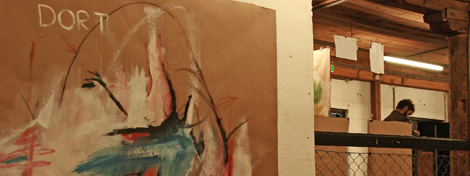
Visitors to the Alte Saline Hallein were greeted by a calm, almost solemn atmosphere as rooms awash in paintings and photographs invited them to step into the picture. This experience was heightened by an film being projected in the room we normally have our lunch talk.The accompanying piano piece flooded the room upstairs where the paintings from Milena Dragicevics were hung all across the room.
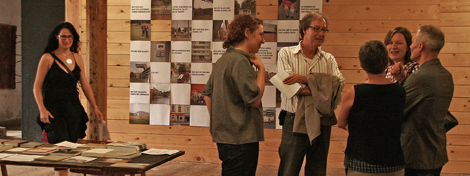
All in all, this years students were quite tame in the way they presented their works, most of them even virtuously sticking to their classrooms and staying away from crazy installation experiments, the stairs and off-limit areas. The works themselves were far from tame, though. Some all raging colours, others calm black and white photographs just to name some examples, it was possible to discover a lot of unique works. The students, most of them wearily showing around visitors or lounging on chairs and couches, seemed on the one hand glad that they could go back to a more peaceful life, on the other hand sad about their impending departure, some already voicing wishes to return. We
hope that for now, they can carry new inspiration and a plethora of ideas back with them. [mp]
The Guerilla Artists
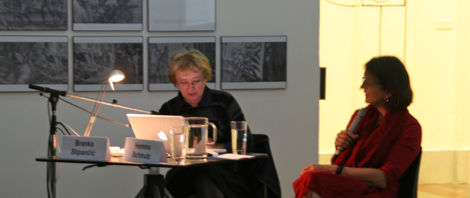
The group of 6 artists, ever heard of them? Me neither. Thankfully, Branka Stipancic took her time to dedicate an evening to introduce a captured audience at the Künstlerhaus Salzburg to their work.
The group, made up of Boris Demur, željko Jerman, Vlado Martek, Sven Stilinović, Fedor Vučemilović and Mladen Stilinović who is teaching a class this summer at the Fortress Hohensalzburg, operatingin the mid-70ies out of a post-conceptual search for new media and ways of expression, turned all of Zagreb into their exhibition space. They would spontaneously hold exhibitions on squares, make art right there on the street - as that was where they wanted to move it - and were always on the lookout for new ways of anarchic rebellion against a system that thankfully did not care all that much anyway.
"It was a kind of ghetto" Branka Stipancic says, "all the artists there had other jobs to survive, and the government didn't care at all what we were doing." She goes on to explain that Yugoslavia at that time was sort of a third party set aside from the western countries but also the communist bloc. "We were free to travel", she says, to the surprise of some of the audience members, "and met other artists, also western artists that came to Zagreb." Here her husband Mladen Stilinović who until then has been quietly sitting in the audience and listening, chimes in to add to the list of artists and other acquaintances. He does this with his usual impish smile, to immediately lean back and disentangle himself again.
The talk then goes deeper into the works of each of the members, which would be too long and complex to describe here. It can be remarked though that, after a period of being forgotten and younger artists not knowing how to deal with their work, artists from that wild period are becoming interesting, as one can see by Mladen Stilinovićs success at the Documenta in 2007 and afterwards. So there's hope that the rest of the group of artists that were also a close-knit group of friends, and their works will reach the limelight too so we can study their works and their philosophy. [mp]