Enchanters and Diamonds
Thursday evening, writer in residence Clemens Berger took the time to read from his latest novel, "Das Streichelinstitut (the caress institute). He presented various parts of the book that explained how things led to the birth of this peculiar institute, but then mercilessly left his audience in the dark as to what will happen to it and the highly likeable protagonist.
"The story", he says, "is mostly about a man who becomes a homo oeconomicus and believes he has this process under control, which of course he doesn't."
He also gives an outlook on a play of his called "Engel der Armen", angel of the poor, that will be enacted in Darmstadt this fall. Once again we have slightly lopsided service provider, this time a discount undertaker that talks to a diamond on his lapel that is made of his mothers worldly remains. Asked why he likes those kind of bizarre characters, he defends them, saying they are simply "symptoms of our times that seem bizarre, but are in fact very normal." And it's fun to think up a character like that, he adds.
As the audience left the Künstlerhaus, it was audible left and right they were still back in the room, discussing what they had heard, some also hurrying home to read their newly purchased books, provided by Rupertus Buchhandlung that was cleverly present at the reading. And who knows, some of them might even be considering a trip to Darmstadt in the fall. I for one will, once I figure out where exactly it is. mp
Dissecting Art

Todays lunchtalk by Maria Lind, art curator and critic, took a stint into theoretical realms as she talked about "Abstract Possible", a project that, in her words, "serves to make the abstract more concrete." She then adds that this is very necessary as current times have turned us into natives of abstraction.
But Abstract Possible is not just a concept that splits the idea into 3 fields, the formal abstraction, the economical abstractions and what she calls withdrawal strategies, seeing as the latin word abstrahere means withdraw, it also channels itself into concrete art shows like the one Maria Lind presented in detail, held at the Museo Tamayo in Mexico. The show completely transformed the museum, included walls and floors, saw pieces merging into each other but also fighting to stay apart. "I saw the visitors reading, moving closer, studying everything and taking lots and lots of pictures. This was very surprising to me and not something I usually see." says a satisfied Maria Lind. "The director made us use walltexts and labels, though, something I dislike as it takes away too much and dictates the viewer too strongly and too early on. I prefer working with leaflets that show facts, not explanation." she adds with a little frown.
Fortunately, the next installment of Art Possible will happen in the Konsthall Stockholm whose head is nobody else but Maria Lind, and two othner locations, effectively taking apart the three strands of abstraction mentioned before. The exhibitions will start in January. For now, she is teaching the class History and Practises of Curating at the Fortress Hohensalzburg and will be part of one of our discussion panels at the Globalart Forum held at the Auditorium (Hörsaal) 230, Juridical Faculty of Salzburg University, Entry Kapitelgasse 6 on the 29th and the 30th of July. mp

Unearthing Site-Specific Stories
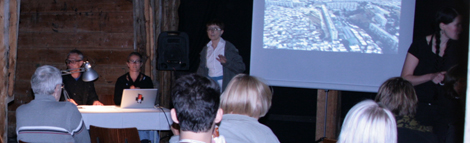
"This", says Sabine Bitter, " is what interests us, places that once held specific promises, that were of some sociopolitical importance. Then we dig and find more things surrounding them, and in the end we can build projects." Projects that can lead to surprising results, like in the Caracas one where they took the venezolan constitution overhauled by Chavez - with the help of the people, of course - and transformed all this into an ascii text forming the superblocks mentioned before. This image was mounted in subway stations in Caracas, leading people to proudly point to parts they had a hand in crafting, but also to wildly discussing current politics. Asked if there were attempts at destruction, they decline. "But maybe only because the stations are well-monitored." Having gleaned a glimpse of their approach, I for one am sure, if it had happened, they would have found it interesting. mp
Peeking through Corners
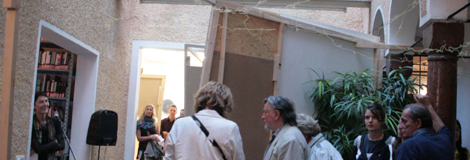
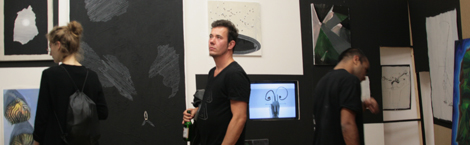
Yesterdays vernissage at the gallery Galerie 5020 saw it completely transformed. Normally a collection of spacious rooms, it had become a labyrinth, leading people around newly-constructed corners and into nooks and crannies. The effect was heightened by the droves of students, teachers and other people associated with the summer academy that had come to this opening.
A concert given right in the gallery by Steve Mathewson and Torsten Mächtel rounded off the evening. Even they went along with the general theme, playing half-hidden between bookshelves.
All in all, the gallery is presenting a very diverse exhibition that is definitely worth going back and looking at in peace. It will be running under the title living on the edge of a silver future, part I until the 20th of August. The Gallery is open every Tuesday to Friday, 2 to 6pm, and from 10 am to 1pm every Saturday. http://www.galerie5020.at/ mp
From Nothing to One
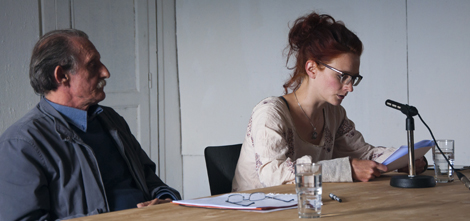
Yesterday saw a radical break with standard lunch talk practise as Mladen Stilinovic not only deprived the audience of images of his work, but didn't go into his artistic curriculum at all, instead focussing on his pursuit of language, a central theme in his works. Even a small performance was in store as his students, scattered throughout the room, proclaimed some of the slogans he had coined throughout the years, taking many of them from people he heard talking on the street.
The most interesting part though must have been the presentation of his very own philosophy of laziness. "The artist in socialism has nothing to do but be poor and lazy, thus he can make art." he says, smiling impishly. For him, the balkan is still transitioning, so it will be interesting to see what happens to this laziness he says can only come from a socialist culture. A great discussion ensued as this concept seemed to really puzzle the mainly western audience. The way the writer of these lines understood it, it means working from the void. Because there are no distractions, one can fully be involved in art, transforming everything one comes across into it, completely unperturbed by the rest of the world. Asked if he is still lazy, the artist replies that "it gets harder all the time, so I try harder, as well." It remains to be seen if he can pass his concept on to his students. Judging by their enthusiasm, he's on the best way there. mp