
| « An Interview With The Director Hildegund Amanshauser | Senses » |
An Interview with Nina Prader
Could you tell us more about Lady Liberty Press?
I call myself Lady Liberty Press, which I consider my label. It opens up this field. On the one hand in the word Lady Liberty, there is freedom, but on the other hand there is this idea of the printing press, PR, or “the press” as writing about something. I’m making the product, the book, but also the content. I define my practice in the field of printed matters. This field is so wide and gives me the freedom to work with everything from a zine to artist book, a comic, radio, culture journalism… Being an artist is such a lonely thing. I always want to connect with and learn about other people. I think the best art is usually an exchange. That exchange takes place for me mostly via things like books, writing, interviews or how you relate to an image you see in a book. When it comes to distribution, you can share on a wider scale. I’m really old school still in the way that I think paper has a radical potential.
Or radio…
Yes. In a way, these mediums are becoming ftihzd*. They used to be the main form of media. Now, radio doesn’t really exist in real time as something you access. I think more people listen to my show Paper&Tape as a podcast than onair. In that sense, the show is like a performance. The aftermath of it spreads.
Stretched in time…
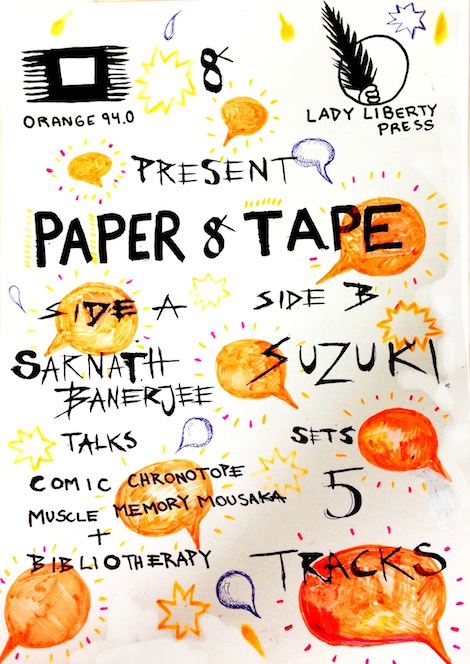
The same thing goes for books. Artist books are becoming such a big thing in the art world. Zines are even entering the art world or university archives, where they have been put on pedestals in a way. They used to just be a way of actually getting people to come to your music show or to get people to come together. I’m interested in those things. Or how a flyer can be political and now a flyer is also just an art work… For my radio show I draw a new flyer each time. I barely use photoshop, when I scan it. Then it can be a little more blown out or trashier. This idea of having trashy flyers on the Internet and on the streets… But, they are originals or an edition of a poster, rather than just being information. I’m adding an aura to them.
On your webpage, certain keywords got my attention such as remembrance, labor, feminism, consumerism; exile, migration, resistance. Could you explain more why those words are important to you?
For me, there are two types of art. Art as a product that has a market value, but then there is this part of me, who is a total ideologue and thinks that art is actually a process; art can make visible the unseen things or maybe even heal conflicts in the world. This may be too big but it’s a good idea to follow. On the one hand, I’m dealing with printed matters, these physical things, but then I’m also dealing with conceptual subject matters like labor conditions, pop feminism, remembrance culture…
Sounds like a utopic approach…
I love the idea of utopia, but I also think utopia can only happen through hard work. I’m working on a series now called Sweat Utopia. Sweat being the juice that is produced in the making of utopia. Ideals that maybe can’t be achieved but must be tried. It’s a good motor.
Will it be a zine as well?
Right now, it’s little fragmented comics. At the end, it might become a zine. I haven’t quite figured out the format, yet. I feel like, the tools that I have to interact are always through art. The way that I define my art practice is through text, image, translation and social practices or performative gestures. That’s my way of trying to tackle these massive subject matters. I don’t think I’m going to cure cancer, but… (Laughter) But, I think writing or finding new forms of visual representation can shed light on blind spots.
* Some words are censored by the server itself such as the word p0rn (I'm trying to find different characters to write the words). Facepalm...

