| « Revealing and Revelling in the Process | A Utilitarian Art » |
History and the Studio
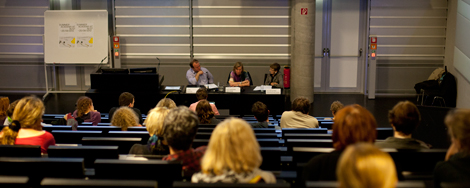
Last night saw the first in our evening Lecture and Discussion series, at the Unipark in Nonntal. We began with a consideration of the Summer Academy’s theme of the “Studio” from two different, but complementary, perspectives.
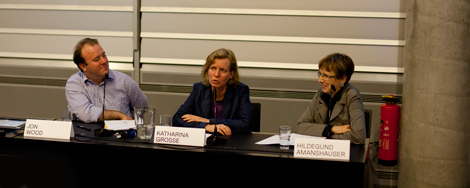
Jon Wood, Research Curator at the Henry Moore Institute in Leeds, provided us with a historical overview, as seen in the photographs of sculptors’ studios from the late nineteenth to the mid-twentieth centuries. The studio, for many, is a curiosity, a physical representation of an artist’s mind, the site of creative endeavour. Its photographic representation, often staged and contrived, can be an artistic statement in its own right, as the studio functions as a stage upon which the protagonist performs his role as “artist”. Yet if such images undermine the notion of the camera as purveyor of “truth”, these images do allow us to see how artists conceived of their studios, and how they wanted these places, and themselves, to be seen. In this sense they remain a valuable insight into what studios were, and how they have been constructed, in the imagination of the artistic community.
Katharina Grosse, a Berlin artist, continued the evening with a personal reflection on the role and meaning of the studio. She developed these ideas - examined in depth in her 2009 volume, Wish I Had a Big Studio in the Center of the City - in terms of the convergence of physical and pictorial space in her work. This was amply illustrated with recent “in situ” examples, such as Blue Orange, her 2012 transformation of the train station in the Swedish town of Vara. Her studio, like those of many of the artists described by Jon Wood, is itself a statement of her art. It was built according to her needs - providing a contrast with the many artists whose studios were built, and thus are restricted by, the needs of previous occupants. Located in the centre of Berlin, it allows her to be visible - to be seen - as an artist, generating the performative aspect which the very construct of the “Studio” embodies.
The lectures were followed by a lively discussion, in which the audience engaged with the speakers, developing the themes in new directions such as psychoanalytical readings, and drawing connections between the two talks.