| « Recalling the Favourite Day | Fine Small Movements » |
On Books with Bernhard Cella
In the book NO-ISBN on self-publishing created by you, Leo Findeisen and Agnes Blaha, there is a text by Ulises Carrion, who says: ?The book is a time-space sequence.? His text was written in 1975, and of course, the understanding of the nature of time and space was different back then. In this sense, how would you reinterpret this sentence? And how does this statement relate to the recent discussions on book making in the so-called post-digital era or the trope of the ?death of the book?.
In 1970s, that kind of publishing the author was talking about used to be done only by a few people who had either access to technology or the money to commission services. By contrast, self-publishing today is a mainstream act, there is a possibility for everyone who wants to publish as a result of digital printing or Riso print.
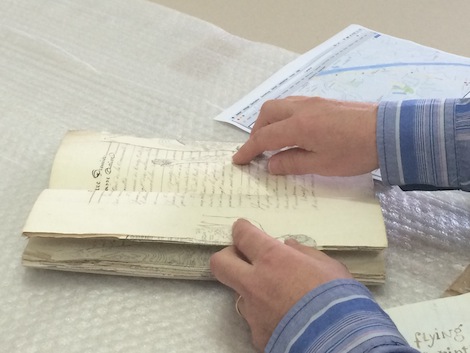
We could say that the internet became a mass medium in the year 1995. From that point onwards, everyone could use it. Then, from 2000 on, social media started to have an impact on our experiences in day-to-day life. I still call myself a half-analog person. I remember that we had no digital experience at all during my childhood. At university, we started to use computers in relation to artistic production. Today, we have more options and the question is how to combine analog and digital media. Books are still the safest way to contain information. Digital media, like DVDs or flash drives, are still not safe from the ravages of time, from becoming unusable after a few yearsThe only medium that can accomplish this like books might be analog-film, but even they start to decay after about 50 years. Tomorrow we will visit the archive of the University Library to see colored prints from the 15th century. Imagine! 600 years of preservation! It will still take some more time to find a way to save digital information for such a long time.
The boom of self-publishing is only possible in the context of new media and internet. The publishing scene around the world is very diverse. Without trying to copy the professional publishing world, they just create their own environment. We see a completely different phenomenon compared to what Carrion was reflecting on at his time. His text is still very interesting to read, although it?s 40 years old ? quite exeptional.
Yesterday, you also mentioned that until recently the history of self-publishing had not been written properly and that some crucial characters, such as Lucy Lippard, who is one of the founders of Printed Matter New York, were even excluded. Why is that?
Well, don?t ask me why, because I honestly don?t know. For some reason, she was not always mentioned, when the history of Printed Matter was written.. But she was still present, and I think nobody would reject the fact that she was a part of it. The way we deal with memory is constantly changing, but I think we?re now living in a time when people are becoming more precise. Today, they do more research than thirty years ago, when you couldn?t have done something like this, because you didn?t have all this information that is available online today.
Could you briefly explain the schedule you follow for your class?
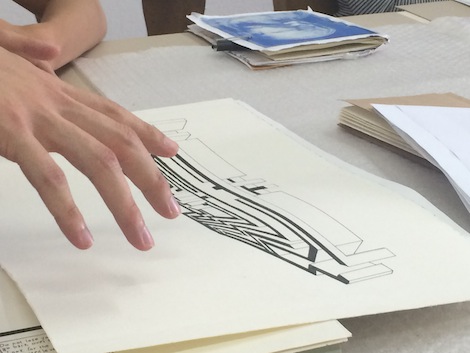
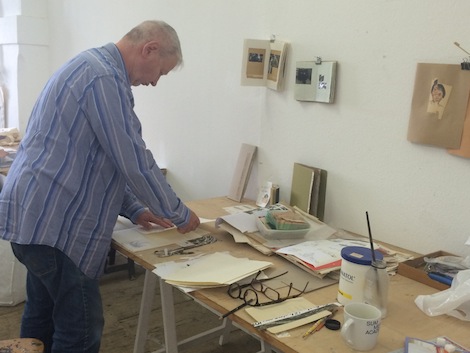
The course deals with the status quo of the printed book and concomitant questions. It enables participants to design and develop their own publications, from the initial idea, through the conception, right up to dummies as a finished product. You create a form, fold the paper, make sketches, you translate your idea into pages and make a timeline? We negotiate how to use the medium for our own interests and we also talk about typography and design In our course, we try to investigate the various approaches and forms of production for our project. These include analyzing pictorial language, different formats and varieties of paper, methods of text production, typography and typesetting techniques. Images, text, the hierarchy of content on the page; different schools of the past? Last week, we were talking quite a lot about theory and analyzing artists? publications.
Everyone in the class has a different approach. Most students are artists. They have a distinct way of dealing with the medium of books in comparison to graphic designers. One student is doing a PhD, so she is trying to find a way to organize her thesis. Before getting into printing, you have to rethink the whole concept. At that point, you have to reprocess the structure of the publication and sometimes the content as well.
Here comes the cheesy question: How do you organize your own library?
My personal library is organized simply by topics. Sometimes I pile up the books that would benefit for a particular project I am working on at that moment. The idea to sort books by color resulted from my studio work.
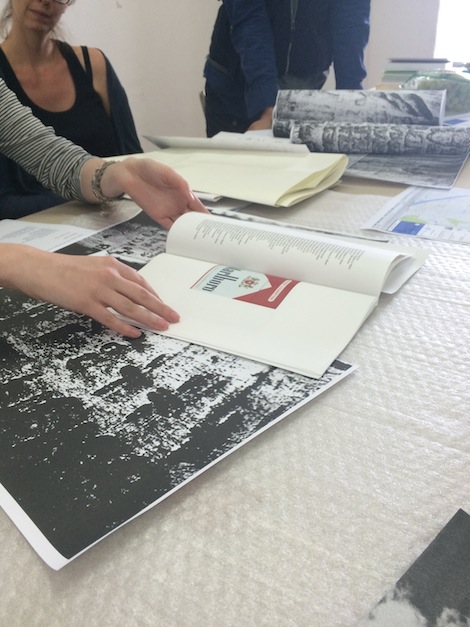
When I first opened the Salon für Kunstbuch in my studio, visitors often asked for certain topics, such as photography, sculpture, or theory. When you enter a space that is filled with books, of course you try to find a way to get an overview. Therefore, I thought that breaking the usual order, which is based on topics, might help to encounter new books. By re-arranging the books according to colors, the readers are lost at first, and then they find something new and unexpected.
One specific quality of art books is that the colors or their sizes have a specific meaning for their design . A multitude of expressions finds a way into the design of a book. This is a part of the experience, and part of what makes them attractive to me and to many others who live and work with books.