
| « Paintings Walked | A Letter to R » |
Pointful Walks and Excursions
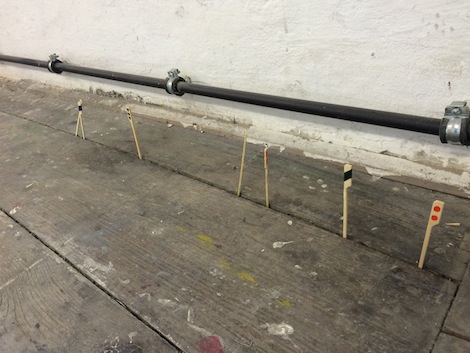
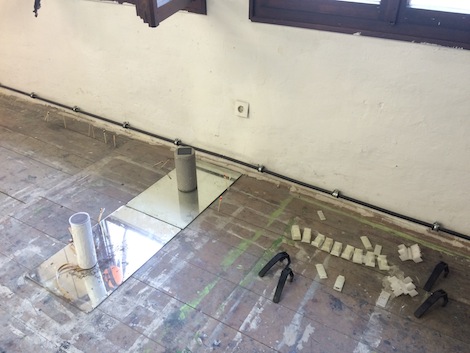
G: Why did you decide working with these particular objects that you name as "lexicons"?
MC: The subject we are studying in this course is “walking out sculptures.” We were talking about interventions, particularly in an environment controlled like Salzburg. Very often, the intervention has to be you, because here you cannot make a mess. So, it has to be something you carry with you.
It really began with the objects, the imagery of the objects. I’ve first started with the coffee stirers I found that make quite nice markers. In my mind, I had a mental image of marks that appear on maps. From that I’ve ended up building this lexicon − a system of signs. But, it’s quite unconscious. It didn’t actually mean anything itself. From that, I thought what might be a nice idea is to start with a lexicon and trying to find a meaning.

G: What kind of signs were they? Did they just pop up in your head and through time you started to give meaning to them?
MC: Yes, it was quite subconscious. Often little red circles, like badly printed signs on cheap paper. The same thing was happening with the ink on wood. It kind of revolved as well: I began to use nail polish or gold pen for instance. That also became the part of the language.
I was looking for meanings to give to each of these symbols. I thought it would be a quite good idea to find a feature or even completely non-descriptive and mundane environment for the markers. So I just pursued from there.
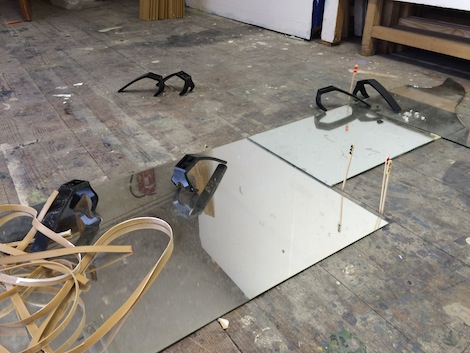
G: How do you choose the spot to mark?
MC: It’s quite spontaneous like the whole thing of Pointful Walks and Excursions. I start to walk perhaps with a particular idea in mind, but as the walk progresses you recalibrate. What originally was the plan is changed with an encounter on the way. It references to Guy Debord and psychogeography. It’s always much more about what happens during the walk. For example, in the first walk I took here, I found myself right out into the suburbs, at the city limits.
G: Although it comes from Guy Debord’s situasionist walks and you work intuitively, do you have a specific method?
MC: It’s more sort or circumstances of feelings that make sense. When I come to pick a spot, I try to vary it. There isn’t repetition. For example, the one in the middle of the traffic island has a certain kind of bathos as well. They are things, which you normally ignore…
G: Have you ever re-encountered them?
MC: Yes… But I think, I’m also looking out for them.
G: For the piece you have been working in the Fortress, you also use the markers.
MC: The space upstairs is like a central point. I’m going north-south-east and west – this afternoon, I’ll be heading for west. The writer, artist Alan Moore says that universe has many centres as people. Every person is the centre. It’s quite arbitrary, but I was thinking the space here as the centre.
G: How do you end the walk?
The end of the journey is pretty much determined by time, something as mundane as “the battery is out of the camera” or I just encounter a natural-kind-of-end. The day before, we were looking for the end of Salzburg and we never quite got there. I found this strange green tower. I’ve already made the lexicon before going out, so I saw an uncanny resemblance between them and that was the end.

