| « Seriously Comical | Revealing and Revelling in the Process » |
The City is Our Factory
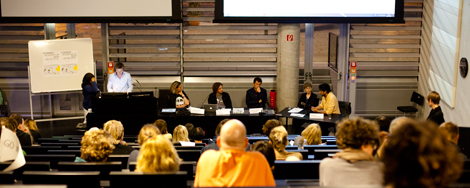
The second evening in the Summer Academy’s lecture series provided a detailed discussion about the role, construction and significance of the city and urban spaces in artistic production.
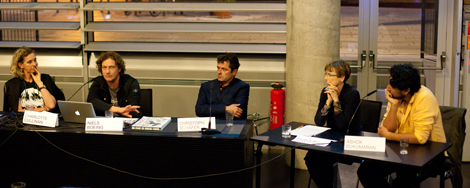
Christoph Schäfer began proceedings in his own inimitable style. Warning us that his talk would be “dry and boring”, he promptly climbed on to a table and proceeded to bark. A short song followed. Dismounting, he then began a sweeping overview of the urban and art. Drawing on Henri Lefevre, Schäfer outlined historical developments, ideas illustrated in his own work, especially the Lamentation for Ur. This suggested various definitions of the city, and art’s role and presence within it. He presented us with a new drawing, From Factory to Facebook, which illustrated new forms of collective production and subjectivity. Competing definitions of participation in art abound, as do constructs of the city. Salzburg, he suggested, is typical of the “image city”: it is “the last place where the bourgeoisie is really safe”.
Charlotte Cullinan described a specific project she undertook in Newcastle with Jeanine Richards. They wished to explore the city as production space, taking an “anti-avant garde” position: for them, “art is not about rational processes” but the responses of the viewer. Two evening events were held at the Laing Gallery, beginning with an invitation which was a “love letter to our audience”. The events involved constructing a “laboratory for viewing”, establishing a questioning nature to the status of the art objects. Cullinan showed photographs of the participants/audience, as they themselves viewed and interacted with the artworks. The experimental nature of the work disturbed some: “a lot of people got very cross with us”. This, perhaps, is the greatest sign of success.
Ashok Sukumaran introduced us to some of the work he has been doing with Shaina Anand, as part if the project CAMP, a space and work studio in Mumbai. He describes himself as an “archaeologist of media”, seeking to extend through the “networks which suck at us”. He has been thinking about the process of “temporalising the city”, utilising film and other media often produced involuntarily, with and without purpose. Through these media, he has been seeking ways to access or substitute intimacy within the city. The abundance of information left over by digital technology allows insights and access, in a virtual “positive voy*urism”.
Niels Boeing is a writer and thinker from Hamburg. He began by posing the question: what comes after capitalism? In the postindustrial age, we are still producers, but the scenes of production have merely moved from the western city to other centres. The information age has left many able to operate, but not understand on a structural or technical level, rendering them subject to others who do possess such knowledge. However, many are trying to reclaim the role of producers, with the rise of open source hardware, allowing individuals to gain this power. “Fab labs” have sprung up all over Europe, places where “manufacturing meets art”, a new sort of factory where individual needs and desire, not profit, predominate.
The ensuing discussion considered many of the issues centering around the notion of the city as a centre or a focus of production. A key point of contention was the idea of “reception becoming production”, and the question as to whether we should take a “ground up” or a “sideways view” when thinking about audiences as participatory.