
| « Studio Visit: Konrad Rainer | The City is Our Factory » |
Seriously Comical
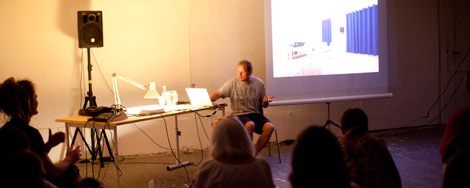
Olav Westphalen entertained us on Thursday lunchtime with accounts of his work, which embrace performance and the conceptual, often darkly comic and always thought-provoking.
Westphalen also works as a cartoonist for the mainstream media, revealing his understanding of popular humour and expectation, features which repeatedly emerge in his art. He shared some examples with us: his attempt to walk on water at Santa Barbara, California, was one of many performance pieces which tested the nature of public expectation. It expressed the comical - his attempt was aided by a preposterous array of flotation devices - and its ultimate failure became its most enduring quality. Such acts cannot, he insists, be practiced or repeated, because then they would become “theatre”, they would be staged, with a predestined outcome. The element of “failure”, moreover, cannot be contrived - it must be genuine to have any meaning.
Other projects have played with constructs of public expectation, performance and politics. His tree house in Kassel, which was too large to fit through the entrance of the museum, was, he claims, a “failed sculpture” - but nevertheless a “good enough sculpture”. Indeed, it became a “focus for local political expression” as it lay outside the museum. Far from failing, it garnered its significance because of the unique congruity of the expectations of what an artwork is, and the fact that it was, at the same time, the product of some guys “having fun in the forest”.
At times his work is both political and satirical: the Flip Flop Factory in Shanghai, or the brilliantly conceived Fertility Coop, function on many levels. His suggestion that art should not be taken too seriously reveals the comic elements which underlie his work. Often it is, quite simply, funny. But this humour also intensifies the serious, or at least politicising, elements. These features are integral to one another. His Extremely Site-Unspecific Sculpture (E.S.U.S.), exhibited around New York in 2000, was a deliberately ambiguous, and yet strangely utilitarian piece, exploring the problems built into objects. That it was mistaken by local drug dealers as a CIA listening device, just shows ways in which such art can provoke, and still, in the retelling, make us laugh.


