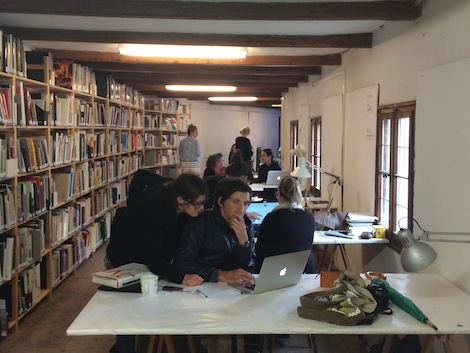
Because of the dedication and speed in the Academy, from time to time our minds resemble a chaotic jumble. Despite being extremely busy, art critic Kimberly Bradley answered my questions on her class Images into Words: Writing About Art and problematics around recent interest (!) of artists on immigration and asylum. It was a great pleasure to meet with the writer in person and to see that besides being an influential writer, she is, umm, so cool. (I know, I sound like such a groupie!)
The class is ending today, and they're working like ants to publish their zine on time!
G:This is your first time teaching art writing in the Summer Academy, however you have been giving classes on contemporary art in NYU Berlin. How is this new experience for you? Could you explain the structure of the class more?
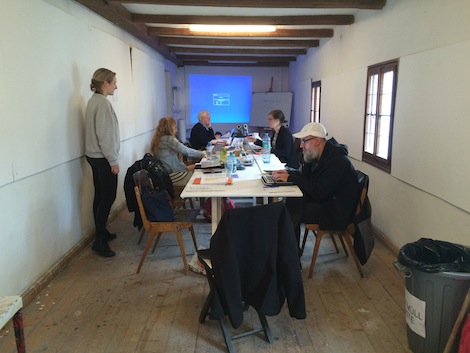
K.B: It’s been pretty fantastic, intense, and temporally so different from the NYU Berlin classes, which go over 15 weeks. My students at NYU Berlin have a week to write each short assignment – the Summer Academy class has managed one piece of writing every day! We’ve been alternating discussion and viewing art with writing exercises and a good amount of homework. Important points have been how to look at artwork and exhibitions and respond slowly, then quickly. We did a “freewrite” on Tuesday, in which the students had to articulate their first responses to an artwork I showed as a slide on the wall, which happened to be one made years ago by my colleague Senam Okudzeto – freewrites break down inhibitions and gets students to trust their instincts. The past two days we’ve been working on how to revise one’s own texts, and we're also putting together a ‘zine – a collection of writing from the class in digital-magazine form. I also give mini-lectures on the mechanics and strategies of art writing and issues around art criticism; these have been more lively as the week has gone on.
G: Recently, as mentioned in your talk, you have been working on a piece focusing on the problems that refugees in Vienna have been dealing with. Could you tell us more about it? I was also wondering how you observe the rise of artists working on topics related to refugees.

K.B: I actually published a long-form piece on the topic in late May, for the publication produced by the Austrian pavilion for this year’s Venice Architecture Biennale; its overal curatorial theme is “Reporting From the Front." The Austrian pavilion took this literally and created a newspaper documenting what its curators did – they sent three architecture and design firms to three refugee shelters (one each) in Vienna and come up with ways to improve not only the physical living conditions in the shelters but also to work long-term with refugees on solutions to temporal problems — one of the biggest issues is months, sometimes years, refugees wait for decisions on their status.
My essay was not about the architecture, but about the people living in it; their pasts, their current plights, their dreams. I spoke at great length to asylum seekers from Syria, Afghanistan, and Iran – some of the interviews were heartwrenching, emotional conversations – and put their stories into an Austrian context.
Otherwise, through earlier newspaper reporting in camps and train stations (!) during fall 2015, I’ve befriended several Syrian refugees and they’ve become dear friends who sometimes need some support, often just an ear. But the odd thing is that I feel a tremendous amount of support from them, too – just like them I’m relatively new in Vienna, and we laugh at the similar problems with “integration” we all have, even if my situation is dramatically different from theirs. Some of this might become a non-art related piece of writing. We’ll see.
As to artists working on topics related to refugees: There seem to be a few types of them. First are the superstars who’ve suddenly decided to make the issue theirs – most notably Ai Weiwei showing Lesbos life jackets everywhere and Olafur Eliasson’s recent show at TBA21 (art stars’ involvement, even if backed by good intentions, is highly problematic to me and a little too much to go into here — one of my Syrian friends asked me, at the TBA21 show’s opening in March: “Do these people have any idea about our reality?”). Second, a scad of other artists seem to be jumping on the topic out of guilt, the desire to feel better about themselves, or simply instrumentalizing the situation and doing one-off projects that are also quite problematic. Of course artists respond to their surroundings and always have, but it’s maddening for me to read Facebook posts asking “If anyone knows any refugees who could be in my art film for one day” and such things. So displaced people are mere art material?. Then, of course, there are those artists who’ve worked for years on identity, migration and displacement as well as geopolitics/history (Hiwa K, Walid Raad, and Wael Shawky are some examples from the Arab cultures). I’m even hearing from one of my young Syrian friends about artists in Damascus who are doing intriguing underground projects that no one on the outside knows much about. It’s still all a bit of a whirlwind in my mind but I feel a long period of research and engagement … and writing … coming on.