
24 / 30 Black Boxes
Yesterday, the darkrooms were inaugurated. The analogue film class by Cinéma Copains developed their first 16mm films. At same time the printing class by Elisabeth Schmirl built an improvised darkroom to work with cyanotype to create blueprints.
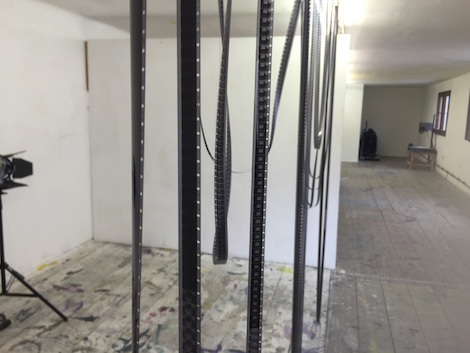
In digital times, both techniques with their dark rooms and analogue materials seem archaeological at first. Why is it important to learn developing analogue film when there are barely any analogue projectors anymore? Why to create prints in times of Indesign? I remember a conversation with Bernhard Cella a few weeks ago at the Festung. We were talking the importance of doing things yourself as an artist.
“In our society that relies more and more on abstract processes, you as an artist represent the opposite of abstraction. You represent for everybody else the knowledge how to develop a thought to a final object entirely by yourself.”
This is why Bernhard Cella became interested in making books, from the first idea to the final publication. The same motivation seems to be present in both the printing and the analogue film class: doing it yourself rather than relying on infrastructure. Hackers often talk about unblackboxing or reverse engineering in this context. They open a technical object and divide it into its different parts to find out how it actually works, to master all of its aspects.
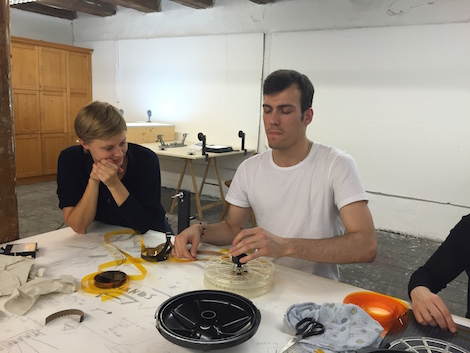
The first thing you notice is that the work in both classes is highly tactile. While digital editing and layout software requires mainly your eyes, for analogue work you have to engage all your senses. On this photo you see one of the students of Cinéma Copains practicing to reel film. His eyes are closed to simulate the lack of sight in the darkroom. His fingers have to rehearse the process several times and he has to learn to recognize the sound when the film is in the right position.
Analogue processes have also a different temporal structure. Making a print is not a workflow as in digital media. Oftentimes you have to wait for a material to dry or for a printing plate to heat up. These breaks bring forth a very different kind of working environment. When you visit Elisabeth Schmirl’s class you see a buzz of activities, each person working in its very individual rhythm. Many of the activities like applying colour are not cognitively demanding. One student compares them to short moments of meditation that are good contrast to the conceptual work involved in creating the plates.
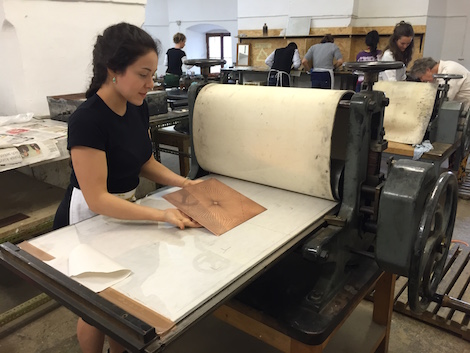
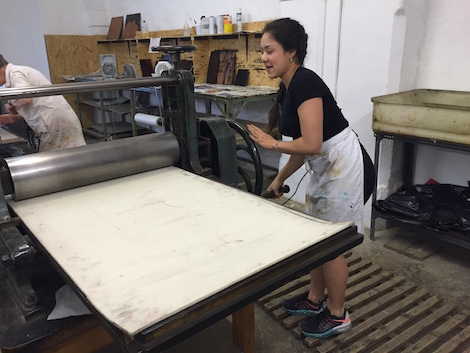
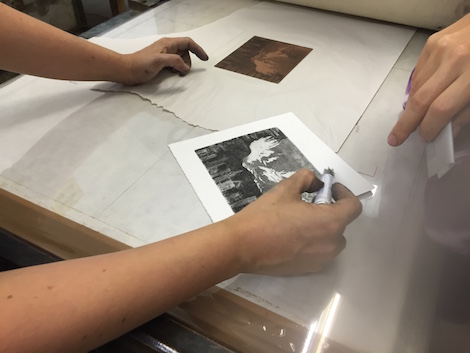
Probably coming back to these antiquated techniques changes also they way you work with digital media in the future. Not only do analogue media allow for a different expression and working rhythm, they are also a system counter-knowledge, an alternative infrastructure. They are a source for different working practices and hold alive a knowledge that is hard to appropriate by digital capitalism. As much as the revivals of vinyl records, as much do these alternative infrastructures wait for a return. This return will be unexpected and take on forms that cannot be anticipated, but some of us will still have the know-how.
23 / 30 Basic Research
“Basic research is what I’m doing when I don’t know what I am doing.” (Wernher von Braun)
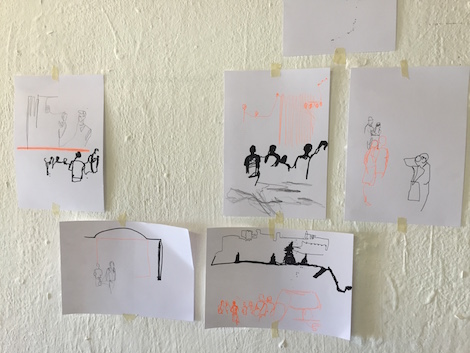
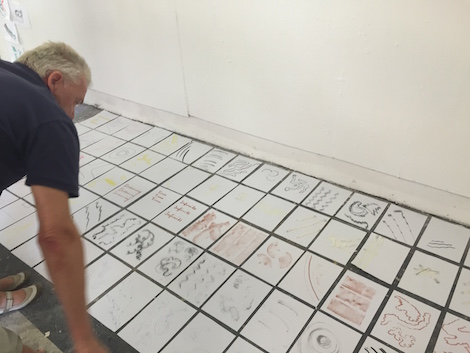
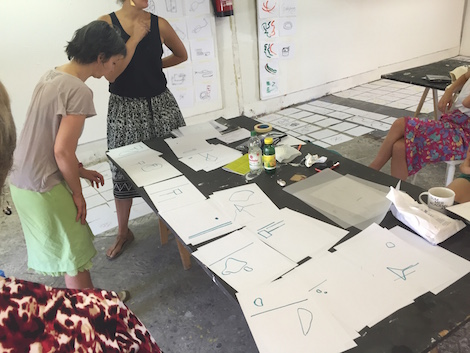
Three lines, a hundred times. This was the first instruction that Adriana Czernin gave the students in her drawing class. They had two days to create 100 drawings, each consisting only of three lines. “It is a concentration exercise, endurance exercise and an exercise to sensitise for the basic questions of what an image is.” I am impressed by the scientific rigor that the students develop in this exercise. Some students create subseries of ten or twenty drawings that focus on one idea.
What is a line?
Where does it start?
Where does it stop?
Is a line a movement?
Is it a space?
Is it abstract?
Is it figurative?
What is involuntary abstraction?
How does space come into existence?
All these questions come up in the discussion of the drawings. They remind of basic research. They are highly theoretical. A single drawing is barely important for itself in this exercise. Often an idea only becomes graspable when looking at a series. You see how concerns and questions appear and disappear when looking at all 100 drawings of a single student. In our conversation Adriana Czernin tells me about how to develop a dialogue with one’s work and why art needs particular modes of experimentation.
Tell me about your course. What are you doing and how did you start?
My course is about relationship between form and content. The relationship between form and content can be really dynamic during the process of creating something. You can start with a vague idea and after some time you look what actually happened. Sometimes it turns out that the result is not the idea that you initially had, but it might lead you somewhere else. Then you ask where does it lead me? Do I want to go this way? Do I want to work out more what is already there or do I go back where I started and look for another form for the idea that had? Or you do it the opposite way: you start with a form and that might lead you to an idea or content. This is a process that appears in almost all practices: a kind of a reflection that you have to develop as an artist. In our conversations, I really try to get students to start a dialog with their own works. They should learn their how works speak to them, as much as they speak to their works.
How does this work? How can you support such dialogue between artists and their works?
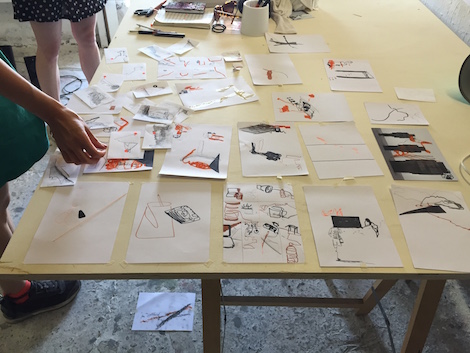
The students tell me about their ideas through some first drawings. Then I ask them to articulate and formulate in words what their intention is. Where do they think it will go from here? When I realize that what they are saying about the works does not match with what I see, we talk about it. I want them to understand that their work can look very differently to somebody who is not part of the process. I don’t say that my perspective is the right one, but I tell them that another interpretation than their own is possible. For me those attempts to articulate, to speak and to look are really important.
When observing your class, I found that experimentation plays an important role. Is that also true for your own practice? Do you also develop a series of drafts to arrive at the final drawing?
I often approach my drawings very slowly. I have to encircle an idea and go through an entire field of ideas to see what is actually possible. Most of the time these processes take a long time. I know that there is something, but I beat about the bush and I don’t arrive at the point where the different elements work together and lead to a concentration that is necessary for a work. Then at a certain moment, I find the right form. But I don’t stop. Through this form I then can look back at the entire field and I see what is possible. Sometimes this already leads to the next work.
You say that this process takes a long time, is that particular for the medium drawing?
It is specific for drawing that you don’t work that long on one piece. This is a great advantage of drawing: you are able to keep a phase and then rapidly go to the next one. After some time you have a collection of these different phases that you can then examine. You can realize that there is something interesting happening at the beginning of the series that later is lost, but then something else appears in the middle of the series that is absent at the beginning. In a next step I can then bring together these observations and work with them.
What do you do when you feel that a student is lost?
In such a case I really try to encourage students by looking at what they have done before. And I ask them: what are you mostly attracted to at the moment. When then say, I really want this, but somehow it does not work, then I try to find promising aspects in their work and point them to them. Maybe they have to go a little bit more consequently in one direction.
So you say, when you are lost, it is important to look back. It is important to ask, ok how did I get here?
Exactly, often the solution comes out of one’s own work. Stepping back often helps, because you can see with more objective eyes what is happening here. Every work changes according to the position you take towards it, at least you can change the focus of it. It also helps to see different works together that seem unrelated at first. Comparing these apparently unrelated parts can also help.
The most important thing is the process: that we talk, that we discuss, that we make, that we try out different techniques.
22 / 30 Writing takes time, writing takes space
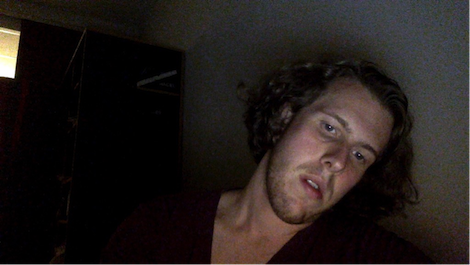
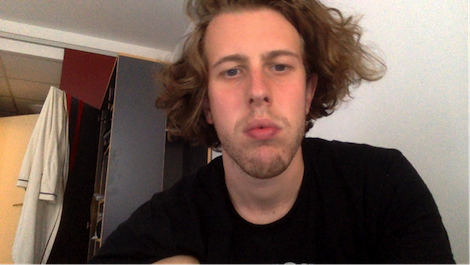
What does your body do when you write? For this text my fingers touched the keyboard of my computer more than 10000 times. The final version is 6290 characters long (including spaces). It took me about five hours in total to write it. And I wrote it at three different locations: at my desk at the Festung, at the desk in my room and in my bed. Why do I tell you this? The interview with Jennifer Allen about her writing course has been a self-referential experience. We talked about writing as art, the process of unlearning it and overcalculation.
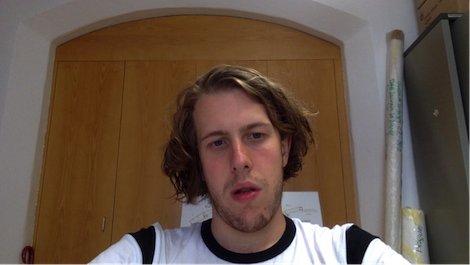
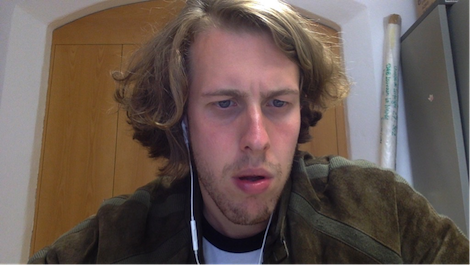
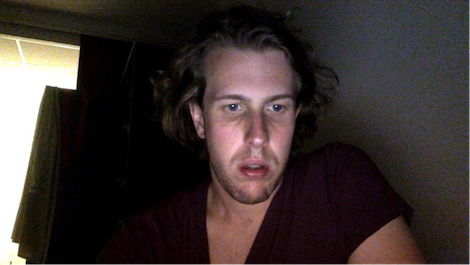
The photos in the text were shot by a programme called LifeSlice. It automatically takes a picture every thirty minutes. They document what happened to my face while writing this text.
What your course about?
The course is about re-learning writing as an artistic medium. So it is not so much about the content or style or grammar, but more about writing as medium. If you see writing as a medium it is really close to making mosaics. It is about one little piece, one letter after another and how it grows like that. Once people re-learn writing as physical, bodily, temporal and spatial medium of expression than they have a lot easier time doing it.
Why is this re-learning important?
We tend to abstract writing. We treat it as such an abstract way that no one thinks about the body anymore. I just showed a text that I wrote. It is three pages long, single spaced. It contains 13.000 characters including spaces. And that really brings it home. I touched the keyboard 13.000 times to write three pages. This is not a long text. But then if you think: try to walk 13.000 steps and see how far you get. Writing texts is really boring. It is tedious work. You may as well be counting lentil seeds. Seriously, 13.000 characters in a short text. Just imagine how many bags of lentils that is. You don’t even think about that. Everybody is like, well it is not serious enough, it has to be more poetic. But for your fingers it is 13.000 times hitting the keyboard.
It’s interesting that you say you want to teach the artistic side of it. In most contexts writing is very functional.
You have always two sides to writing: a connotative and a denotative side, something that is direct and something that is indirect. Art is obviously supposed to be indirect. If you say, this is a painting of my mother, which is about sadness, then it is not interesting to look at. As information it is completely exhausted. Art has many different meanings and you can always re-interpret it. Whereas if you take the exact opposite this would be a traffic sign: no parking at any time. It is very clear. There is no question about how to interpret it. That is the problem within language itself: you have these two poles.
Who are the people in course?
So we have two tendencies in the course. We have artists, who are coming from the indirect side and who had artist training and now want to become writers. Their problem is: how do I get text more direct? If you want to write a curatorial statement, you are going to reach a huge public. It could be professionals, the press, so it is going to have to really direct and simple. The other students come from art history. They are coming a very direct way of writing. They want to go more to the artistic side of writing. How do you bring that direct language to something that is somewhat indirect without killing it?
How can I imagine this process of unlearning and relearning writing in your class?
I think you learn it through your body. If you try to write a sentence with lentil seeds, you will be aware of what writing entails. Another person had to write with toothpaste. That was a really interesting exercise. One student who wrote with plastic letters used all the letters to write words with them. The one with toothpaste wrote one sentence and then gave up. I find that interesting how people use the materials. You get a physical sense of it. And then we have in the afternoons these collective workshops. They are called ‘kill your ego’, ‘time’ and ‘space’. So you re-learn it spatially, you re-learn it temporally and then what we do in the afternoons are studio visits. So each person gets to present a selection of their texts.
What do we tend to forget about the temporality of writing?
You don’t know how much time is put into one text. James Joyce would work a day on one sentence or even a week. Then you have this really famous Belgian crime writer, George Simenon: he would write an entire book in three days. He would come out of them and would have migranes and throw up. He wrote more than five-hundred books in his life. The time of writing has no relationship to the time of what you read or how long it takes you to read or the amount of space it takes up. So that means you have to impose your own temporality on writing.
Does that also count for space?
Text is about space. Above all it is about space. In a drawing you could sketch your face really light. You can’t do that in a text. You have to type every single letter every space, period and comma. There is no skipping over. I compare it to a dinner party. The first time you made a dinner party you probably didn’t make the right amount of food. You under- or overcalculated. That happens with texts, too. People don’t have a feeling for space. Most people have way too many ideas that they try to say when they don’t have enough space. I literally say to my students: walk the text. Walk the words with your body. Can I say all this in 200 words? Most people can’t.
I assume that at certain moments in your class people have to deal with a writer’s block or other resistances towards writing. How do you deal with that?
I haven’t seen that problem and I was quite surprised about that. The quality of the texts has been really good. I think when you are writing in a group it is like learning to swim. When you are alone, you are like: ‘I don’t know if I want to go in there, I will better lie down at the beach again.’ When you are in a group you are: ok when everybody does it, I can do it, too. I have never had a situation where somebody was completely blocked. We think of writing as solitary and special and sacred, but in fact it does not have to be. I think already the group experience helps a lot to kill the ego. Everyone is in the same boat, we all have to do the same things.
21 / 30 The legacy of gazes
Is it not strange that we 'take care', rather than giving it? We take care of something or of somebody. We say: ‘take care’ when somebody leaves on a journey. But what is it that we take when we take care? A sorrow? A fear? A concern? In German Kummer (sorrow, grief) and kümmern (to take care of something or sombody) describe the same relationship. Taking care means sharing a concern or a sorrow. Maybe care requires both: the taking and giving of concern.
The visit to the zoo has left its traces in the exhibition of Maha Maamoun’s class. Many of the pieces in their exhibition address the experience of looking when visiting a zoo. One example is Pavel Matoušek’s land art painting Untitled (Pre – History). He installed an old telescope in one of the windows of the exhibition space. Through the telescope you could see him spreading 40 kilograms of flour on a field in the valley some kilometres away from the Festung. The flour attracted all kinds of birds that became part of the painting.
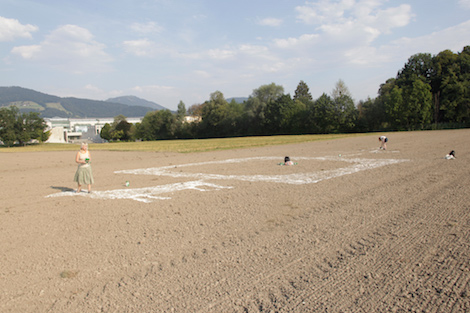
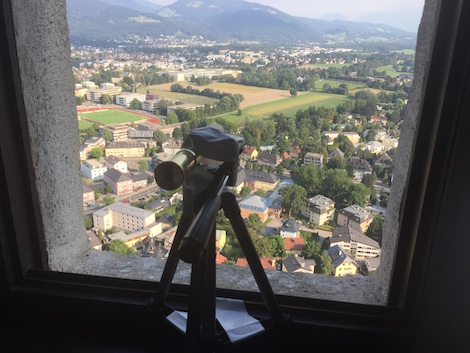
“The place was important for variety of reasons: it is visible from all around the castle, from all the tourists telescopes as well as from window of our studio. Secondly, there is a main walking path from fortress to Hellbrun around that field. And thirdly, the place itself is very pretty, with nice view from the fortress and there is a football field right next to it. With all those lines it somehow reminds me of a drawing. And of course, it is about a correct distance for the telescope.”
Witnessing Matoušek’s, we see an instant tableaux vivant coming into existence: an ephemeral zoo made up of ‘free’ animals. They only become the subject of our attention through the old telescope. You realize the constructedness of zoological voy.eurism.
On the opposite window of the exhibitions space you could find another site-specific installation. Martin Bolatti from Buenos Aires collected the sounds of orgasms of different animal species for his piece What do you see?. He edited these sounds into a soundscape. Listening to the looped track, we as viewers were invited to sit down and look out of a designated window.
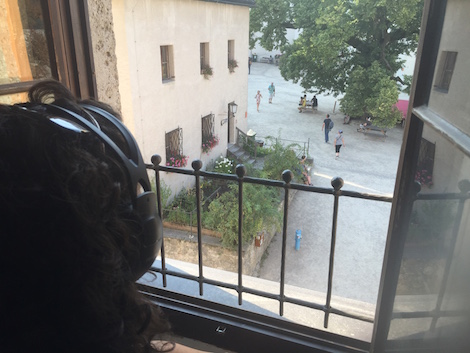
From the window you could see the tourists visiting the Festung. The sounds of the installation turned the idyllic view on the court into another zoological experience. You instinctively connected certain sounds to the movements of passing tourists. Again the strong immersion of a zoological voy.eurism is activated and transgressed. Not only become the tourists figures of an animalistic spectacle, they at the same time remind us as viewers of our own zoological voy.eurism. Both pieces create a self-reflexive observation that poses the question how the construction of a gaze changes what you are looking at.
This care for the legacy of gazes was also a concern in the exhibition of Tobias Zielony’s class. Silvia Scheid’s photo series Street Studio consists of minimalist portraits of refugees in Salzburg. In contrast to press photos that show refugees in their miserable shelters and create icons of suffering, Scheid’s photos avoid any background. She brought movable colourful background panels to the shootings. Erasing and simplifying the background allows to see her protagonists beyond their social role of refugees. Yet, oftentimes a little detail from the actual background remains uncovered. This renders visible the process of covering, too.
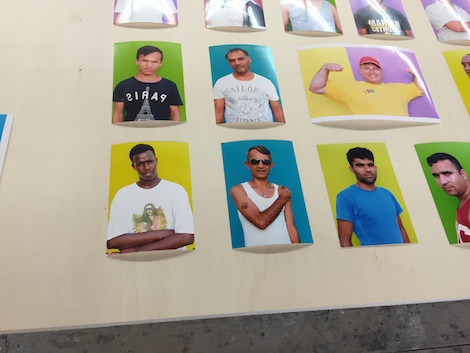
When I descend the Festung after the exhibition all these images are still on mind. Yes, gazes have a history and they have a legacy. Just as our bodies, our gazes are the result of evolutions: biological, cultural and political evolutions. As artists and writers we have to deal with these pasts and have to wonder: which gazes do our images and texts enact? Which gazes do we reproduce? Which one’s do we avoid and set free for extinction?
20 / 30 Intimate materials
Time passes differently at the quarry. I get this impression when preparing my trip to Peter Niedertscheid’s stone sculpture class. The class is living and working for four weeks at a quarry at the foot of the Untersberg south to Salzburg. If you google Untersberg, your first hits are conspiracy theory forums and forums on esotericism:
“On the day of the earthquake in Nepal the Untersberg was bleeding.”
“The emperor Charlemagne lives in the depths of Untersberg. Once in hundred years he awakes with his court and goes to its peak. If he sees ravens, he goes to sleep for another hundred years, if the ravens are gone, he will leave the mountain to fight the last battle of humanity against the anti-christ.”
“Once a wedding party followed a small man into the mountain and after dinning there they fell asleep for 500 years.”
Many of the myths and theories about the mountain are about anomalies in time. When I arrive at the quarry and see the different stone sediments, I get an idea why the mountain is such an object of fascination for many. You see the layers in the stone and realize how small the fraction of time is that you inhabit as an individual compared to the time of the stone.
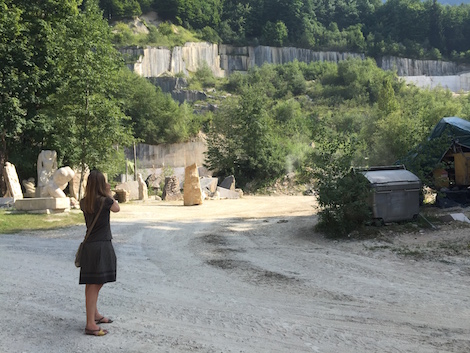
The students work with this stone, the Untersberg-marble. It is a limestone that is extracted from the quarry and has been used for stone sculptures since antiquity. “Everything starts with the material, you have take time to find the right stone to work with” tells me Peter Niedertscheider. Only on Sundays the class is alone in the quarry. Then the workers, who extract the stone leave the site. So, only on Sundays the class can stroll around in all parts of the quarry to look out for stones to work with. “Choosing the stones has to be in the morning otherwise one doesn’t see flaws”.
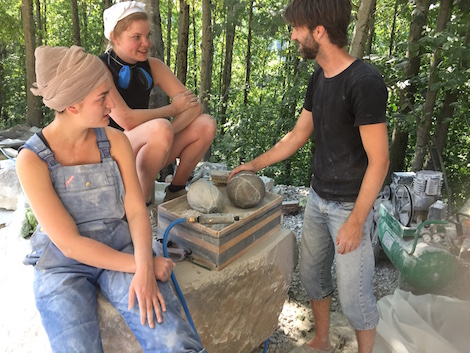
No class is more intimate with its materials than Peter Niedertscheider’s. Not only do they create sculptures. They are also studying the stones surrounding them: how is the stone extracted? How does it change after rain? How does the heat affect it? How does it smell?
When you watch them working, fine dust fills the air. You smell the stone and literally breath it. Peter tells me that every stone has its own smell. Most of the students work on small dimension objects, not larger than a head of lettuce. “The dimension is already a solution. You can transport it easier, it is much cheaper and you have more time to carve out details.”
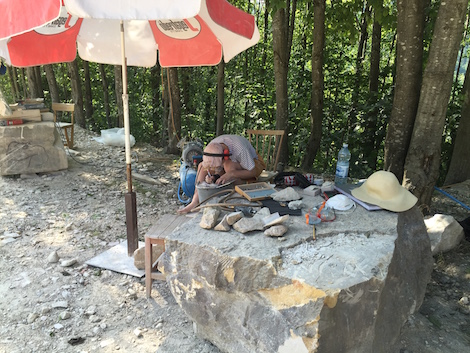
One of the students works on a sculpture of an apricot kernel of the size of a football. “This might seem easy at first, but if you watch carefully there is a lot of form in the kernel.” The tool she is using looks like a larger-than-life dentist drill. Peter tells me that stone sculpture is not taught at many art schools anymore. For most of the students this is the main reason for taking the class. They want to exploration stone as material for their artistic practice.
When I leave, I notice the soundscape in the quarry. I imagined it to be a silent space only disrupted by the sound of hammer and wedge forming stones. In contrast, you hear the buzzing of compressor motors, the whir of saws and drilling machines cutting through the heat of the afternoon. “It’s a matter of time. You can work much faster with machines” tells me Peter Niedertscheider. “Working with stone takes time, even if you work with machines."

