
Where are we running with our flag?

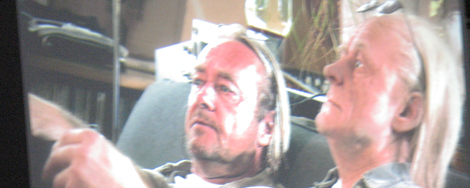
While you watch the two videos next to each other, both showing the run in the middle of the street with the red flag, one from 1968. and the other from 2002. you realize that this run is not only a political act but that in its core it has a very personal, very intimate memory. Question pops up if it is ever possible to run away from the memories you have? To run away, so far away, to a space where new language will be born and this new language will not make us think that we are all running after old models but it will be a space of new discovery.
I am not suggesting that originality is the most important to our third lecturer in the series of lunch talks and one of the teaching artists, Felix Gmelin. I would argue that he doesn't care much about it. It is not grand gestures that he seems to be after but this delicate change, this delicate new something that comes out of repetition. Let's see something new by seeing it again. Let's question the perception of the world around us and let us play in a sense with this idea of time. Remember that all this is a circle; we are all part of our own small community, then one bigger community and then the world. Why not reenact memories, time that was important not just for you personally but for the community we all share and see if the end will be the same or will it lead us to a new place.
The artist seems to suggest that the actions we take should be and are political ones. The questions you ask yourself and the questions you ask of others should be well thought through and answers received taken with respect. The individual should be respected and protected in this fast pace moment we are all in. The capitalism, globalism, all these -ism's have they taken away the right to the originality, to the individual?
With juxtapositions of two completely different videos that some may think never will go together Felix Gmelin suggests that small changes, juxtapositions of sound or of soundtrack can be the small actions to take so that the time is not possibly wasted in waiting for the big move. Act and see what comes out of a small action that may be the trigger to something new and to the new way we look at things. Allow yourself the moment where you don't know what will happen and explore that. Take that moment to be a moment of action and not stillness and fear.
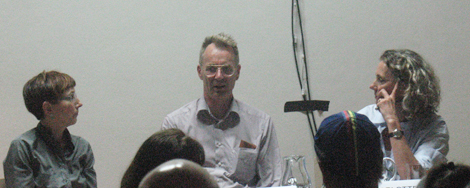
This notion of not knowing and exploring seems to have transcended to the first talk in the lecture and discussions series organized later on in the evening at the Kunstlerhouse. Stephan Dillemuth, similar to Felix Gmelin emphasizes the importance of the community, of the collaboration between the peers in the search for the solution to the problem artists, art educators face today. Issues talked about in the lecture, where more practical in nature and dealt around the questions of research methods in art today and how to implement these methods in art educational systems but as well as in art creation. It is here that Stephan Dillemuth explained more his ideas about the notion of "Bohemian research". It is exploring life by living life. It is realizing that 90% of experiments end in failure and that is why they are called that. "Go and fail but fail better."
Stephan Dillemuth was later joined by the teaching artist Charlotte Cullinan and director of the Summer Academy Hildegund Amanshauser in exploring more this notion of Bohemian research and also what the differences in teaching methods are and what in fact could be said that art research methods are.
What seemed to connect the day together in the end was found in the idea that the community is and in some cases again needs to be an important factor. That the run should be a relay run where we are all aware where we are and what we need to do.
Necessities for Hubert Scheibl
Word game interview with Hubert Scheibl created itself as a collaboration between me and his assistant Michael Koller.Both of us wanted to bring his best side out, that playfulness and open spirit and it was no surprise to me that with ease he said yes to the idea.
We thought that if the interview is done in this way it would be funny, interesting to the artist himself and what we would in return receive are little clues to who the artist is and what is necessary to him.
Ksenija Pantelic: Rabbit.
Hubert Scheibl : Field.
KP: Gold pot.
HS: Empty.
KP: Barbie doll.
HS: Clone.
KP: Six pack.
HS: Stupid.
KP: Ping pong.
HS: Great.
KP: Drive.
HS: Boring.
KP: Hotel Room.
HS: Doesn't exist.
KP: Surprise.
HS: Greatest.
KP: Small white dog.
HS: Favorite.
KP: Mushrooms.
HS: Mexico.
KP: Spider
HS: Louise Bourgeois.
KP: Silence.
HS: Necessary.
KP: Banana.
HS: Banana bar.
KP: Robin Hood.
HS: Children.
KP: Rainbow.
HS: Beauty.
KP: Voodoo.
HS: Necessary.
KP: Mirror.
HS: Lacan.
KP: Fortune teller
HS: History. Human history.
KP: Sunrise.
HS: Necessary.
KP: Luck.
HS: Necessary.
KP: Garlic.
HS: Memory.
KP: Chess.
HS: Special.
KP: Dolphin.
HS: They give names together. They are smart.
Tutti frutti day
The day starts with a train ride. I am on the move. Mountains are silent and still. They control it all. All before me and all that will come after me.
I exit the train.
"Entschuldigen, sprechen Sie Englisch oder Serbisch?"
"Serbian? Off course !"
Alte Saline in Hallein now in front of me. I run into a group of students from the Hohensalzburg Fortress.
(KP2: See, there is somebody that you know).
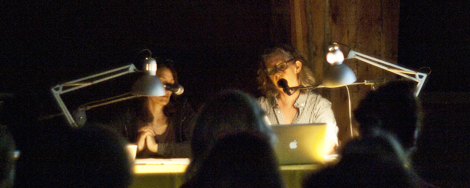
Now, let's begin the talk about cross roads. Let's talk about control and resistance, about professionalism and amateurs. Milena Dragicevic and Charlotte Cullinan have the floor of the old salt factory. It is the second lunch talk. Silence. Questions. Silence. When is the time to start allowing yourself the dignity to say "I can't", to say " I won't " and not feel like you have your tail between your legs?
Resist. Your work should be the resistance. As an artist be all and be nothing. Be humble but also lay down the law. Maybe sometimes not ruin things with the truth. Make sure all that you do is natural to you. How do you gain control in your life and in your work? How much should we all create? Where does the pressure to create come from? Should we stop? There is so much stuff around us already. Where do we go with it all?
(KP2:Please do continue to breathe).
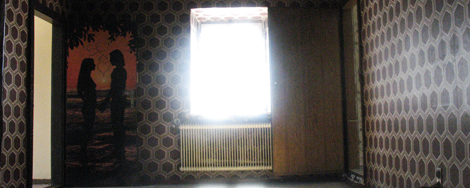
Walk again. Visit the old house where a butcher lived .Rumor has it he was imprisoned at one point in his life. Why? What is the history of the house, of the family that lived there? Thomas Kilpper with his student will research. They will implement their spirit, their energies and group dynamics into the space with heavy wall paper, patterned with boats, palm trees and big blue flowers. Up in the attic old sausages witness it all. They are still hanging there.
Think about how is the action of destruction sometimes an action of creation, "I can't "as a moment where you allow yourself to move back and make something completely new. Is this process something natural or is it a struggle? How open are you to change? The house has no say in it but I got the impression that she agrees with what students and their teacher plan to do. About what comes after they leave, I am not so sure. "It is a dream of modern architects", Thomas Kilpper says.
I am on the train again.
"Entschuldigen, sprechen Sie Englisch oder Serbisch?"
"Serbian? Off course! "
Go inside a mountain.Go to the top of the mountain and walk on the grass inside a concrete building of the Museum der Moderne Monchberg where Hubert Scheibl will guide us through the rooms and introduce us to his paintings.
Maybe not question everything too much now. If the paintings are moments of creation or destruction, possibly at this time this question is not relevant. Maybe let go and allow them to be just large scale marks in time that you can't repeat.
Is tutti frutti different colours inside one box?
Name the blog and just post. It is getting late.
How serious do we take ourselves Herr Kommandozentrale?
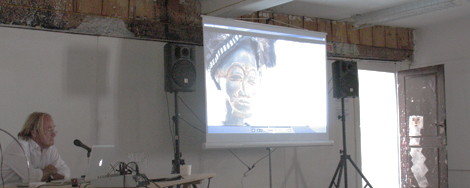
"One is born as an original but you end up as a copy " is one of the sentences that I picked up at the first lunch talk organized today at the Hohensalzburg Fortress. The first in line to break the ice was the artist, painter, lover of music and one of the professors, Hubert Scheibl.
Possibly as his alter ego or somebody that helps him organize himself and his work, in the video that opened the talk, we saw a life size figure, similar to the wax figures in Madame Tussauds museum of the artist himself, Kommandozentrale.I bring him up because I found that this work possibly reflects the artists views on the questions surrounding the lunch talk series. Apart from the focus on the working methods of the teaching artists issues surrounding the notion of professionalism, amateurism or who is a genius in the art world will be talked about and were talked about today.
The talk was organized in German but I decided not to use a translator. I have everything recorded but I wanted everything around me during the talk to act as a trigger. The movement of the audience and the reaction of the lecturer himself did at certain points make me lean to my new friend and ask her to translate for me. That is what made me think that something important, something interesting is being said at that time.
As an artist who considers the act of painting primarily as a very intimate and personal action, Hubert Scheibl presented his methods of working and his views about what art is today and what a role of an artist is in a very humble way.But, what you could also feel today was his playful nature, his inquisitive mind and his open spirit. Yes, I did get all this and I didn't understand a word.
Once asked by the director of the Summer Academy Ms. Hildegund Amanshauser who led the talk with the artist, if he considers himself a professional or an amateur, Hubert Scheibl answered that he considers himself a playful dilettante. If this is really true or not it was left open for all of us to think about. His works for sure do not look dilettante nor did I get a feeling that he is truly a dilettante himself.I got the impression that the artists was suggesting that maybe we should not take ourselves too seriously but not in the manner that we should not create serious works or be serious but that we should not be closed minded and stubborn in our views.
The questions about who today is a professional, amateur, genius are very difficult questions to ask. To some they may be interesting questions to ask and answer but today I got the feeling that other questions were more important to the artist. The questions about our relationship with nature, with ourselves, the struggles that we are all faced with and the idea that we all need to overcome ourselves to be able to function and move forward seem to be more pressing matters.
"Make sure you watch your paintings because they sometimes can come back and slap you in the face" was another sentence that I now decide to leave you with.
And off we go ...
KP: So, how about now, do you think you will be ready?
KP 2: I am not quite sure really. I thought that I would be less nervous then what I am. I mean it is just writing, meeting people...
KP: I know, but you will be meeting people that you will be interviewing about whom you don't really know much about due to the fact that A) your lack of research B) fear C) you come from Serbia...
KP 2: Yeah I know, but C is always used as an excuse, I should just Google.
KP: Did you google?
KP 2: I did google...
...........
And so off we go as the adventure for all of us involved in the Summer Academy of Fine Arts here in Salzburg has started today. First group of classes started in the morning in the amazing Hohensalzburg Fortress and the nearby Alte Saline in Hallein.
It is still quiet. Students are in their classes and in their groups. Few of them come to the registry office and ask for assistance. But as of yet we are all in our small groups,in the place that we have left behind and are willing to shed. The official opening and meeting of all of us is scheduled for tonight at 6 pm. At least 200 or 300 people are expected to come, among them the mayor of the city, member of the city government, different directors of cultural institutions along with their staff as well as students and teachers and organizers of the Summer Academy.
To be invited to participate and be the first blogger in residence during the duration of the Academy is more than a privilege to me. I did try to prepare myself, I did some research but let me be honest and tell you that I decided to drop everything I thought about doing and to allow myself to become open to all that is about to happen to me, to the teachers and students, to the organizers that have worked hard in organizing this year's Academy. In this manner I will try to let go of the filters that I am used to using and to see what this adventure will teach me. I can already feel that everyone involved in making this project last is truly committed to what they are doing.
A lot of things are coming our way and I am sure that all of us will be changed in the end. Some maybe for a long run, some maybe just for the duration of the summer. But I am sure that nobody can stay indifferent to all that is surrounding us at the moment. The city in itself has a feeling of a theatre stage, the location of the classes only emphasize the tradition and the long-lasting nature of the Academy.
Today, we all begin to play and explore.

