Goldextra
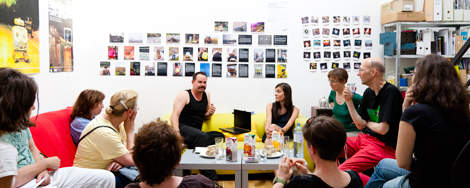
The series of studio visits yesterday took us to Goldextra, an art collective based at the Künstlerhaus in Salzburg. We were met by three of the groups members: Sonja Prlić, Doris Prlić and Georg Hobmeier. They explained the background of the collective, and illustrated this with some of their recent and current projects.
Founded in 1998, the group at pone point had some thirty members, although that has now reduced to six. The idea has also changed. At first they worked as an open group, bringing in many artists and musicians - at one point they even ran a record label - but now their work has become more focused. The members have different backgrounds, ranging from theatre and performance arts to media. Their studio space serves as an essential meeting place, as they each live in different cities, as well as a place to discuss and generate ideas. It also serves as a veritable history of the group, littered with remnants of previous projects and works.
Each member works both within and beyond the group, and the joint projects involve some or all. The work, reflecting their interdisciplinary backgrounds, transcend any one medium, and they are always seeking to expand into new fields. An example is their recent computer game, “Frontiers”. The game centres on migration and immigration, with gamers able to play either as migrants or as police/border guards. With the game, they hoped to engage a community not usually associated with politically aware art - the gaming community - in these sensitive political issues. The game has certainly proved successful, with over 30,000 downloads to date.
Other projects reflect their diversity, from the ethnographic 99 Ways to Die in Scotland, to Strange Accommodation, a project recounting the absurd variety of sleeping arrangements artists have found on their travels.
Did someone steal the dog?
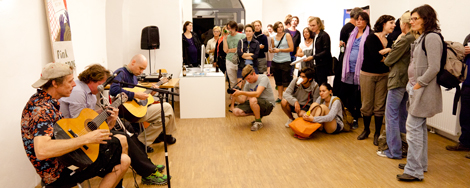
Stephen Mathewson is an American-born artist, writer and musician who now lives and works in Austria. His exhibition, Miami Deathwish 2, which opened on Thursday at the kunstraum pro arte in Hallein, reflects and transcends his range of interests, his quick humour and love of storytelling. When asked for a quote to sum up the show, he was quick to answer: “I love eating steak”.
The opening involved performance of several forms, including a recorded conversation between Mathewson and David Quigley, and a live performance of number of his songs. The relationship between the music and the visual art is a “greyzone”, never clearly defined or definable, but ever present. Matthewson can, however, explain how the creative process of the two forms overlaps: it is easy to “flood” your mind with too much painting, and music provides an outlet; but also while writing or playing songs he finds he often turns to the paintings and views them differently.
The exhibition is part of an ongoing story, which essentially revolves around dog-napping. In the end, the dog rescues himself, rendering the effort of the owners futile. It is also to be a record project at some point in the future, showing once more how the two relate. It was, he admits, really hard to do: but then, as many have said, anything worthwhile is hard to do - even if its just looking for the dog.
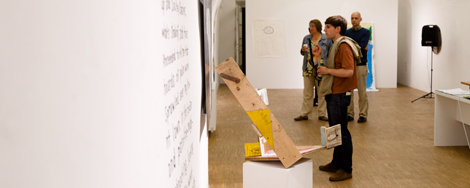
Architectures of time, form and meaning
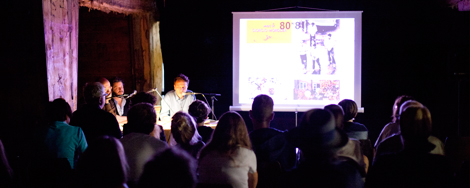
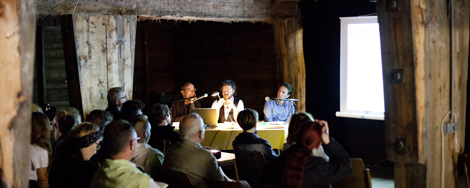
On Wednesday the Alte Saline in Hallein was the scene of a remarkable session featuring the diverse, yet complementary, talents of Christopher Roth, Harald Trapp, and Mathieu Wellner.
Christopher Roth is a writer, director and artist. He presented parts of his 80*81 project, which re-examines the crucial years of change 1980-81, which, he suggests, saw the end of communism and the rise of neo-liberalism. The project has led to a series of books, peformances and exhibitions, and covers a scope which is hard to summarise. In Hallein he did so by performance: a re-enactment of one of the most infamous events of 1981: the attempted assassination of Pope John Paul II, with Harald Trapp playing the Pope and Mathieu Wellner would be assassin Mehmet Ali Ağca.
Harald Trapp is a writer and architect who has been trying to rethink what architecture actually is, and working on a book seeking to explain what it can be. He discussed the notion that architecture originally was about hiding and concealment - and thus carries connotations of control and even suppression - in sharp contrast to contemporary notion of inclusiveness. In his attempt to visualise a grand theory of architecture he has returned to its roots and looked to its future, and realised the role of the observer in defining the concept of architectural form.
Mathieu Wellner is a theoretical architect who described a specific project titled “Transitory”. This involved finding synonyms for the word “transitory”, and then inviting a number of people - including artists - to pick one synonym and explain their choice and the meanings and connotations the word in question carries for them. The result is a complex of meditations both philosophic and aesthetic.

Sculpting ideas
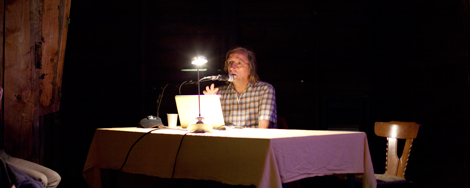
On Friday, renowned sculptor Manfred Pernice discussed his approach to, and ideas concerning, art. His sculptures are made from simple, everyday materials - plywood, one of his favoured materials, appeals to him precisely because of its low quality textures. These choices underlie much of what he does. He illustrated his talk with a wide array of examples of his work, highlighting various aspects and themes which have interested him.
Pernice often employs the work of other artists in his pieces. This collaborative process creates layers of art: paintings included within his sculptures remain works of art in their own right, as the work of the respective artist - but placed within the context of his work take on new layers of meaning. Diverse subjects and ideas arise, but some themes seem to be recurrent, such as place - from villages in Italy to new towns in Scotland - and industrial process, such as the linoleum and glass industries.
Many of his sculptures are not fixed in their construction. This, he suggests, is a more open way of considering sculpture. The particular arrangement of the pieces of a work in a certain exhibition need not be final: they can - and indeed should - be rearranged. The very multiplicity of possibilities is a key point of interest for him. How collectors who buy his pieces then choose to arrange them, of course, is another issue.
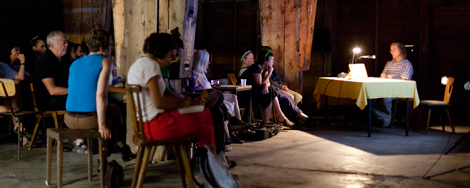
Being a painter in a man's world
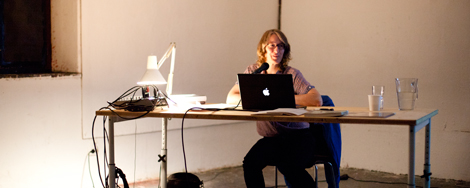
Katrin Plavcak is an artist who is prepared to ask difficult questions. Throughout her talk yesterday, she posed questions which were both rhetorical but also highly relevant: “are you an artist or a painter?”, “do you feel outdated being a painter?”, and “isn’t painting just an excuse to smoke cigarettes?”. Her work embraces painting - something she still strives to perfect - but also installations, sculpture, textiles and more.
Plavcak described her Berlin studio in detail, and how it functions in her work. Running a studio, she suggested, is a “conservative thing to do”, and she believes it is becoming less common. But it is nevertheless a central to her work: it is a place “out of time and space”, where she passes ideas through herself “like a filter”. One of the best moments in life, she says, is entering the studio each morning and viewing the previous day’s work.
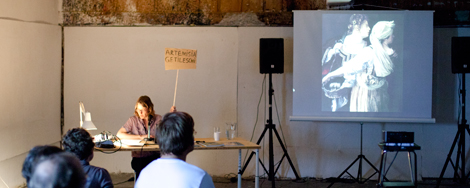
She also spoke about some of the women artists who have influenced and inspired her. Many are great names who were famous in their own lifetimes, but whom the vagaries of art history have overlooked or even intentionally ignored. Remarkable artists such as Sofonisba Anguissola, Livinia Fontana, Artemisia Gentileschi, Judith Leyster, Maria Sibylla Merian, Rachel Ruysch, Adélaïde Labille-Guiard, Rosa Bonheur, Elizabeth Thompson Butler, and Mary Cassatt. These were women who succeeded in an art world dominated by men and male prejudice, several of them becoming members of elite academies of art. They represented a defiant attitude - Gentileschi proclaimed that within her “bosom sleeps the heart of a Caesar”. Plavcak looks to these figures and also draws on Virginia Woolf’s “Room of One’s Own” to identify the qualities a woman needs to survive in the art world.