
From Science to art

Hanspeter Hofmann is a Swiss artist who lives in Basel. On Thursday he explained his work and his quite unique path to becoming an artist.
Hofmann did not train as an artist. His interest in art has always been self generated, leading to a quite different approach and way of thinking from many others. Initially he trained and worked in the natural sciences, and also studied and taught philosophy and aesthetics. The strict conditions of the scientific laboratory led him to consider how art could function under such conditions. His choice of painting as a medium was in part driven by the idea that it was less institutionalised - that he could work alone in a studio; although he now admits he was naive to believe he could work without others.
The development from the scientific to the artistic has defined his work. But it has not been an absolute change, as his backgound continues to give character and direction to the way he approaches the process of cultural production. Many of his paintings draw on patterns found in the natural world. There is also a sense of evolution: often he takes structures form earlier works and develops them in new pieces. His interest in the “human” perhaps summarises his journey: in the beginning he saw the human as a subject, then as an object, and now as a project. This transition from science to art underlies his original approach.

The Social functions of Architecture
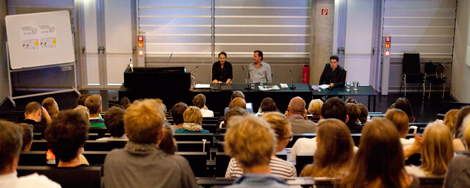
Arno Brandlhuber is a Berlin based architect, concerned with the interaction of architecture and the social. On Wednesday evening he spoke to use about a range of pressing issues, and some of the ideas which underlie his work.
He began by explaining some of his projects and the role of functional purpose. One example was a sport and cultural centre in the Ruhr: a combination of dance and sports - “high and low culture”. The building had to be defined by the length of a football field: which means, its function determined its form. He then turned to a number of ideas and issues surrounding the interaction of architecture and social relationships, including a gallery project in Berlin, and the work of Hans Kolhoff, who made challenging designs for Potzdammer Platz before the wall came down.
Architecture is not defined by its appearance, whether it looks good, but the way in which it orders social relationships. However the issue of social relationships cannot be dealt with according to good or bad architecture. It is the overlap between the social and the architectural that become key political issues. Two discourses in particular illustrated these problems. The first concerned government policy and space for cultural production. In the past, publically owned buildings which were not required - for example school buildings which were not in use - were often let for low rents, on the assumption that they would be needed at some point in the future. These spaces were available as artist's workspaces at very affordable prices. However changes in the economic thinking have led to a change in policy. Traditionally the budget of local government was calculated on a real cost basis; but the introduction of calculations based on potential profit suddenly cast these buildings as a loss, because they were not realising their full economic potential. This new way of thinking meant that local budgets were recalculated to show a loss. What had been a long-term policy, which in the short term benefitted local cultural production, was then replaced by a sort term profit orientated policy. The only way for local government to balance their books was to sell unused buildings to the private sector. The result has been an increasing loss of affordable space for cultural production. Several prominent artists wrote letters to candidates of the parties in the Berlin Senate elections, requesting that public property was no longer sold. All the parties responded with the same support for privatisation. The media reacted supportively, as artists found that there may be a connection between the loss of studios and urban property politics. But the policies remain.
The other issue concerned the plans to rebuild the Stadtschloss on the site of Palace of the Repubic on the Berlin Schlossplatz. The prohibitive cost of the project, which Brandlhuber suggests is driven by partisan politics, has created strong opposition. He shared a film in which he and a number of others satirise the project and its aspirations. But, he fears, it is too late to prevent it. It can only be parodied, not halted, he said with resignation. The parody, however, remains a powerful tool of political critique.
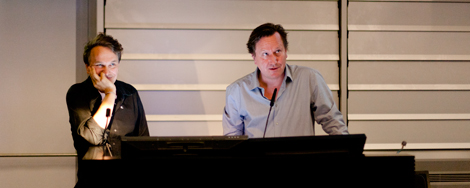
Jo Ractliff's Lunch Talk on July 27, 2012
reviewed by Christoph Schäfer, August 11, 2012
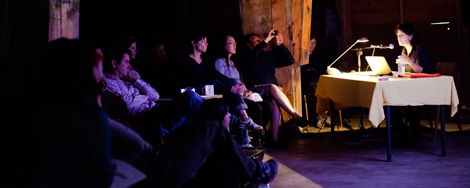
One of the great adavantages of this year’s first term of summeracademy is the somewhat unplanned coming together of many likeminded spirits in the city of Hallein. A continuous flow of conversations weaves through the days and the town, thoughts move between classes and continue in bars, a talk in the day might get a reply in form of a belly-dance at night, narrations from hometowns blend in, and stories from Johannesburg, Bombay, Minsk or Havanna echo in the alleys and backyards of the town at the foot of the mountain. Experiences from Moscow, London, Hamburg resonate in drawings, paintings, sculptures or photos, made by people who came from Beirut, New York, Urfa or Rio. It's this layering of times and places, of cities, their people and their stories, that I would only days later understand as an underlying theme of Jo Ractliffs series "Johannesburg Inner City Works". Overlapping fotos, images taken on walks through the rapidly changing city centre of postapartheid Joburg, but - I will come back to that series later. Let me first mention Jo's voice. A voice I can't forget since she sang me a Patty Smith song in a nightly car ride with Hildegund and Katya last year. And how could I write about her talk, without taking into account her love for a dark breed of country and the sinister resistance of Johnny Cash. She played those from her laptop over double Ballantine's on ice in the "Parachute Bar", from playlists labelled "Killer Country 01" to "Killer Country 14" and they again alter my imagination about South Africa, where her play lists are legendary and where they are distributed through radiostations, circulated on pirated CDs and later marketed as legal ones. Imagining South African travellers driving through the wide country to Jo's sinister tunes, sets a much darker atmospheric backdrop, than the happy multicultural image, that South Africa likes to project into the world. The dark warmth of Jo's voice provides a gentle but slightly uncanny undertone for a talk about a multitude of works related to the City of Johannesburg, and it is impossible for me, to write about this fine talk without taking our continuous flow of conversations into account: Jo's talk was a response to discussions I started a year before, on cities and the politics of space - and the thesis of the spatialisation of social movements. The talk placed itself in response to this year’s summeracademy-theme of the studio and the direction this discourse got from other participating artists who shifted their studio into the city. And it kicked off with a piece of video from the internet,from a real studio:the clip, even if some years old, still makes the air freeze: right wing Afrikaner Weerstandsbeweging (AWB) secretary general André Visagie, depicting himself as a victim, can't cope with the fact, that he is being interrupted by a black woman, and leaves the show uttering icy threats at the courageous lady. When the talk show host tells him off, he starts grabbing him, getting the repeated answer: don't touch me on my studio. The somewhat weird sentence quite clearly speaks about a politics of body and space in todays South Africa: http://www.youtube.com/watch?v=e3sWmsMkFio And Jo continues with a graffiti, that turned up in post-Apartheid Johannesburg: the mysterious pissing man, who startet to mark spaces in downtown Johannesburg. "This is the real thing" said co-professor Milena Dragicevic afterwards, relating to Jo’s work connected to a park in downtown Joburg, as the place is called by it's inhabitants. Whites and corporations had fled the city centre after the end of Apartheid, and now the area was populated by increasing numbers by migrants from former "homelands" and neighbouring countries - the poor who want to make their luck in the exploding Megacity. Now, former hotels and office-buildings are crammed with hundreds of people and highrises are controlled by slumlords. It sounded like the idea of public space as a common shared space, has vanished, a space that could offer at least a minimum of relief - if it ever existed here. South Africa has been admired for the peaceful negotiation process after the abolition of Apartheid. Rightly so, but the suppression of violence comes at a price. The suspended collective rage of justice against the former oppressors never happened, white people still own nearly the same proportions of land and wealth as during the regime. Maybe there is a connection between these processes and the outbreak of individual violence after the racists were forced to step back. Jo and friends teamed together and developed collaborative practices with and in inner city communities, taking the park as the vantage point of creative, documentary, playful or artistic projects, that step by step transformed the park, again, into a public ressource. During these days, Ractliffe started a new series of urban photographs, shot with small instant cameras. She started to use these, after her professional equipment had been stolen once again. Urban crime and dystopia are thus inscribed into these images from the start. The shots overlap and blend into each other, and Jo never cuts out a single one - much rather they are always presented in long strips. A format that relates to the panorama format of the 19th century. A little detour here (unavoidable when you write / think "city"): before photography pioneer Daguerre took off in the new field, he built and designed "Panoramas". His giant 3D-surround displays worked with space and artificial light changes, were attractions and forerunners of today's 3D-surround cinemas, often located in the centre of the spreading Paris' arcades. The panorama format developed earlier and is, till today employed for depictions of battlescenes, romantic landscapes and centrefolds of erotic-magazines. Idealized landscapes, the male gaze on female bodies and the warlord's perspective on the battlefield may well have more to share than just the format. The view of the General or King leading his troops from a secure hill, or that of the aristocrat shaping the landscape, is inscribed into these formats, and all these symbolic meanings and powerstructures inscribed into these views/perspectives, are, what the splintered and fragmented panoramas of Jo Ractliffe work against: her view is from within, it is involved, it has even been hurt and attacked by "the subject". The view of a woman in Johannesburg is not the same view as the view of the male Flaneur in 19th century Paris. And yet, these late urban romantics or early situationists, these day-thieves and bohemians, these urban researchers on dope - are closer to the way that Jo Ractliffe moves through the city, than to the uninspired NeutralPointOfView, the "New Topographics" so pretentiously strive for. Even though there is an undeclared war going on in today's Johannesburg, Ractliffe finds poetry in its streets, layers of history and meaning, crimes in the form of mountains that form inner-city high-plateaus shaped by exploited goldminers, Joburg’s original sin and primary accumulation, as well as, maybe, not far away, in the wall of the city, a secret door, or the north-west-passage into imagination.
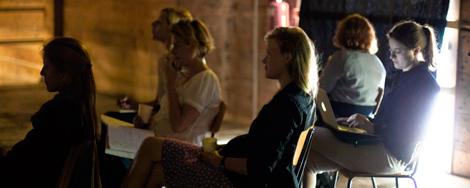
Maria Lind, Lunch Talk on August 8, 2012
In her lunch talk Maria Lind focussed on the history and current questions of mediation in contemporary art, from the 1920s to today. She talked about Alexander Dorner, who undertook groundbreaking work as director of the Landesmuseum Hannover from 1925 to 1937, establishing "atmosphere rooms" and starting to collect contructivist art, photogaphy and film. After migrating to the USA he became director of the art Museum at the Rhode Island School of Design in 1938. At Rhode Island, Dorner reorganized the traditionally displayed works in the Museum into dramatic installations which appealed to the public. Lind then turned to Willem Sandberg, the director of the Stedelijk Museum in Amsterdam from 1945 to 1962. During his tenure he expanded the museum and developed new exhibition techniques, earning international renown. The private gallery of Iris Le Clert (Yves Klein, Le Vide, Armon, Le Plein) was a the third example of new mediation tecniques and methods. Lind also referred to Charlotte Kolon's Spaces of Experience: Art Gallery Interiors from 1800 – 2000 (Yale University Press), which includes useful information on the history of these developments.
Lind then considered the current situation with regards to the concept of collectivist spectatorship, the educated consumer, the educated citizens spectatorship, and the entertained consumer. In the discussion we talked about the necessity of establishing new criteria for the evaluation of small-size art insitutions, going beyond merely counting numbers and sponsers.
Hildegund Amanshauser
Places in stone

Today in Hallein, Susanne Tunn and Hagbart Solløs spoke about the importance and many connotations of “place” in their work as sculptors.
Susanne Tunn is a sculptor from Germany. For her, “place” itself is sculptural. The location of her work is an integral part of it. She showed us images of some of her pieces in situ: on the roof of a building, in a barn, in a church. Her “Table for Two Couples and a Dog” is placed in a forest; and crucially, doesn’t include a table - the space, and the place, define the work. This interaction between the work and the location invites a very different way of viewing and interacting with the art work on the part of the viewer. She went on to suggest that modern architecture can also be sculpture, once more implying the importance of place.
Hagbart Solløs is a Norwegian artist whose work has been installed in prominent public spaces throughout Scandinavia. He began by considering the Roman concept of genius loci, the “spirit of place”. Such a concept has always been an important part of cultural production - and was crucial, for example, in European Romanticism - but Solløs instead highlighted the rise of a more economic world view in the last few centuries which shuns the mythology of place. More recently, however, the rise of the new science of “terra psychology” has sought to explain the semi-mystical aura of place. His own work develops these ideas, and in doing so has become an important part of urban environment and space in several cities. Placed in public space in Oslo, his monument to Hiroshima, “Pax”, 50 Years after Hiroshima, which incorporated stone taken from the devastated city, embraces these themes.


