
A Look into the Stone
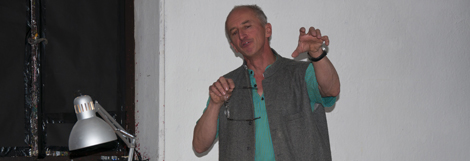
"I was lucky from the start", he says, "because I already knew at 15 I wanted to be a sculptor." About 10 years after that, he was offered a stipend at the summer academy in 1986 and thus took part in the first stone sculpture symposium there which helped him realise that stone was in fact his material to work with. "It was and still is a bit different though, normally in those symposiums that have now spread all over the world professional sculptors come and work together for a month or so, but here another aspect is added, that of the teaching."
This is also what he really enjoys about being back now, the working side-by-side with people coming from completely different artistic fields that have always had an interest in working with stone but have no experience at all. "They have a completely different way of looking at the stone, a certain innocence. This I find very fascinating." He's always ready to share his expertise, his materials and tools, some of them built himself, a thing he really loves doing as it helps him make the stone even more his material than it already is. "I like preserving the nature of the stone, for example, I would never make a round shape out of a square stone or the other way around." What he loves doing instead is hide his traces, work the inside of the stone through slits he makes in the bottom, sometimes even fully hiding all his work on it. "I draw a certain pleasure to see my work and be the only one that knows its hidden interior."
For all those wanting to discover something now, there will be a guided tour through the working site of the symposium and the quarry itself this Saturday, the 6th of August, at the Kiefer quarry at the foot of the Untersberg at 5pm. I for one am already looking forward to it and hoping for nice weather as it's really a lovely place to visit and linger at. [mp]

So What Is It Now? - Global Art Symposium II
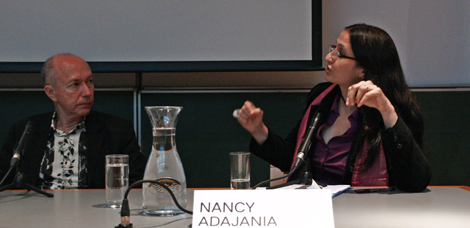
The second day of the global art symposium, consisting of two discussion rounds and several lectures, saw a rather theoretically-based first part with speakers like art curator and critic Maria Lind and Nancy Adajania, also curator, critic and a cultural theorist.
They demanded the museum to be built up as an international hub, not a space that exhibits but one that houses cooperation and processes. Another aspect brought up by Nancy Adajania was that of ethical responsibilities and what global art was against, which in her opinion is something that completely shifted towards the artist, giving him/her room to make their own ethical stands. She also sharply declined global art the protection of transculturality, which in her words "is no temple for it".
Things got interesting when global art was all of a sudden declared a condition that needed to be medicated and channeled, but how was not all that certain, aside from introducing new networks especially interlinking and aiding smaller projects and institutions everywhere.
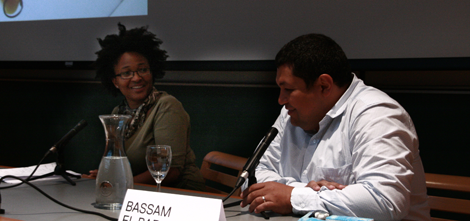
The audience went into the lunch break with visibly full heads. Things got a bit more practical as artists Jitish Kallat and Senam Okudzeto took the stage in the afternoon, with a more theoretical interjection by Bassam El Baroni, curator and art critic who sharply seperated fine art from contemporary art and analysed the dynamic of the art market, explaining the different ways of making it as an artist today. He also proclaimed the end of art, claiming the artist working in an artificial timezone that is cut off from the past and the future, a statement that helps to make sense of a lot of art produced today.
Senam Okudzeto on the other hand was a lot more concrete in her exploration of globality, explaining the Ghana-based NGO Art in Social Structures (AISS, http://www.artinsocialstructures.org/), she has founded and she is executive director of. The organisation, it's members people from all across the globe, strives to free art in Ghana from its elitism and get the people in the street interested in it. The ensuing discussion made some interesting points, stating that artworks are actually not global, but stem from a location, travel the world and create local reactions. So how can this art that has become global through its travels be brought back to its local communities, and why is there even global art? As Senam Okudzeto sharply remarked, over these two days we slipped into easily talking about global art without questioning the term in itself, reminding us of the mail art of the 60ies and 70ies and adding that spam thus might be the new global art.
In the end, we come away with some answers and a lot more questions that have even more possible answers. To say it in the words Hans Belting, our very first speaker, started off his talk with, "it is difficult." Difficult, but oh so interesting. Maybe we should just all meet again next year and see if in the meantime we found some more answers and questions concerning this fascinating topic that is always in process. mp
Abstraction through Stills
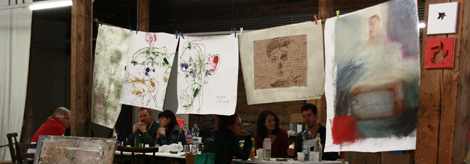
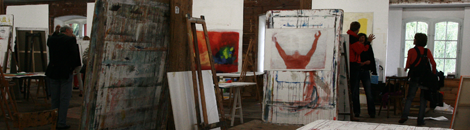
There's currently four classes being taught at the Alte Saline Hallein. One of them, the class Painting, Photography and Film under the direction of Hubert Scheibl, already finished this weekend, presenting their works right in their working space. A class titled like this, one would expect fragments of film or photographs or something more directly linked to these media.
To my surprise, upon entering the room that was still arrangedin individual working spaces, the eye was met by a labyrinth of colourful, more or less wildly abstract paintings that hung, stood and lay wherever one looked. In-midst were the students, cheerfully sharing a victory meal together before packing up their works. They all seemed to have had a great time and received a good deal of inspiration. As one student said, "He [Hubert Scheibl] made us watch films and take scenes of them to work from, which was a very new approach for me."
Let's hope they can take that inspiration with them along with their works, and that the finissage of the other courses happening next weekend in both Hallein and at the fortress will be equally as interesting. mp
The Path to Global Art - Symposium Day I
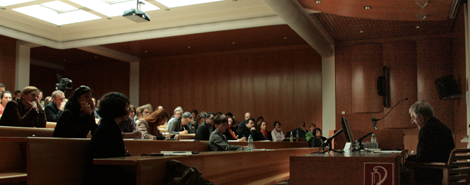
The first part of our global art forum saw Hans Belting, art historian and professor emeritus at the State University of Arts and Design, Karlsruhe, sketch out the way from world art, a term still rooted in colonialism and mostly meaning traditional art which made it unaccessible to contemporary non-western artists, to global art.
Monica Juneja from the University of Heidelberg then picked up the thread, turning into a slightly different direction though by questioning wether there can be a global art history, taking into consideration the disclipine eveolved with western art and is thus a concept embedded into it. In her opinion, it is mostly relationships that need to be thought over, between people and institutions, but also things like the fabled incongruity of the global and the local or the notion that the aesthetic and the politic are incompatible.
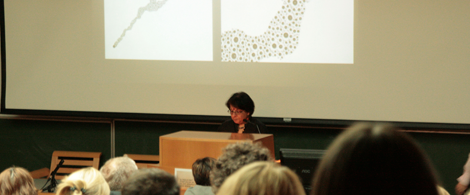
The following discussion, starring the aforementioned speakers plus Peter Friedl who is currently teaching the class titled "Images as Concepts" at the Alte Saline Hallein, very much circled around the very nature of global art. The experiment of trying to tie it to contemporary art led to what can almost be called a diss of the latter, with Hans Belting stating that artists today in fact should step out of the contemporary and Peter Friedl even going as far as saying that contemporary art makes him nervous and he tries hard not get lumped into it. Also discussed was the master narrative and how it had to be changed to confirm with the new global thinking. In the end, it was agreed global art was indeed a challenge that called for a lot of rethinking, that needed institutions to be less inert, perimeters to change, not only in the field of art history, but generally in all artistic areas and practises.
On this first day it was already interesting to see how many different positions and focusses are coming together here, be it those of practitioners or theorists, of speakers from formerly colonised areas or ones haling from those that did the colonising. For me, one of the most important questions remains to be asked: Is there actually a thing like global art?
The symposium continues on Saturday. mp
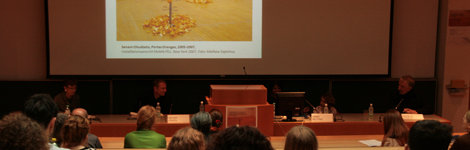
NEW LOCATION FOR GLOBAL ART SYMPOSIUM ON JULY 29 AND 30
Due to the huge interest in our "Global Art" Symposium we had to relocate it to a different venue.
NEW: Auditorium (Hörsaal) 230, Juridical Faculty of Salzburg University, Entry Kapitelgasse 6, 5020 Salzburg
////////////////////////////////////////////////////////////////////
Aufgrund des großen Interesses an unserem "Global Art" Symposium mussten wir es an einen anderen Ort verlegen.
NEU: Auditorium (Hörsaal) 230, Juridische Fakultät der Universität Salzburg, Eingang Kapitelgasse 6, 5020 Salzburg

