
| « The question of ethics | Dancing in the Urban Setting » |
censorship
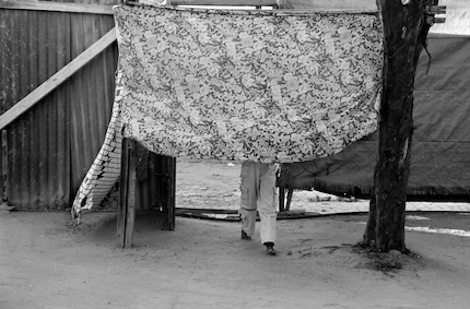
Ahlam Shibli, Goter, Al-Naqab, Palestine, 2002–03
series of 44 photographs, 38 x 57.7 cm; 57.7 x 38 cm, gelatine silver prints; chromogenic prints
Due to the censorship in Holywood on kissing longer than 3 minutes in films, quick-witted Hitchcock created his own tactic for Notorious (1946). Looking out to a beach in Brasil in a fancy flat, Ingrid Bergman and Cary Grant start kissing. After exactly three minutes, they briefly stop, whisper into each other’s ear and continue to generate tension. The scene lasts two and a half minutes.
From “Degenerate Art” to jailed journalists of Turkey, bans on the works of writers, journalists and artists have a long history. Ahlam Shibli and Joanna Warzsa had to deal with censorship as well in different parts of the world. In the talk Art and Censorship on last Tuesday, Shibli touched upon a problem she faced years ago in Tel Aviv Museum because of her nationality as a Palestinian and bomb threats to Jeu de Paume during her retrospective, due to the content of images depicting photos of martyrs in the homes of Refugee Camps in Palestine. It should be stressed that the artist’s main concern is to give visibility to problems that are put out of sight by a certain power rather than taking a side. Shibli’s works mostly contemplate on the idea of home, revolving around the notions such as the right of calling somewhere home or exclusion of representation.
A Christmas tree that is usually identified with cozy gatherings might create vigorous tension as in the case of Manifesta 10 that Joanna Warsza talked about. Kristina Norman’s installation Souvenir (2014) − a part of the work also consists of a video, Iron Arch − recalls the Christmas tree of Kiev’s Maidan Square that became a political symbol during the Ukranian Revolution in 2013. Because of its political resemblance the green metal structure generated a problem and unfortunately, the work was removed. In the talk, the curator mentioned the strategies they had to come up with to resist such a censorship.
Jonas Stahl’s The New World Summit (2012) − exhibited as a part of 7th Berlin Biennial – the installation questions the notion of democracy formed by states and exclusion of ideas by labeling them as terrorists. The installation was displaying the flags of the so-called terrorist (!) organizations, which, of course, didn’t please certain authorities at the end...
Well, tomorrow I will continue with the Skype meeting of the curating class with the art historian, art critic and curator Helmut Draxler.
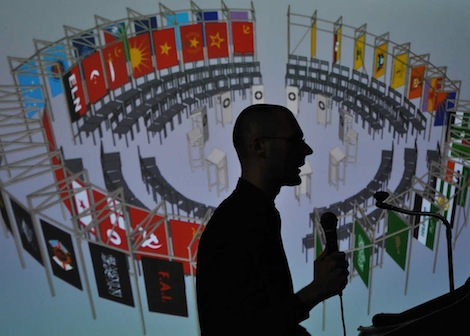
Image source: DAI

