
| « preparations | censorship » |
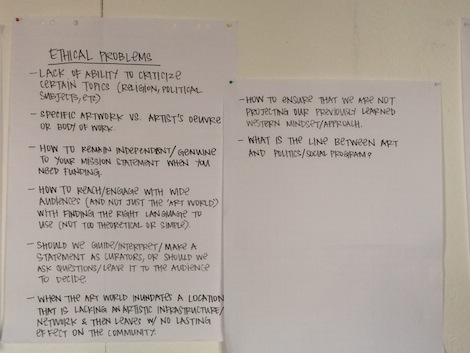
The question of ethics

Helmut Draxler’s text Showing Nothing: The Ethics of Institutional Critique flirts with dualities such as ethical-unethical in order to create a wider, say, almost rhizomatic understanding of the issue. During the Skype meeting with the art historian/curator the class of Joanna Warsza raised their questions in relation to the afore-mentioned text. As Draxler pointed out, moral is bound to norms and rules and create the violence in order to realize the ideal. Whereas, ethics includes its opponent to the equation: “unethical is in the ethical.”
Draxler mentioned the fact that as curators working with institutions there is no escape from the unethical. Moreover, he believes art should intermingle ethical with unethical. The curator pushes it even further and suggests embracing the unethical as artists rather than trying to be ethical; for him the negotiation between ethical and unethical is crucial. Draxler defines ethical as the assimilation of acts that are considered ‘ethical.’
The art historian drew attention to the “welcome culture” for refugees in Europe. Despite the fact that it’s crucial to create spaces for refugees, without solving the real problem on a political level, such a culture wouldn’t end this violence. On the one hand, it’s amazing and so important what people are doing. On the other hand, there is another aspect of it: “they do it for their bourgeois moral, which cannot solve anything.”
Well, nothing is black or white. Furthermore, again who decides what the ethical is?
At lunch, I was talking with Ahlam Shibli about her series Eastern LGBT (2004-2006) with LGBTQI members, who were born in the East but living in different parts of the world to create a new home, where they can freely fulfill their needs. For most of the people being a queer, going beyond the binaries of woman-man and loving each other regardless of gender is unethical and amoral. I told Ahlam that I’m queer as well and we talked about the problematics of nuclear family structures, reproduction and how it is forced by states so that ideology of the nation or the religion is passed on to the next generation – let’s not forget the economical aspect of a family, how consumerism is accelerated…
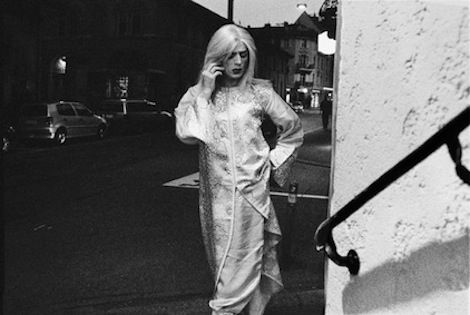
Ahlam Shibli, Eastern LGBT International, 2004 / 06
series of 37 photographs, 37.8 x 57.6 cm; 57.6 x 37.8 cm; 70 x 100 cm; 100 x 70 cm, gelatine silver prints; chromogenic prints

