
| « Storytelling | Gestures of contemplation » |
Looking at things
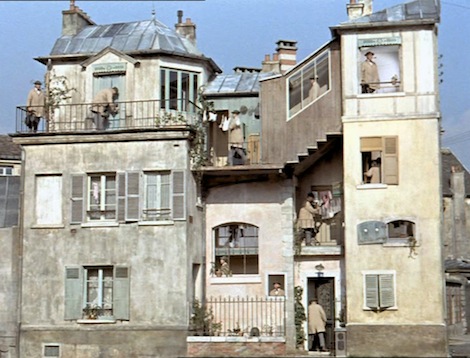
On the third day, I feel like the character in Jacques Tati’s Mon Oncle (1958) in fastforward. Writing a blog about classes taught by different artists from various backgrounds; capturing certain moments that would narrate talks and events, besides the daily acts surrounding the Fortress, call two things to my mind: Impressionism and surfing on Internet. As an impressionist I catch a glimpse of light, or say, I’m the nerd surfer constantly clicking on links and opening new windows, indefatigably scanning the screen…
The due of yesterday for the classes of Ahlam Shibli and Ben Katchor was to ‘look at things’. As Katchor pointed out in yesterday’s talk with Varda Caivano at Museum der Moderne Salzburg, a shoemaker’s approach to a certain space would differ from a baker. In a similar fashion, yesterday Shibli asked the students to go to sites without a camera, to be able to focus on details released from the pressure of pressing the shutter. In that way, the survey becomes more significant rather than immediately taking the photo, she thinks.
I visited Katchor’s class today. The artists explained why they chose that spot to draw and described their emotions and observations with text in their comics. Here are some notes:
-Do they start from left to right or right to leftt?
(I was thinking: what about top to bottom or vise versa?)
-Where to structure the text?
-How the text changes the information?
-the picture falling back into the realm of text
-Sometimes one has to explain what is going on behind the scenes.
-urgency of finishing and not losing yourself in details
(Katchor mentioned different approaches to detail in the classical paintings of Southern and Northern Europe. In the South the details are indicated. The artists tried to get the bigger picture before they went deeper, whereas, in the North, aggregation of details was more significant.)
-Why do I want to tell my story/show in this particular way?
-drawing within a drawing
-let the drawing fall into a landscape.
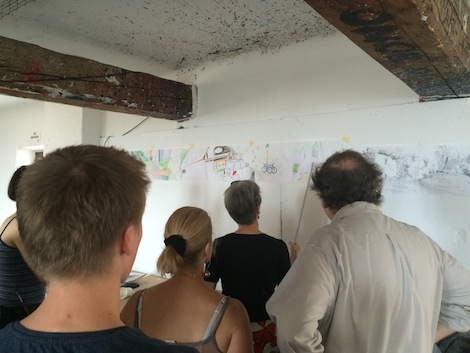
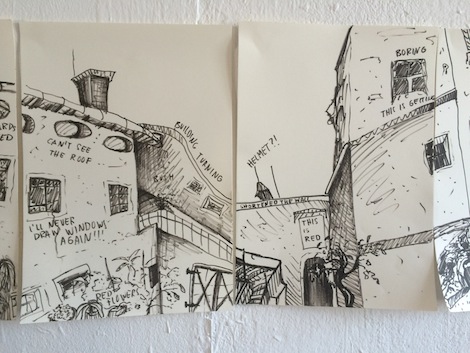
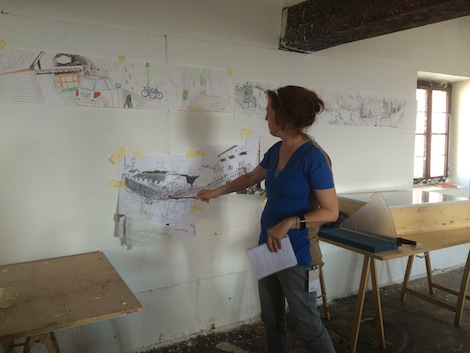
One of the artists attending to the class asked a question in her comic. As far as I remember it was like: “Why do people like views? Is it a form of ownership?” This morning, I was thinking something similar, when I’ve decided to act as a tourist before rushing to the Fortress and had a coffee at Café Tomaselli. Two years ago, when I was in Salzburg for Jennifer Allen’s writing class, someone recommended me to sit at the terrace of that particular café. I was pondering: why do people feel attracted by this terrace? Being on the second floor of the building doesn’t change the view; because of the buildings around, you still gaze down the same street. However, the perception changes as you look from above − slightly like a bird’s view or a drone’s. Funny enough, as I wanted to read more of the text The Postcolonial Constellation: Contemporary Art in A State of Permanent Transition by Okwui Enwezor that is being discussed in Alya Sebti’s class, I was looking at my screen rather than enjoying (!) the view…
Katchor’s class is called Comics in Performance. Before digging into performativity in comics and storytelling, please watch the video below Children in Old Japan 1959 Kamishibai that the artist showed at the class.
(Tomorrow: What would be the relation between gaze, notions such as 'forgetting, undoing, polyphony of voices' discussed in Sebti's class and the comic The Imaginary War Crimes Tribunal, originally created for Metropolis Magazine that Katchor performed in yesterday's talk?)

