Lunch Talk - Alice Creischer and Andreas Siekmann
So what they did after selecting the paintings and researching about their background was asking several artists from all over the world to create an "answer" to the original. The reason why they didn't choose only bolivian artists but international ones was explained in a very clear way.
"Principio Potosì" stands not only for the city itself but also for the industrial working processes happening there. People were brought from the Philippines to work in the mines and the coins which were produced and embossed in Potosì were probably spread worldwide - as they were found on nearly every coast in the world. So Creischer and Siekmann define Potosì as one of the first capitalistic- and global-economic system we know about.
In the end Alice Creischer and Andreas Siekmann gave a very clear insight into to work as a curator and as they themselfs seemed so enthusiastic about Principio Potosì that a travel to Berlin in October (thats where the exhibition is going next) seems really worth it.
For more information visit: http://www.luzart.ch/ausstellungen/dem-principio-potosi-auf-der-spur.html
Torn and stained, yet beautiful – A different kind of photography
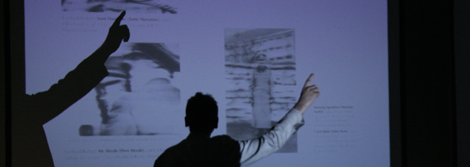
This motion he shares with the surralist movement, but what with his works happen by chance, surrealists like Guy Debord would destroy photos and film they found on purpose, going as far as showing a 90 minute film composed only of black and white screens. They would also use failed pictures like a woman with 4 eyes that seemed to come right from another plane of reality. An altogether approach can be found with artist like Sigmar Polke and Gerhard Richter, who also ridiculed the aforementioned ghost pictures apearing in tabloids. Sigmar Polke also took his characteristic dots straight from newspaper photos. Gerhard Richter, on the other hand, uses different photos as direct templates for his paintings, incorporating blurriness and faults in the pictures. like in a painting of bathing women that, seeing just a photo of it , might well be from Miroslav Tichý. Like this, Roberto Ohrt led an alert audience through a short history of accidental photography. Now, with old analog ways of photography turning vintage and interesting, also because the materials are hard to obtain, we'll be waiting to see how the road continues.

The essence underneath the material - The essence in the material

Not wanting to just talk about her own work, Liliana Moro invited Cecilia Casorati, professor for contemporary art in Rome, to hold the talk together. Starting from a provocative statement by Sol Lewitt from the 70ies, "Materials are the damnation of art", she describes how the artists of that time saw their working materials as an important factor in their work and how this changed in the 80ies and 90ies, where artists said they simply use the materials, but don't consider them important enough to be talked about. At the end of the 90ies, this shifted again. Materials were once more important, but more in their political context.
This, she demonstrates with a work by Liliana Moro, called " Underdog" from 2005, that deals with the losers of society, who they are and how they are seen. Interestingly, the work consists of 5 dogs cast in bronze, one of them dead. Asked why she used this material, Liliana Moro stated that she felt like using a traditional material, linking it to grand monuments of leaders and heroes. This leads right to her other work Cecilia is presenting, called Piazza # 3 (square # 3), which is part of a series of small structures built from all kinds of materials and covered in silver spray paint. In Italy, the squares are the heart of life, adorned with monuments of kings and generals. Liliana wondered, what could be placed there today.
The one Cecilia presents, telephone poles built from plastic and beans, covered in spray paint concealing everything underneath, deals with the mysterious death of publisher Federico Fellini. Compared to different political art, like the wooden slates by Francesco Arena. Put next to each other, they stretch as long as the last walk of Giuseppe Pinelli, an Italian anarchist that fell to his death from the windows of a police station, Lilianas work is accessible without knowing the bigger story, something she is very happy about.

Guided to the Future by Spirits

Hilma af Klint, Swedish pioneer of abstract art working in secrecy between 1906 and 1922, guided by spirits, as she wrote, is still not very well known today. To change this, Gertrud Sandqvist, professor of contemporary art and member of several international art boards, came to Salzburg to broaden our horizon about what she herself calls a potentially strange topic. But, as she continues "I have always been interested in how artists think and how the knowledge they develop is different from our linear knowledge."
Hilma af Klint, born in rural Karlberg in1862, is a good study case for her. Doing abstract paintings as early as 1906, even before Kandinsky. From her diaries, it becomes apparent that she was a medium, deeply enthralled with mysticism and spiritualism, which was nothing unusual at that time. After attending art school from 1880 to 1885 and making a small name of herself as a landscape painter, she formed a group of 5 women known as de fem (the five) or the Friday group that would hold séances every Friday. In those séances, spirits would possess her, infusing her with the desire to paint. Her first abstract cycle came into being between 1907 and 1908, "spirits working through me, guiding my hands." as she wrote in her occult diaries.
This may also come from the spirit of the time, though, as it was easier to say for women that a force was working through them than trying to claim anything more than basic brainwork as their own. When trying to show these works to her friends, she was told it was inappropriate. Dispirited, she invited Rudolf Steiner to her studio, a Christian woman looking for support in something that must have bewildered her to no small degree. She didn’t gain it, in the contrary. Rudolf Steiner greatly disliked her work, telling her it was simply wrong to talk to spirits and paint this way, especially her works depicting man and woman as equal and showing the female spirit in the male body and vice-versa. Devastated, she completely stopped painting for 4 years. After those 4 years, the spirits told her she was now mature enough, so she started doing a cycle titled "The swans", encompassing 111 works in the dimensions of 150x150cm.
These swans represented the male and female forces in their astral form, switching to abstract forms all of a sudden in 1914. She was still talking to the spirits, yet now, she herself was doing the paintings, freely experimenting with different "forms and expressions, not showing her works to anybody. The series finished with a key painting, completely different from her other work, titled Human Chastity", seen today as a self-portrait of the artist. After this series was completed, she would still paint, but only small aquarelles as she would not trust herself, an aging unmarried in a time this was seen completely inappropriate. After the death of her mother in 1920, already aged 60, she travelled for the first time, meeting Steiner again who once more told her she was wrong. She would still receive ideas for large-scale paintings from the spirits, foremost from one called Amaliel who had first offered her works in a séance in 1907, which she had immediately accepted, but only recorded them in her diaries without executing them anymore. When she died in 1942, she advised her relatives to keep her works stored away for the future. So her oeuvre stayed hidden in basement, refused by the public until the 80ies. Now she holds her place among the pioneers of abstract art, something she always knew herself. Most of her work is still in the basement, thankfully well preserved by the circumstances, and it is only sporadically that selected works are shown to the public. Gertrud Sandqvist ends her talk with the hope that all of us will one day get the chance to see the impressive work of a strong woman that, against all odds, would not stop executing a work that she felt was needed for the future of all humanity.

New paths to an old history
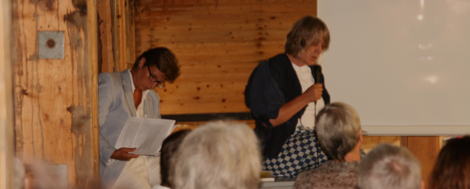
When travelling Peru and Bolivia two years ago, Ines Doujak and Catrin Seefranz didn’t just collect whatever rare textiles they could find. They went to look for the deeper story literally woven into the textiles, as indigenous tribes used woven cloth to record their history, mythology and everyday life before the arrival of the conquistadores. Colonialism ended up pushing indigenous women into textile making, often as tribute to the Spanish crown, whereas before it had been freely practiced. In those times, pieces of cloth, much more precious than the sum of their threads, disappeared over the ocean to end up on display in some museum, never to be seen again by their weavers. Ines Doujak and Catrin Seefranz try very hard to get away from this colonial outlook, they record the stories around the cloths, find out about their sacred nature ("They belong to the ancestors and must not be cut or harmed in any way", as they find out from one woman) and plan on incorporating all kinds of people in the second part of their project due to start this fall.
On the outskirts of Vienna, they plan what they call "the eccentric archive", where they will invite scientists, anthropologists, artists, specialists on textiles and Latin America, also some of the people they met while travelling there, to look through all of the gathered materials, "or rediscover them", as Ines Doujak says. They don’t want to store everything away like a classical archive does, but newly interpret these pieces. "We know we cause a lot of questions and critique, and we have to be careful how we do things, but a lot happens as we go along so we can never plan that well." is how Catrin Seefranz sums it. I wish them best of luck with their endeavor and hope to one day see their archive.