
Ghalya Saadawi
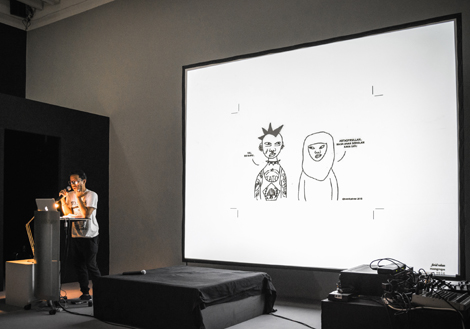
How has art changed in recent history into a transnational category and a cabinet of curiosities in Beirut? The Beirut based sociologist and author Ghalya Saadawi suggests to return to time, in order to confront the geographical and identitarian paradoxes at the heart of global, transnational contemporary art.

(Ziad Abillama, Pourquoi n'arretes-tu pas de mourir?, 2005, video-still, courtesy Ziad Abillama)
And if we are to be frequently solicited to talk about our locality, we may as well need a better set of theoretical tools with which to do so, in order to bypass total disinclination, instrumentalisation, ahistorical understanding or pastiche.
The lecture considers art in/from/out of Beirut as symptomatic thermostat, not as artefact; as something to be thought through history and infrastructure, not spatially. It will address the conditions by which we can understand globalisation in art through the local (or the locally transnational), while thinking about future making/thinking in ways that do not oversimplify and succumb to a given, total category of the global under capitalism. The talk thus covers art in Beirut without needless overviews, while paying close attention to transnational and neoliberal art discourse and practice.
The lecture will take place on Thursday 3. August at 7 p.m. at Galerie 5020, Salzburg.
Grace Samboh
Function over passion: The millennials’ take on recent art practices is the title of Grace Samboh’s lecture. As a curator, writer and researcher, who lives and works between Yogyakarta and Medan (both ID), she will talk about the art scene in Indonesia.

(Children drawing on sands of the Brumbun Beach, East Java. Amongst villagers, Moelyono is known as a "drawing teacher" rather than as an artist. The fact that people gave him this title made it easier for him to fulfil a function that people needed from him. Photo courtesy: Moelyono)
A special focus is given to the topic of different roles and how they are being played, taken, rejected or ignored within each environment.
Further Grace Samboh is in search of what comprises a curatorial work within the surrounding scene. She ranges within the existing elements of the arts scene around her, she considers the claim that Indonesia is lacking art infrastructure especially the state-owned or state run as something outdated. She believes that curating is about understanding and making at the same time. With the platform Hyphen, her concern is to encourage Indonesian arts and artistic research projects and publications. You can find her writings also at sambohgrace.wordpress.com

"Still in love with Instagram" Grace says about herself. Check out her account.
Her lecture will take place on 26. July 2017 at 7 p.m at Galerie 5020, Salzburg.
Global Academy
As the opening of the 2017 Summer Academy is coming closer, we would like to present our event’s programme and tell you about the lecturers of the Global Academy series.
(Photo: Farid Rakun (ruangrupa; Jakarta (ID)) at Global Academy 2016, © ISBK, Mira Turba)
The project began in 2016 with the Global Academy conference and continues this year with five lectures; four of which deal with diverse art scenes on the vast continent of Asia, all having attracted increasing interest over recent years. Ghalya Saadawi talks about the scene in Lebanon, highly acclaimed since the 2000s, Virginia Whiles about Pakistan, Diana Campbell Betancourt about Bangladesch and Grace Samboh about Indonesia.
In addition, Ruth Noack, one of the leading representatives of a universal curatorial approach, will talk about “global curating” in her lecture A museum in a school.

Studies show, that despite innovative educational programmes and contemporary approaches, little has changed in terms of equal access to the pleasure and knowledge contained in museums. Why not take the museum into the school? Ruth Noack is asking. The lecture will look at practice-based research in this field, which takes its inspiration from a few examples of non-Western museum practice.
The lecture will take place on 19 July 2017 at 7 p.m. at Galerie 5020, Salzburg.
Andreas Lolis
Fascinated by the relics of the 21st century, by all the things that we discard on a daily basis, Andreas Lolis has been working since 2011 on a series of marble sculptures that are replicas of thrown-out boxes and styrofoam material.
One of those pieces is on show at the Fridericianum in Kassel within the presentation of the EMST during documenta14.

In his course at the Summer Academy he asks: What does it mean to work with a monumental material? And how can the traditional technique of stone sculpting simultaneously be contemporary?
The course is taking place at the Untersberg quarry, which for centuries has provided the so-called “Untersberg-marble”, which is in fact limestone. The place offers the ideal conditions for different approaches of working. As the student’s live and work directly on site at the quarry for four weeks, the atmosphere is very inspiring.

Distruktur
“Muito romantico” is a film by Distruktur. It is a stream that carries along hearts and minds. A playful rearrangement of experiences, memories and fantasies into a journey transcending space and time. Melissa and Gustavo cross the Atlantic to start a new life. They set sail on making films, friends and music, but fear awakens when a secret emerges. A cosmic portal opens up inviting them to expand their journey beyond time and space.
Check out the trailer
Melissa Dullius and Gustavo Jahn have formed Distruktur in 2007, when they moved from southern Brazil to Berlin. They started making films together in 1999, first on Super 8 and later on 16mm, their medium until the present day. Beyond conceiving and producing moving images, they appear as actors and musicians and act as lab technicians, doing a great part of the post-production work of their films. Films by Distruktur have been presented in festivals such as Berlinale, Torino, Moscow IFF and Videobrasil, as well as in Berlinische Galerie in Berlin, New Museum in New York, Paço das Artes in São Paulo, and Vilnius Contemporary Art Centre.
The 2017 course, held by Distruktur, at the Summer Academy proposes Film as a sensitive body and assumes, that 16mm film material has properties that react not only to light exposure but also to contact with other bodies and substances.

