
Paulina Olowska
If the Summer Academy’s motto 2017 „Why produce art“ is a fundamental question, it is even more essential in the field of painting. Why painting now, is there any reason left? The famos artist Paulina Olowska knows many: „painting is an amusing, very clever, ancient, outgoing, silly, smart, stupid, groundbreaking, world-changing method of social confrontation and a tool for the future“. She can teach you how to use a painting for your own means, while having an intense dialogue with it at the same time. Through painting you can look on other things. Olowska did so, on Punk, fashion, feminism and the avantgarde. Beyond her inquiry into urban utopias, she also began investigating the ancient, the pagan and the feminine. More information and images you find here.
Though her paintings are obviously constructed, almost like staged settings, one gets the impression one might enter the fictional scene or parts of the image would expand into the real space. Subsequentely her work is not confined to the painted surface, it extends to other media and contexts, for example to performance and theater. Recently her piece „Slavic Goddesses“ (together with Sergei Tcherepnin and Katy Pyle) was enacted at the legendary „Kitchen“ in New York. She again revisited the Polish artist Zofia Stryjeńska, basing the performers costumes on her designs.
Also well known is Olowska’s acclaimed performance „Alphabet“ she showed in several venues, like Galerie Meerettich in Berlin and Moma in New York.
Here she talks on her interest on neon signs. Come to Salzburg if you like to see one of hers in the collection of Museum der Moderne.
A longer talk on her works and occupations you find here.
Tony Chakar
Tony Chakar is a Lebanese architect, who's comprehensive thinking includes literature, philosophy, and art. You do not need to be an architect to participate in his course as his interests reach beyond architecture. Just to get a little impression of the wide spread range of his subjects, have a look at this insightful talk below at Bunker Ljubljana August 2016. He is explaining the title of his show "On becoming two". If you happen to be in Beirut you can still see it until March 26 at Beirut Art Center.
Ruth Noack
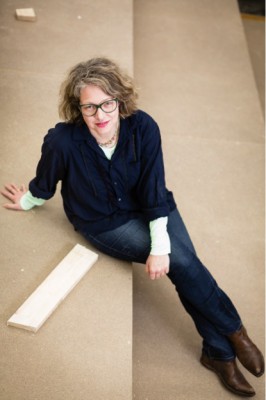
Ruth Noack, trained as artist and art historian, is an enthusiastic teacher. Since the 1990s she has worked as art critic, university lecturer and exhibition maker, in 2007 she was curator of documenta 12. The "migration of forms", and the question of “cultural education” two of Noack’s pivotal interests were already important at that time. For Ruth Noack an exhibition is not a singular event, but a medium, a process, in which many people are involved, not only artists and curators.
Her course in Salzburg will investigate the “non-transmittable” form and its potential to resist in times of a globalized art world. What sounds quite abstract here will be grounded and become tangible by her distinguished curatorial experience and concrete examples. Individually or in teams, participants will develop exhibition concepts, going through the steps of discussion, research, proposal and implementation. They will not necessarily end up with an actual exhibition, but learn about “thinking with works of art”.
Ruth Noack on transnational art production:
Lukas Pusch
Lukas Pusch founded the White Cube Gallery Novosibirsk with Konstantin Skotnikov in a ramshackle garage in 2008, the first center for contemporary art in Siberia. One year later, they assembled the gallery on the platform of a ZIL-130 truck and organized touring exhibitions along the Russian-Mongolian border. In 2012 the exhibition space was shown in front the main entrance of ART Cologne.
Though Lukas Pusch insists he is not making politics but art, his projects as well as his extraordinary woodcuts and prints can hardly be not regarded as political. His works are satirical, direct and extremely independent. It's their unpredictability, that makes them subversive. Read more on the project Slum TV, Pusch initiated together with lokals and artist friends in Mathare, Nairobi in Die Zeit.
However his priority in art is image-finding and artistic autonomy. Pusch's outstanding technical skills allow him to teach the basic craft as well as to show the many possibilities of printmaking.
Some images you find here. Have a look at "der antist" too. It is a magazin he publishes with artist TOMAK.
Melissa Gordon
Melissa Gordon’s approach to painting is intellectual and experimental, and it has bodily and performative aspects too. Her painting course will examine the role of gesture in abstract painting; although it has always been regarded as the direct expression of a creative force, today it can be explored in its historical significance as a rhetorical figure and restaged anew. The students will use everything they come across, home-made tools, found objects, silkscreens, their bodies and paint to make gestures, in space as well as on painting.
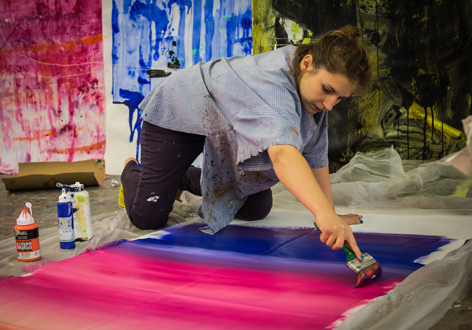
(Photo taken at Melissa Gordon's course, Summer Academy in 2016)
In her own work the London-based american artist implements her particular cache of gestures - enlarging hidden details, zooming in on patterns of reproduction, and distorting information with abstraction - to reconfigure histories, surfaces, and iconographies through a feminist lens. She takes a humorous and insightful stance vis-à-vis modernist art history.

Installation view „Painting behind itself“ Cosar HMT, Düsseldorf
Have a look at more intallation views of her exhibition in Düsseldorf too.
Here you find a text in hyperalleric on Gordons exhibition at Marianne Boesky Gallery and here a text in frieze.
Below you find a documentation of the talk she gave at the summeracademy last year.

